
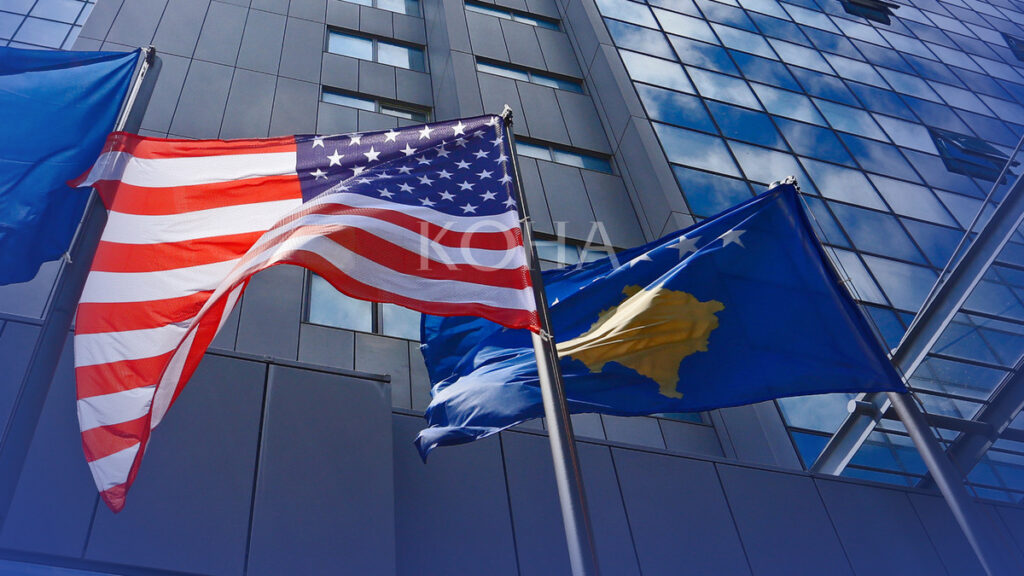
Although Kosovo and the United States of America proclaim a close political partnership, economic relations between the two countries remain underdeveloped in some aspects. Kosovo still faces challenges in utilizing opportunities for increased trade and investment from the United States. This is also evidenced in the latest report of the US Department of State, which emphasizes that economic relations between the two countries have not been institutionalized through bilateral agreements.
It is not just the 10 percent tax, recently imposed by President Donald Trump’s administration, that is a concern in economic relations between Kosovo and the United States.
The lack of bilateral investment agreements and the elimination of double taxation have limited opportunities to benefit from trade preference programs. This is also evidenced in the latest report by the US Department of State, which discusses the investment climate in Kosovo.
It notes that Kosovo has a flat corporate income tax rate of 10 percent. The report also notes that Kosovo does not have a bilateral investment agreement or double taxation avoidance agreement with the United States.
“Kosovo does not have a bilateral investment or double taxation agreement with the United States. Kosovo’s duty-free treatment of certain exports to the United States under the Generalized System of Preferences (GSP) expired in December 2020. To date, the U.S. Congress has not reauthorized the GSP program,” the State Department report for 2024 states.
The President of the American Chamber of Commerce, Arian Zeka, says that over 300 products from Kosovo have benefited from the program, which has expired five years ago.
“This speaks to the business environment in general. The beginning is only showing the corporate income tax, which we refer to briefly as the profit tax. In this case, it was intended to be equivalent to the 10 percent customs tariff. However, there is no connection with the decision of the US Administration. The decision is reciprocal to the customs tariff, which is not mentioned in this part of the report. The rest shows the benefits that more than 3.500 products from Kosovo have unilaterally benefited from preferential treatment during export to the US, within the framework of the GSP that expired on December 31, 2020,” said Zeka.
According to him, as long as the Generalized System of Preferences, known in English by the abbreviation GSP, was in force, which enabled Kosovo to export products without being subject to customs duties, the rules of origin were very easy.
“That is, for a product to gain origin, in this case Kosovo, it has not been very burdensome, and as long as the same rules continue to apply, then Kosovo can become attractive for attracting these investments, which will focus on manufacturing sectors or manufacturing industries in general,” he emphasized.
Kosovo has signed double taxation treaties with Albania, Austria, Croatia, Hungary, Ireland, Latvia, Lithuania, Luxembourg, Malta, the Netherlands, North Macedonia, Saudi Arabia, Slovenia, Switzerland, Turkey, the United Arab Emirates and the United Kingdom. Meanwhile, old treaties with Belgium, Finland and Germany from the time of the former Yugoslavia are still in force.
Kosovo has signed a trade and cooperation agreement with the United Kingdom, has a free trade agreement with Turkey, and has begun the process of joining the European Free Trade Association.
After three years of surplus in the trade relationship with the US, Kosovo experienced a deficit in 2024. This is due to the ban on mattresses imported from Kosovo. And, last year, dresses took first place among Kosovo’s exports to the United States, reaching a value of 11.4 million euros.
This product, as well as others originating from Kosovo, will be subject to a 10 percent tariff, following the decision made last week by President Trump.
Last year, Kosovo exported goods worth 39 million euros to the United States. And imports from the US reached the highest point ever, 106.5 million euros.
In total, about 3.97 percent of Kosovo’s exports during 2024 went to the US.
The package of trade measures recently imposed by US President Donald Trump includes all countries, and the US administration has called this measure reciprocity.
Kosovo applies a 10 percent customs duty on US products, which is similar for all countries with which it does not have a free trade agreement.
President Vjosa Osmani has requested the Government to suspend import tariffs on all products from the US.
This request, according to Osmani, was made to send the message that Kosovo is ready for stronger relations with the US.