
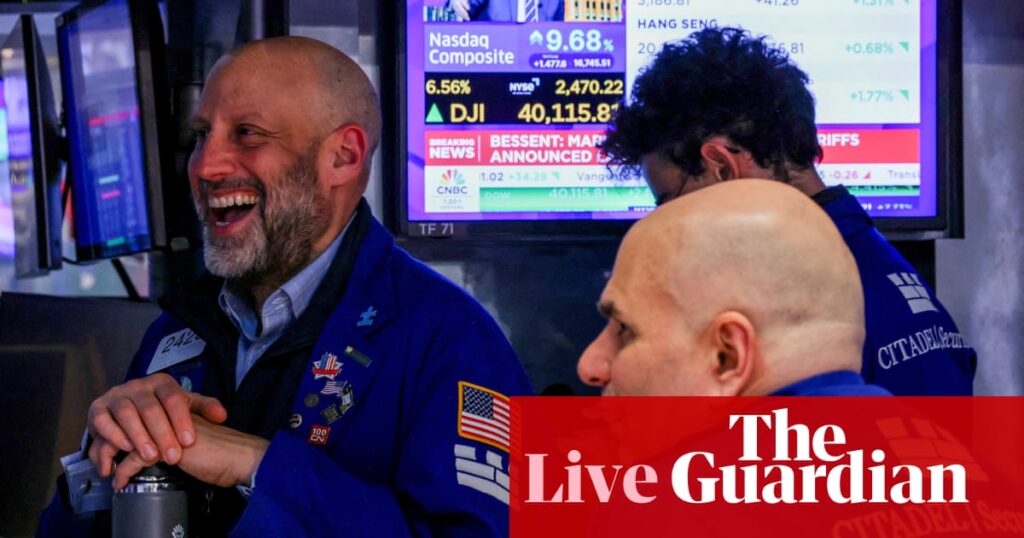
Stocks surged to one of their biggest gains since the second world war after Donald Trump paused his tariffs against most nations except China, as investors had desperately hoped he would. Trump, though, did raise tariffs on China to 125%.
The S&P 500 soared 9.5%, though the index is still below where it was when Trump announced his sweeping set of tariffs last week. The Dow Jones industrial average flew nearly 3,000 points higher, and the Nasdaq composite jumped 12.2%.
Updated at 17.23 EDT
Key events
Please turn on JavaScript to use this feature
Wondering how federal workforce cuts might affect US national parks? An update:
Interior Department staff, including those at national parks, have been offered buyouts and early retirement, the Associated Press reports.
Employees across the Department of the Interior have until the end of Wednesday to respond to the latest offer to take buyouts or early retirement, according to a document obtained by The Associated Press, as the Trump administration continues its efforts to reduce the federal workforce.
The offer for deferred resignation, often described as a buyout, or early retirement was sent April 4 — one day after Interior Secretary Doug Burgum issued an order for national parks to “remain open and accessible” and directing officials to ensure proper staffing.
Not all workers can take the buyouts or retire early. Among the workers exempt from the offer are wildland firefighters, law enforcement officers, aviation jobs and cyber security positions.
Bernie Sanders has released a statement condemning “Trump’s trade chaos.” Here’s a highlight from the full statement:
As someone who strongly opposed disastrous unfettered free trade deals with China, Mexico and other low-wage countries, I understand that we need trade policies that benefit American workers, not just large corporations. Targeted tariffs can be a powerful tool to stop corporations from outsourcing American jobs. They can help level the playing field for American autoworkers or steelworkers to compete fairly against companies who have moved production to countries where they can pay starvation wages.
But Trump’s chaotic across-the-board tariffs are not the way to do it.
Imposing steep tariffs on countries like Germany or France will not bring jobs back to America. These are not low-wage countries. Corporations are not shutting down plants in America and moving them to Switzerland. Trump’s blanket tariffs will just raise prices for American consumers and hurt our relationships with allies, undermining our global position.
Microsoft said it is “slowing or pausing” some of its data center construction, including a $1 billion project in Ohio, the latest sign that the demand for artificial intelligence technology that drove a massive infrastructure expansion might not need quite as many powerful computers as expected, the Associated Press reports.
The tech giant confirmed this week that it is halting early-stage projects on rural land it owns in central Ohio’s Licking County, outside of Columbus, and will reserve two of the three sites for farmland.
ShareThe day so far
It’s 6pm on the US east cost – thanks for following along with us as we head into the evening. Here’s a reminder of the day’s key events so far:
-
Global markets surged after Trump announced his 90-day tariff pause. The S&P 500 surged 5.6%, while the Nasdaq has jumped over 8%. Trump’s Truth Social statement suggests he has backed down on tariffs on most countries for 90 days, applying instead a 10% tariff.
-
Trump’s 90-day pause on tariffs may not exempt the 25% tariff on cars, Ireland’s deputy prime minister has revealed, after a face-to-face meeting with US commerce secretary Howard Lutnick. Simon Harris, the first EU politician to meet anyone in Trump’s administration since the tariffs were announced last Wednesday, said he spoke to the European trade minister Maroš Šefčovič immediately after his bilateral meeting in Washington today.
-
“We’re going to put tariffs on the pharmaceutical companies, and they’re going to all want to come back,” Donald Trump said this afternoon, an idea he has raised before. “They’re going to come back – I’m not going to pay them any money.”
-
Speaking to reporters on Wednesday about his tariffs policy, Trump acknowledged people were getting “a little bit afraid” and said: “I thought that people were jumping a little out line” and getting “yippy”. He added that his announcement on the 90-day pause and 125% raise on China could be “temporary.”
-
The WTO chief said the US-China tariff war could reduce trade in goods between the two economic giants by 80%, pulling down the rest of the world economy. Ngozi Okonjo-Iweala said that the US-China tariff war could reduce trade in goods between the two countries by 80%.
-
Addressing reporters at the White House on Wednesday, treasury secretary Scott Bessent said the latest changes in Donald Trump’s tariffs policy was Trump’s “strategy all along.” He said: “This was his strategy all along, and that you might even say that he goaded China into a bad position, they responded.”
-
China announced new tariffs of 84% on imports of all US goods, up from the 34% previously announced, hours after US tariffs on Chinese products went up to a staggering 104%. China’s retaliation sent stock markets falling further with major indices down in the UK, Germany, France and Spain.
-
The EU announced 25% tariffs on a range of US imports in a first round of countermeasures. The 27-member bloc has agreed to impose retaliatory tariffs on €21bn (£18bn) of US goods, targeting farm produce and products from Republican states. All member states voted for the retaliation, with the exception of Hungary.
-
US markets recovered later on Wednesday after Bessent indicated America was open to trade agreements with allies and a subsequent group deal with China. In his first comments since China’s 84% tariff announcement, Trump urged Americans to “be cool”. The US president bragged about countries “kissing my ass” to negotiate tariffs during a Tuesday-night dinner.
Updated at 18.11 EDT
Here is a look at the full list of tariffs Donald Trump originally threatened – and the new updated rate country by country:
Trump repeated his threat to use military force if Iran did not agree to end its nuclear program, saying Israel would play a key role, Reuters reports.
Speaking to reporters, Trump said Iran could not be allowed to have a nuclear weapon.
Trump’s executive orders today include one targeting water pressure in the shower. Trump has signed an executive order that aims to roll back water efficiency standards on appliances, according to the White House, the Associated Press reports.
That prompted the president to muse about how he likes to let the water run in the shower and how new faucets are disappointing.
“In my case, I like to take a nice shower to take care of my beautiful hair,” Trump said.
Anytime you see a new faucet, he said, “you know it’s going to be a long wash of the hands.”

Lisa O’Carroll
Donald Trump’s 90-day pause on tariffs may not exempt the 25% tariff on cars, Ireland’s deputy prime minister has revealed, after a face-to-face meeting with US commerce secretary Howard Lutnick.
Simon Harris, the first EU politician to meet anyone in Trump’s administration since the tariffs were announced last Wednesday, said he spoke to the European trade minister Maroš Šefčovič immediately after his bilateral meeting in Washington today.
He told national broadcaster RTE: “I spoke to Maroš straight after the meeting to update him on the details from our discussion with Secretary Lutnick. I think 90 days is a significant period of time. Whether it’s enough remains to be seen … there are still clarifications needed. It looks like, for example, the higher rate on cars and steel and aluminum is likely to remain, and 10% tariffs still aren’t good.
“Tariffs are bad. So we need to be cautious in relation to this. But crucially, what this has done is provide the space that the European Commission, European member states and Ireland has been calling for.
“It’s been a big part of our diplomatic and political effort over the last while to try and create space for real and meaningful engagement.”
In relation to the threat to impose tariffs on pharmaceuticals being exported from Ireland to the US he added: ““I did also take the chance to talk to the secretary about the two-way relationship between Ireland and the United States, and I must say, he spoke favorably in relation to the Irish economic model and our economic success to date.”
Updated at 17.22 EDT
Trump said the idea for today’s tariff pause came together “without access to lawyers”.
“Was this idea of a [tariff] pause … did this just come about this morning?” a journalist asked Trump.
“For a period of time, I wouldn’t say this morning. Over the last few days I’ve been thinking about it,” Trump said.
“I think it came together early this morning, fairly early this morning,” he added. “Just wrote it up, I didn’t – we didn’t have the use of – we didn’t have access to lawyers. We just wrote it up from our hearts, right? It was written from the heart, and I think it was well-written too.”
“It was written as something that I think was very positive for the world and us,” Trump went on. “We don’t want to hurt countries that don’t need to be hurt. And they all want to negotiate.”
Trump added that the impact of today’s tariff pause surprised him, but that he thought it was good.
“We’re happy about it. I didn’t know it would have that kind of impact. The biggest increase in the history of the stock market? That’s pretty good.”
Donald Trump speaks at the White House. Photograph: Nathan Howard/ReutersShare
Updated at 17.18 EDT
Despite Donald Trump’s 90-day pause limiting tariffs, imports from Mexico and Canada will still get taxed by as much as 25%, according to a White House backgrounder, the Associated Press reports.
The backgrounder contradicted an earlier statement by the treasury secretary, Scott Bessent, who said Mexico and Canada would also be tariffed at 10%.
Unlike the tariffs that Trump temporarily took down to 10% to give time for negotiations, the taxes on the United States’ two largest trading partners are a separate matter. Mexico and Canada are being tariffed ostensibly to stop fentanyl smuggling and illegal immigration.
Updated at 17.15 EDT
Trump once again talks tariffs on pharmaceutical companies
“We’re going to put tariffs on the pharmaceutical companies, and they’re going to all want to come back,” Trump says, an idea he has raised before. “They’re going to come back – I’m not going to pay them any money.”
Updated at 17.17 EDT
Trump is signing different executive orders now, and taking comments from journalists. In a response to a reporter’s question on any progress on making a deal about the ownership of TikTok, Trump says that the US will have to wait for now to see what happens with China and the deal.
ShareSupreme court allows Trump’s firings of independent agency board members to take effect, for now
The supreme court on Wednesday allowed the Trump administration to oust two board members who oversee independent agencies, for now, the Associated Press reports.
John Roberts, the chief justice of the United States, signed an order pausing a ruling from the federal appeals court in Washington that had temporarily restored the two women to their jobs. They were separately fired from agencies that deal with labor issues, including one with a key role for federal workers as Donald Trump aims to drastically downsize the workforce.
Roberts handles emergency appeals from the nation’s capital.
Updated at 16.54 EDT
Interim summary
Here’s a look at where things stand:
-
Global markets surged after Donald Trump announced a 90-day pause on tariffs except for China. The S&P 500 is surging 5.6%, while the Nasdaq has jumped over 8%. Trump’s Truth Social statement suggests he has backed down on tariffs on most countries for 90 days, applying instead a 10% tariff.
-
Speaking to reporters on Wednesday about his tariffs policy, Trump acknowledged people were getting “a little bit afraid” and said: “I thought that people were jumping a little out line” and getting “yippy”. He added that his announcement on the 90-day pause and 125% raise on China could be “temporary.”
-
The World Trade Organization chief said Wednesday the US-China tariff war could reduce trade in goods between the two economic giants by 80%, pulling down the rest of the world economy. Ngozi Okonjo-Iweala said that the US-China tariff war could reduce trade in goods between the two countries by 80%.
-
Addressing reporters at the White House on Wednesday, treasury secretary Scott Bessent said the latest changes in Donald Trump’s tariffs policy was Trump’s “strategy all along.” He said: “This was his strategy all along, and that you might even say that he goaded China into a bad position, they responded.”
-
China announced new tariffs of 84% on imports of all US goods, up from the 34% previously announced, hours after US tariffs on Chinese products went up to a staggering 104%. China’s retaliation sent stock markets falling further with major indices down in the UK, Germany, France and Spain.
-
The EU announced 25% tariffs on a range of US imports in a first round of countermeasures. The 27-member bloc has agreed to impose retaliatory tariffs on €21bn (£18bn) of US goods, targeting farm produce and products from Republican states. All member states voted for the retaliation, with the exception of Hungary.
-
US markets recovered later on Wednesday after Bessent, indicated America was open to trade agreements with allies and a subsequent group deal with China. In his first comments since China’s 84% tariff announcement, Trump urged Americans to “be cool”. The US president bragged about countries “kissing my ass” to negotiate tariffs during a Tuesday-night dinner.
Updated at 17.28 EDT
Trump tariff pause gives S&P 500 one of biggest days since second world war
Stocks surged to one of their biggest gains since the second world war after Donald Trump paused his tariffs against most nations except China, as investors had desperately hoped he would. Trump, though, did raise tariffs on China to 125%.
The S&P 500 soared 9.5%, though the index is still below where it was when Trump announced his sweeping set of tariffs last week. The Dow Jones industrial average flew nearly 3,000 points higher, and the Nasdaq composite jumped 12.2%.
Updated at 17.23 EDT