
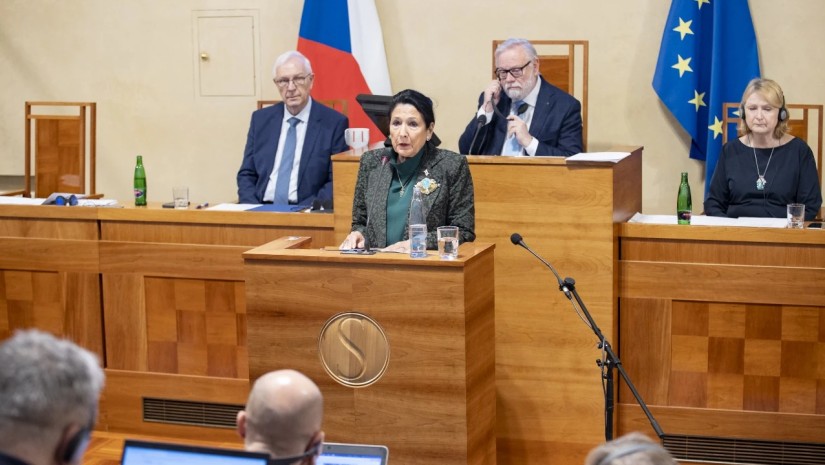
Former Georgian President Salome Zourabichvili delivered a speech in the Czech Senate.
In the opening of her address, Zourabichvili emphasized the importance of April 9, urging senators to observe a moment of silence in memory of those who lost their lives on that day in 1989.
“April 9 is a solemn day for every Georgian. On this day in 1989, Russian soldiers and tanks rolled into the centre of Tbilisi, crushing a peaceful demonstration calling for freedom and independence. They used gas, clubs, and atrocious violence to break up a crowd of mostly young people. 21 were killed, many of them women. Hundreds more were injured, but the message of that night did not disappear. It ignited a national movement and paved the way for, two years later, the Declaration of Georgia’s independence,” Salome Zourabichvili stated.
The ex-President remarked that while Georgia was granted EU candidate status some time ago, the country is now slowly slipping into Russia’s sphere of influence. She expressed concern that the European response to this situation is not reflective of the current reality.
“One year ago – almost – Georgia was granted EU candidate status. Today, the very same country is being dragged into the Russian orbit and turned into a testing ground for authoritarian tactics, and the European reaction has not matched the gravity of what is happening.
This moment is not just any Georgian political crisis. It is a European challenge and a threefold challenge: a challenge to liberal democracy itself in Georgia and Europe. If democracy can be undone in Georgia in one year after three decades of support first by the Georgian population itself, but also by the EU and the United States, after years of your support to build free media, independent courts, and civil society – then what does it say about democracy’s resilience? Should it be so easy to destroy it?
If we allow this to happen, we send the message that democratic institutions are fragile; autocrats can succeed if they move cynically enough. The Georgian population is ready to resist.
It is also a geopolitical challenge to the EU. Georgia is not just any small state. We are part of the European neighbourhood and a key link in the strategic chain that includes first of all the Black Sea, and is also threatened from the Ukrainian shores, the South Caucasus, Armenia’s fragile peace and its new path towards Europe, and Europe’s new connectivity routes to Central Asian energy and resources,” the ex-President continued.
Zourabichvili warned that if Georgia succumbs to authoritarianism, it would not only diminish Europe’s political and moral standing in the region but also adversely impact Europe’s global position.
“Let me be blunt: if the European Union cannot protect the values it has spent decades promoting; if it cannot act to defend the very people and institutions that it helped build; if it cannot respond with clarity to a small defiant state captured by corrupt elites and Russian influence, then its foreign policy credibility is at risk. And so would be its new defence agenda because rearmament without the will to act, without rapid decision-making, is just strategy on paper. It is not deterrence, it is not power.
Let us be clear: Russia is watching and preparing its next steps. What it failed to do with tanks in 2008 in Georgia, and with the last war against Ukraine, it is now trying a new formula, a hybrid strategy of silent conquest that is tested now in Georgia as military aggression was tested in Georgia in 2008.
This new playbook requires no army, just three ingredients: election manipulation, propaganda and disinformation, and a proxy oligarch to capture institutions from the inside. And there is more. If Russia cannot win – and it is not winning the war in Ukraine by military force – it may try to win it politically by manipulating future Ukrainian elections, undermining public trust, dividing society, and weakening Kyiv from within as it has done in Georgia,” Salome Zourabichvili stressed.
Additionally, the ex-president cautioned that if a hybrid approach to governance is accepted in Georgia, it could set a dangerous precedent for other countries to follow.
“Georgia is a test. If this hybrid strategy succeeds in Georgia, it could be replicated elsewhere in Europe. If it works in Georgia, a country that has known for years, if not centuries, how to resist it, it can and will be copied elsewhere – Moldova, Romania, or even deeper into Europe because it’s cheap, it’s quiet, and so far it has met no serious resistance from outside.
So what must be done? Europe must act now, not with words alone, but with a real counter-strategy. Fighting is for us to do and will continue, but our partners should provide: first electoral protection. We are calling for new, free and fair elections, but that will be of no use if we do not have new tools – not just for observation, but for prevention because this new game is rigged before election day arrives.
We need political clarity. Make the EU position public for all to see. Let the Georgian people, overwhelmingly pro-European, know that they are not alone. Sanctions – fast, targeted, and financial – because they work when they are aimed, especially at those who finance the takeover or that support it.
Defend the values you have invested in: the pro-European society, the NGOs, the free media, the free judiciary, and the independent institutions. If we let them be dismantled now, we send a signal to every autocrat in waiting.
Today, Georgia is in that fight. We do not ask you to fight for us, but we do ask you to stand with us, to raise your voice, to speak with clarity, to act with purpose – because if we fail to defend Georgia today, we may wake up tomorrow in a very different Europe.
With today’s resolution, the Czech Senate is showing an example of support to the other European nations, and from me and the Georgian population, I want to thank you for that,” the ex-President concluded.