
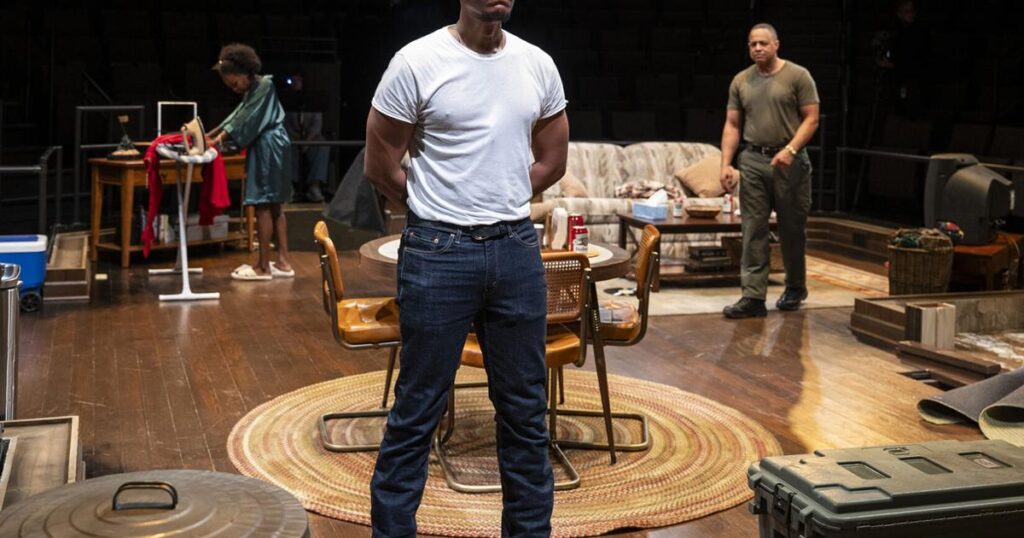
On one level, Suzan-Lori Parks’ “The Book of Grace” is a gut-wrenching dysfunctional family drama. On another, given the setting and the circumstances, it comes across as a parable about the prejudice and potential panic in our country right now.
This is somewhat surprising since the play actually premiered in 2010 at the Public Theater in New York, though Parks has revised it significantly for the Chicago premiere at the Steppenwolf Ensemble Theater. One of the things she did was make all three of the characters Black, which changes the racial dynamic both within and outside of the family, though it doesn’t necessarily make it more or less relevant.
However, the setting in Texas near the U.S.-Mexico border, is in the news more than in 2010, as is the penchant of those in power have for disparaging immigrants and refering to them as “aliens.” Vet (Brian Marable), the family patriarch and a border patrol agent, is holding forth on the subject when we first meet him. He’s actually preparing the speech he’s going to give when he receives a medal for apprehending a truckload of migrants. He’s also ironing his uniform so the creases are sharp enough to scare anyone.
Vet’s second wife, Grace (Zainab Jah), is offering encouragement and getting ready to go to her job as a waitress at a cafe. A cheerful woman who sees the good in everything, she also introduces us to “The Book of Grace,” a journal she’s been keeping of newspaper clippings, stories, sayings and other positives, though it’s secret, so she hides it under the floorboards.
Both Vet and Grace are awaiting the arrival of Buddy (Namir Smallwood), the son of Vet’s first wife, who has been estranged from his father for 15 years. A veteran who earned a bronze star and claims to have been a “tech bro,” Buddy ostensibly has returned for his father’s award ceremony, though it is soon revealed that he’s desperate for a job and wants Vet to get him one as a border patrol agent.
Buddy, who is secretive and mentions having PTSD, also has other motives that remain murky until he starts calling himself “Snake” and recording “The Book of Snake” on his cell phone. A complicated mix of moral crusader and revenge-seeker superbly played by Smallwood, he yearns for freedom and his father’s love but can’t help being cowed by Vet, turning him into his own worst enemy.
The roots of this intimidation, which seem to go back to childhood abuse, aren’t entirely clear, but we do get plenty of evidence of Vet’s animosity towards the adult Buddy. Instead of being greeted warmly upon his arrival, the son is given a military-style third degree including a pat-down and search of his foot locker. Nothing he can do is good enough for his dad and, after Vet disapproves of his behavior during an impromptu job interview at the base, he makes him respond to increasingly impossible scenarios while doing strenuous exercises.
The extent of Grace’s mistreatment by Vet emerges slowly, and with every instance, she placates and makes excuses for him. She stops taking an algebra class when he objects, starting her book and hiding it instead. She also denies herself a beautiful red dress — and gets in deep trouble with Vet when Buddy buys it for her. Jah is so luminous and lovely in the role that even if she can be seen as an enabler who is just “waiting it out” and trying to get through the days, as she admits to Buddy, we have to empathize.
Marable does a bang-up job as gung-ho Vet, but I don’t know if we’re supposed to sympathize with him because of the compartmentalization, built-up aggression, resentment and isolation resulting from his job. I found him to be a total monster and thought the play would have been more interesting if he had some redeeming qualities.
I also found parts of “The Book of Grace” too drawn out and the ending confusing, especially with regard to Grace.
Steve H. Broadnax III has directed the stellar cast beautifully, but the staging in the in-the-oval Ensemble Theater is problematic. Scenic designer Arnel Sancianco crams in the slightly shabby apartment (including a kitchen that blocks an exit) and surroundings, augmented by Rasean Davonté Johnson’s projections including the border wall, but the blocking is difficult. One whole outdoor scene was played directly below where I was sitting, with the characters facing in the opposite direction, and I was looking at their backs during other scenes as well. Grace was standing right next to me during her opening monologue — and didn’t look once in my direction or anywhere except straight ahead of her. For all the glories of the theater, I kept thinking how much better a proscenium-arch or thrust stage would have been.
Notwithstanding, “The Book of Grace” is a must-see for the acting.