
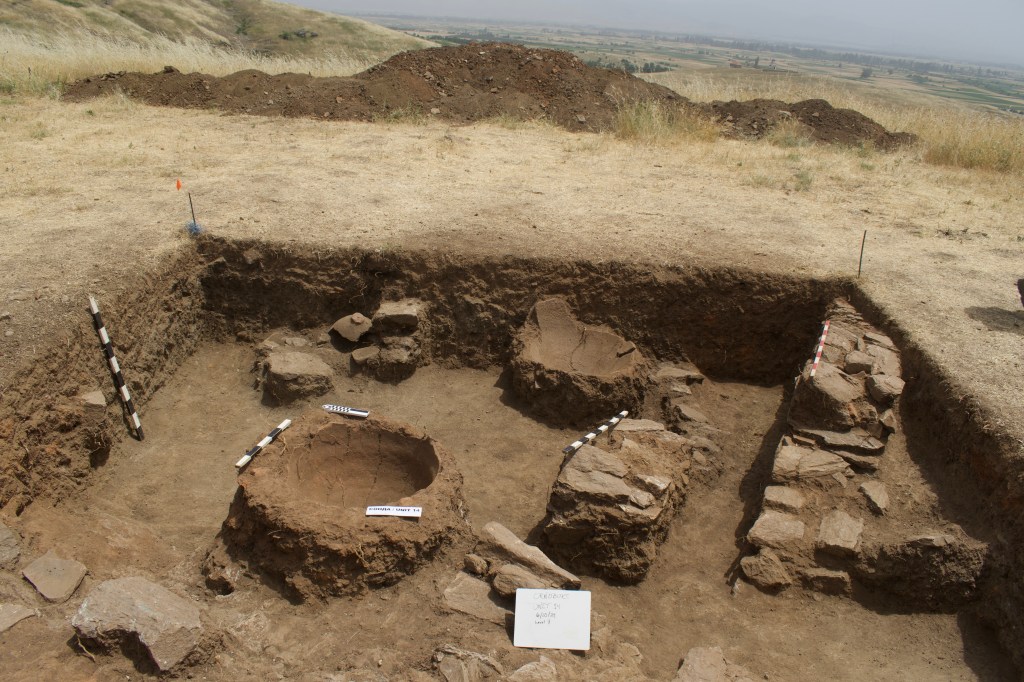
Researchers from Macedonia’s Institute and Museum–Bitola and Cal Poly Humboldt have been working for years to uncover an ancient city in North Macedonia. According to an announcement from Cal Poly Humboldt Monday, archaeologists have found clues from city ruins near the village of Crnobuki, known as the archaeological site of Gradishte, that indicate the settlement is much older than initially thought.
The site was excavated 15 years ago. The acropolis was believed originally to be from around 221-179 B.C.E., during King Phillip’s reign, and thought to be remains of a military outpost built to defend against Roman attacks. The origin was later pushed back after the discovery of a coin that was minted during Alexander the Great’s lifetime, from 325-323 B.C.E.
Archaeologists now believe humans began occupying it as far back as the Bronze Age, from 3,300-1,200 B.C.E., after the unearthing axes and fragments of ceramic vessels. According to the university, this research means tangible evidence of a thriving city before the rise of Rome.
Nick Angeloff, Cal Poly Humboldt anthropology professor and archaeologist, called this a once in a lifetime discovery in the press release.
“This discovery is significant,” said Angeloff, in the release. “It highlights the complex networks and power structures of ancient Macedonia, especially given the city’s location along trade routes to Constantinople. It’s even possible that historical figures like Octavian and Agrippa passed through the area on their way to confront Cleopatra and Mark Antony at the Battle of Actium.”
Through the unearthing of stone axes, coins, a clay theater ticket, pottery, game pieces and textile tools, researchers have found artifacts originating between 360 B.C.E. and 670 A.D., by dating charcoal and bone. Work in 2023 found the settlement spanned at least 7 acres, the discovery of which Cal Poly Humboldt noted was aided with the use of ground penetrating radar and drone-deployed LIDAR funded by the University. Cal Poly Humboldt researchers traveled to North Macedonia in summer 2024 to participate in excavation.
Engin Nasuh, archaeologist at the National Institute and Museum–Bitola, said in the press release this work opens a window into the history of the Macedonian civilization before Alexander the Great.
“We’re only beginning to scratch the surface of what we can learn about this period,” said Nasuh in the press release. He told Cal Poly Humboldt this site was first mentioned in literature in 1966, but has remained a mystery for decades.
He said these findings contribute to a deeper understanding of ancient Western civilization, a small piece in the mosaic of early European civilizations, as the ancient Macedonian state is among the first modern states in Europe.
“It is a civilization that played a major role in today’s understanding of the world and the desire to connect different civilizations and cultures,” he said in the press release.
Angeloff suggested in the release the site could be the lost capital city of the Kingdom of Lyncestis, Lyncus, which settled in the seventh century B.C.E., and could possibly the birthplace of Queen Eurydice I, the grandmother of Alexander the Great. Notable structures there include a possible Macedonian-style theater and a textile workshop.
According to the release, students, faculty and researchers from the institutions continue to work uncovering the ancient city.
Sage Alexander can be reached at 707-441-0504
Originally Published: April 7, 2025 at 1:47 PM PDT