
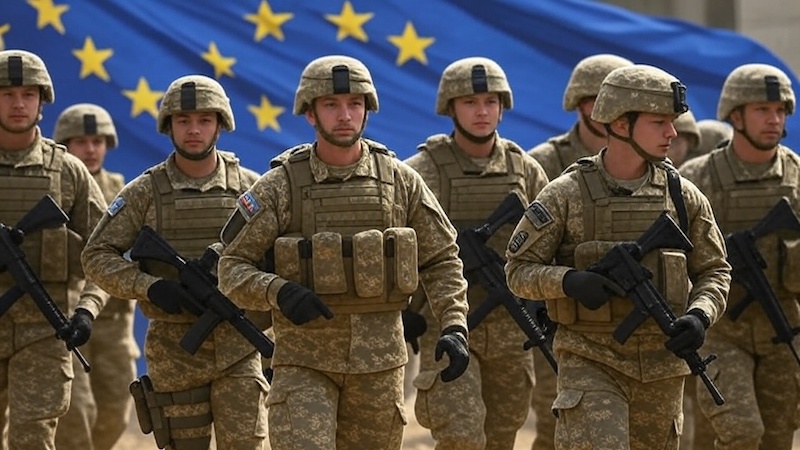
The ongoing three-year Ukraine War and President Trump’s uncertainties surrounding US defense commitments of military support for Ukraine and NATO has once again catapulted the EU’s Bloc’s urgent need of having its own military force. Zelensky has been instrumental in reigniting the debate that has failed to generate consensus within Europe, despite its long history.
Ursula von der Leyen, president of the EU Commission since 2019, has called for a “European Defence Union,” and last month unveiled “Rearm Europe”—a five-year plan quickly rebranded “Readiness 2030,” after Spain and Italy complained that the original title was too militaristic.
Historical Background Of A Common EU Army
The notion of an EU army was first suggested in the early 1950s as a way of building capability against the Soviet Union without rearming West Germany. Proposed by the French government, it would have consisted of the EU’s six founding members—France, Luxembourg, the Netherlands, Italy, West Germany, and Belgium. A treaty creating the European Defence Community was signed in 1952, but never ratified; instead, West Germany joined NATO and the Western Union, a military alliance formed in 1948, and the idea was shelved.
While the European Defence Community (EDC) was never fully realized, the concept of a unified European military force has continued to resurface. The EU concept of a common army, often referred to as a Common European Defence System (EDS), is a proposal to create a unified, EU-level military force that complements, rather than replaces, the national armies of member states. This proposed structure would involve a rapid deployment capability, a joint defense investment and procurement strategy, and the potential for a 28th European Army, working alongside the 27 EU individual national armies. The envisioned EU common army aims to enhance the bloc’s strategic autonomy, enabling it to act independently in defense and security matters.
The Proposal: Key Elements
- Joint Investment and Procurement: The proposal emphasizes the need for significant joint investment in defense, research, and development, including the potential for shared financing of nuclear capabilities. Streamlining defense spending and procurement across member states to eliminate redundancies.Reducing reliance on NATO and the US for security guarantees.
- Rapid Deployment Capacity: A Rapid Deployment Capacity of 60,000 soldiers is proposed to provide a quick response to crises and conflicts, complementary to the territorial defense responsibilities of the national armies. Establishing a cohesive military force to respond to external threats and participate in peacekeeping missions.
- Integration with NATO: The proposed EDS would be designed to be compatible with NATO, potentially serving as its European pillar.
- Europeanization of French Nuclear Capabilities: The proposal suggests the possibility of sharing the costs of maintaining and deploying French nuclear capabilities, allowing other willing EU member states to contribute.
Challenges
The concept of a common army faces several challenges, including concerns about duplicating efforts with NATO, potential lack of political will from member states to commit resources, and uncertainty about how the EU’s role in defense would be defined.
Control over a potential EU army would necessitate significant shifts in sovereignty and decision-making processes. Currently, defense remains a national prerogative. Establishing protocols for deployment and engagement, potentially through qualified majority voting to prevent individual states from vetoing collective actions.Amending EU treaties to allow for shared military command structures.Financing a common EU army presents substantial challenges, especially given varying economic capacities among member states.
EU Leaders In Favour: Common EU Army
European Commission President Ursula von der Leyen highlighted the need for political will, noting that “a lack of political will” has hindered the EU’s defense capabilities.
Italian Foreign Minister Antonio Tajani emphasized the necessity of a European army, stating, “If we want to be peacekeepers in the world, we need a European army.”
Spain’s Socialist prime minister, Pedro Sánchez, is the latest EU leader to echo Zelensky—he announced that Europe needs its own defense force to combat “old imperialist impulses in Russia,” especially in light of reduced support from the US. He called for a military force “with troops from all 27 member countries, working under a single flag with the same objectives.”
European Leaders Against: Common EU Army
Kaja Kallas, the EU’s foreign affairs chief and vice president of the EU Commission, claims that it’s not necessary. What’s more important, she says, is that the bloc’s 27 armies “are capable and can effectively work together to deter our rivals and defend Europe.”
Poland’s foreign minister, Radosław Sikorski, who is adamant that an EU army “will not happen.” Denmark, which has historically seen NATO as the continent’s primary defense mechanism. UK opposes the idea of an EU army, arguing that it would unnecessarily duplicate NATO.
Dutch Prime Minister, in a 2018 statement Rutte rejected the idea of a European army, asserting that “NATO is and remains the cornerstone of our defence policy.”
NATO Against Pursuing An Independent EU Army
NATO Secretary General Mark Rutte has expressed cautious skepticism regarding the concept of an EU Common Army. While he supports strengthening Europe’s defense capabilities, he emphasizes that such efforts should complement NATO rather than duplicate its structures.
Rutte advocates for increased defense spending among NATO members, urging them to exceed the traditional 2% GDP target in response to evolving security threats, particularly from Russia. He underscores the importance of transatlantic unity, warning that unilateral actions by either the EU or the US could undermine collective security efforts.
In summary, while Rutte supports bolstering Europe’s defense capabilities, he maintains that these efforts should reinforce NATO’s role and foster inclusive cooperation among all allies, “rather than pursuing an independent EU army”.
While the concept of a common EU army garners support in principle, practical implementation will face major hurdles related to sovereignty, financing, and political consensus. Ongoing discussions and initiatives indicate a gradual move toward deeper defense integration, but the realization of a unified military force remains a long-term endeavor.
Common EU Army is a distant dream and is not likely to take shape in the present form in the years ahead. What appears to be a viable option is to have a deputation type UN model of NATO/EU (28th European Army) Common Army and to have Annual or Biannual joint training. Will the common NATO cum EU members be in a position to share the defence burden of both the organisations? The deputed units to the Common EU Army need to be funded by their respective countries to overcome the challenges foreseen in raising the visioned 28th European Army. However, a Common EU Army Headquarter could be considered for coordination and training. NATO Secretary General Mark Rutte has also stated that there is “No Alternative to NATO.”