
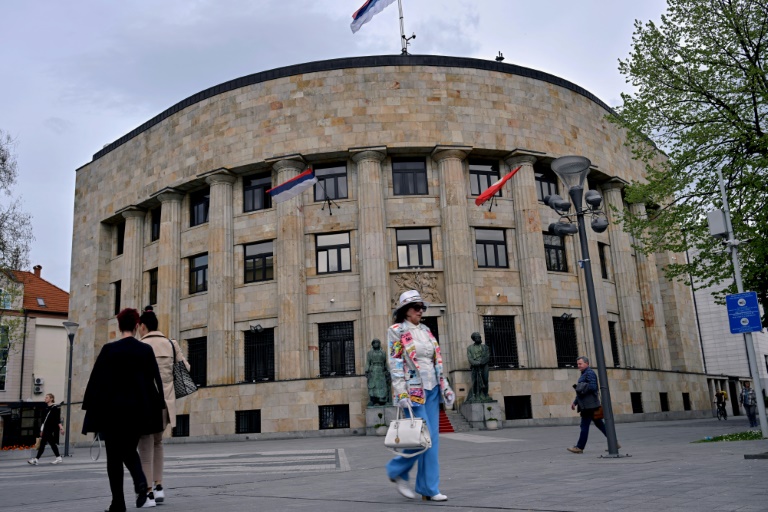
In the Bosnian Serb capital of Banja Luka, some praise their longtime leader Milorad Dodik — who is wanted by Bosnia’s courts for his threats to secede — as a strong leader, “a boss”.
But others AFP talked to say they are sick of his nearly two decades in charge while many seem not very bothered if he is arrested.
Dodik, 66, has been at the centre of a political and diplomatic storm for months for defying judges and the accords which brought peace to the divided Balkan nation after the bloody wars of the 1990s.
But no one has yet dared to arrest him, because such an operation was deemed too risky, with the danger of reviving old enmities.
Since the warrant was issued by the national court in mid-March, Dodik has travelled on at least two occasions to neighbouring Serbia as well as to Russia where he met President Vladimir Putin.
“Dodik is a strong man, a boss, nobody can do anything against him,” said pensioner Bosko Milinkovic, enjoying a sunny day in a Banja Luka park.
Asked by AFP what would happen if Dodik would be arrested, the 74-year-old replied that “people will remain silent over it. What else could be done?”
This time Dodik may have gone “too far”, he warned, while one of his friends sitting on the same bench accused Dodik of lining “his own pockets”.
Nearly three decades after Bosnia’s 1992-1995 war that claimed nearly 100,000 lives ended, people are still living with its consequences.
The Balkan country’s remains split into two semi-autonomous halves — the Serbs’ Republika Srpska (RS) and a Muslim-Croat Federation linked by weak central institutions.
Mile Petrusic, a 67-year-old war veteran who gets around on crutches due to severe rheumatism, regrets the war.
“We’ve all lost. And they (the politicians) still don’t understand that. We don’t have to start another war,” he said, getting off a bus with difficulty.
Dodik being arrested does not worry Petrusic.
“Some people need to understand that they’ve made mistakes and withdraw, get some rest,” said the man who blamed the authorities for the economic crisis that has forced many young people to leave the country. They include his two sons, who have left for Germany.
– ‘Should have been arrested long ago’ –
Svjetlana, a 40-year-old economist who did not want to give her last name, said she believed that Dodik is being attacked “because he is obstinate”.
“Our president is a strong and powerful leader, known all over the world… he will do what’s best for Republika Srpska,” said the mother, who accused the media of creating tensions by “raising the possibility of a conflict”.
“It’s not a life and death situation, like the one I remember from 1992, 1993… I feel good and free in this city. But also in Sarajevo,” she said, referring to Bosnia’s capital populated mainly by Bosnian Muslims.
However, once the camera was turned off, tongues loosened.
“We should have arrested him (Dodik) 10 years ago. He plundered us,” a 60-year-old public sector employee told AFP on condition of anonymity, saying he feared losing his job.
“I’m middle class. When I have to buy shoes for one of my children, it’s a problem. Going out to dinner with my family once a month is a luxury, not to mention going on holiday to the seaside.”
Writer and analyst for several local media Dragan Bursac said Dodik is no longer able to stir the people “to identify with him”.
People are not likely to come out and defend him, said Bursac, a known critic of Dodik.
“This man will be punished in one of two ways: either he will be arrested, or he will flee,” he told AFP.
A third course would be for the stand-off to drag on until general elections next year.
“But if we accept that, it means we have no state,” Bursac insisted.
Sitting on his bench, Milinkovic warned that some people are afraid of possible unrest.
“If something like this were to happen, it is the poor people who would suffer. Politicians always get away with it.”
rus/cbo/ljv/fg