
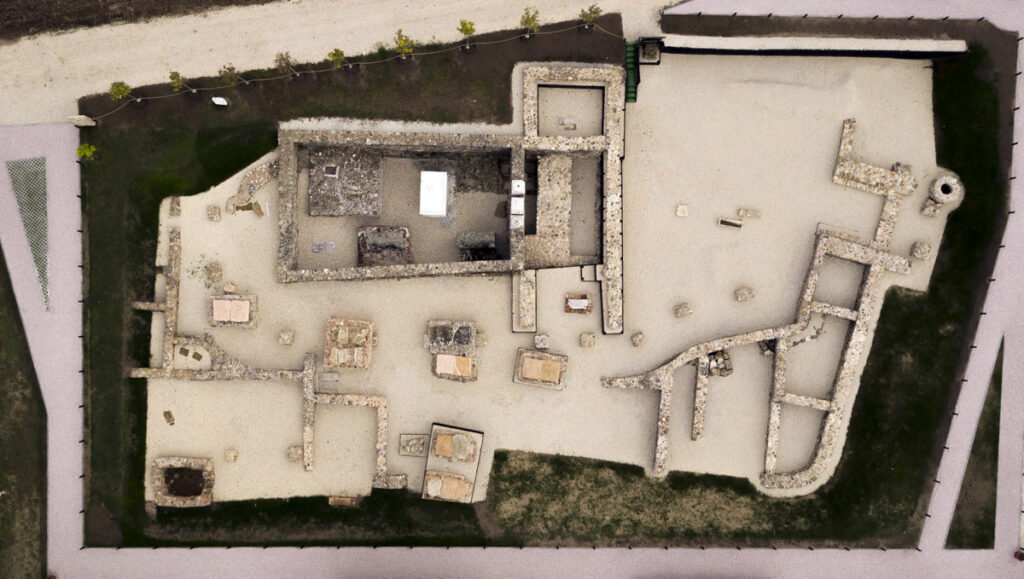
Helping archaeologists create models of archaeological sites, analyzing the distribution of artifacts and spatial analysis to understand the connections between different places, historical periods and cultures are some of the opportunities offered by the technology that is made available to Kosovo thanks to the five-year agreement with Germany. Cooperation in geophysical research with “LIDAR” and “GIS” technologies is the main topic of the agreement and a step like this enables the unraveling of ancient sites and the provision of important information about the emergence and development of past civilizations.
The Archaeological Institute of Kosovo and the German Institute of Culture will cooperate in several areas over the next five years. Research with the latest equipment and methods is the keynote of this cooperation, which helps archaeologists at the IAK to gain advanced knowledge of archaeological sites without having to excavate them at all. The agreement signed between the Archaeological Institute of Germany and the Ministry of Culture will also serve as an opportunity for the exchange of experiences between the two parties.
The archaeologist of the IAK who has been actively involved in this process, Elvis Shala, has provided details of the agreement signed at the beginning of the week. He said that there will mainly be cooperation for geophysical research with “LIDAR” and “GIS” technologies. He explained that “LIDAR” as “Light Detection and Ranging” is a technology that uses laser light to create 3D maps of surfaces. According to him, this technology in archaeology is used to scan and analyze terrain, revealing structures and objects that may be hidden by dense vegetation or soil cover.
He explained that this method has helped unravel ancient sites and provided important information about the emergence and development of past civilizations.
As for the “GIS” or “Geographic Information System” technology, he said that in archaeology it is a tool that uses cartography and geospatial analysis technology to collect, store, analyze and visualize data related to archaeological sites. According to open information about this system, “GIS” helps archaeologists create models of archaeological sites, analyze the distribution of artifacts, and perform spatial analysis to understand the connections between different places, historical periods and cultures. This system is described as being very important for the documentation and management of cultural heritage, enabling a more accurate and effective approach to its research and conservation.
Shala said that they have not yet determined exactly which localities they will explore together.
“But the goal is to document a large part of Kosovo, especially with ‘LIDAR’ and then create a ‘GIS’ system so that we have accurate maps of localities. This also helps in modern developments such as infrastructure, development plans of municipalities, construction of industrial zones and others”, said Shala. According to him, through these systems it will be known exactly what the extent of localities is.
“But what is more important is that during the cooperation we will provide these devices and we as an Institute will also be trained in this technology,” he said in an interview with KOHĪNA.
According to Shala, the exchange of experiences and capacity building is also a positive part of the already signed agreement.
The agreement was signed by the Secretary General of the Ministry of Culture, Youth and Sports, Bislim Bislimi, and the Deputy Director of the German Archaeological Institute, Lukas Werther.
The German Archaeological Institute has been an internationally active research institution within the German Federal Foreign Office for 150 years. In addition to archaeological research worldwide and its commitment to the protection and preservation of cultural heritage, the Institute is an important part of Germany’s cultural and educational policies. With a total of 11 branches and departments, such as those in Athens, Istanbul, Cairo, Madrid and Rome, the Institute is active both at home and abroad.
Kosovo’s cultural heritage institutions have several agreements with foreign institutes and institutions. One of the countries with which such agreements exist is France. The cooperation began two decades ago. The first joint excavations in Ulpiana began in 2006.
In 2017, the signing of an agreement between the École Normale Supérieure in Paris (ENS), the Embassy of France in Kosovo, the University of Pristina, the Ministry of Culture, Youth and Sports of Kosovo and the Archaeological Institute of Kosovo (IAK) renewed Franco-Kosovar cooperation in Ulpiana. Subsequently, MAFKO (Franco-Kosovar Archaeological Mission) was established. This cooperation includes three complementary components: scientific, educational and museographic.
In this context, the first mission was held in the summer of 2017. Then
The Franco-Kosovar archaeological mission funded by the European Union and led by Christophe J. Goddard (ENS/AOROC), Arben Hajdari from the University of Pristina and Milot Berisha from the Archaeological Institute of Kosovo, has produced results in the Ulpiana Archaeological Park, while mapping using the ARP method of measuring electrical resistance. This non-invasive technology, developed by the French company “Geocarta”, makes it possible to detect structures up to two meters deep and map an underground area of several hectares. Thanks to the scans and research carried out earlier, the archaeologists had already discovered traces of a Roman basilica more than 50 meters long still partially underground, as well as a building measuring forty meters and the nearby streets. The scans carried out allow the archaeologists to understand more precisely the urban environment of the period around the Roman basilica. An underground map of the area, according to the archaeologists, is essential for a deep understanding of the archaeological site.