
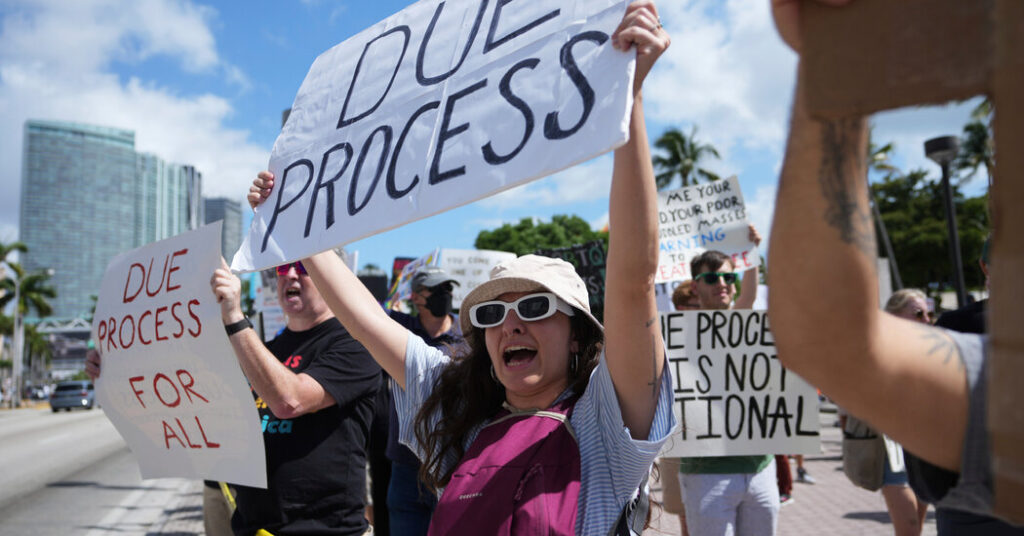
Thousands of protesters across the country once again took to the streets on Saturday to rally against President Trump and his policies, a sign of sustained resistance to his leadership just two weeks after cities and towns nationwide saw mass demonstrations.
Although the turnouts in cities like New York, Washington and Chicago appeared to be smaller than the protests on April 5 — several thousands marched in the nation’s capital on Saturday, compared with tens of thousands earlier this month — more than 700 events were planned from Jacksonville, Fla., to Los Angeles, according to one of the organizers, the group 50501.
The participants raged against the president, who they say is trampling on civil liberties and the rule of law, and overreaching in immigration, federal job cuts, the economy and other areas.
In front of the White House, protesters repeatedly shouted a single word.
“Shame!”
Thousands more marched from the Washington Monument. Many demonstrators berated the administration for not bringing Kilmar Armando Abrego Garcia, the Maryland man who was wrongfully deported to El Salvador, back to the United States. Waving upside-down American flags, they marched along the eight-lane Constitution Avenue, chanting “Bring Kilmar home.”
Julia Fine, a Maryland resident who was holding a sign at the protest by the White House that read “free Garcia,” said the prison in El Salvador where Mr. Abrego Garcia is being held reminded her of “concentration camps.”
“That’s where we’re headed with this,” she said.
Concerns over the government’s handling of Mr. Abrego Garcia’s case echoed at demonstrations from New York City to Cincinnati to Chicago.
At a protest in Midtown Manhattan, where protesters filled 15 blocks on Madison Avenue, Barry Knittle, 64, carried a sign that read “Free Abrego Garcia Now.”
“It’s an injustice,” said Mr. Knittle, a manager at an engineering firm who lives in Mt. Kisco, N.Y. “And I fear it’s just the beginning.”
Although many of the events on Saturday were traditional protests, many also were intended to unite local communities through activities such as food drives. Mass protests during President Trump’s first term, like the Women’s March in 2017, often focused on a single topic, but demonstrators on Saturday expressed concern on a wide range of issues: federal job cuts, their 401(k)s, veterans’ rights, Social Security, the war in Ukraine, transgender and gay rights.
“Everything here is a big issue,” said Fio Holloman, 22, who attended a rally in Chicago’s Daley Plaza.
Hundreds of protesters rallied in Fort Worth, at one point shutting down traffic for at least four blocks. Jeannie Walker, 54, couldn’t land on just one issue when asked what brought her to Saturday’s protest.
“All of it,” she said.
Aaron Burk, who attended the Washington rally and whose girlfriend took a federal buyout from the Department of Energy, said he was worried that the administration would not stop at deporting undocumented immigrants without due process and would imprison and deport U.S. citizens.
“Where does it stop?” he said. Mr. Burk added that his daughter is transgender and that he was most concerned about the dehumanization of minorities.
In Jacksonville, Fla., hundreds took to the streets to protest a number of causes, including the president’s attacks on the L.B.G.T.Q. community and the government’s desire to alter the Endangered Species Act.
“We are losing our country,” said one demonstrator, Sara Harvey. In the last few months, she said she had protested the federal job cuts led by Elon Musk and joined the nationwide protests on April 5.
“I’m worried for my grandchildren,” she said. “I do it for them.”
A celebration in Concord, Mass., to commemorate the 250th anniversary of the beginning of the American Revolution, was not part of the organized network of protests, but some people took the occasion to draw parallels between then and now.
Conan Walter, 65, stood on the Old North Bridge holding a large poster scrawled with the words “Stop fascism now.”
“This celebration is about us getting out from under the King of England’s authoritarian rule,” Mr. Walter said. “That rule is trying to make a comeback today, and it’s important that people step up against that and meet the challenge.”
Still, not everyone in Concord was there to protest on Saturday. Deborah Bucknam, 78, an avid Trump supporter and lawyer from Northern Vermont, said she felt shut out of the political conversation on Saturday morning. Ms. Bucknam came to Concord to honor American history, and she said political differences shouldn’t overshadow the milestone.
But she acknowledged that demonstrators were allowed to voice their dissent.
“Protests are part of the American experience,” she said. “We have a right to protest, but everyone has a right to protest.”
Nichole Manna contributed reporting from Jacksonville, Fla.; Nate Schweber from New York; Mary Beth Gahan from Fort Worth; Robert Chiarito from Chicago; Kevin Williams from Cincinnati; and Lila Hempel-Edgers from Concord, Mass.