
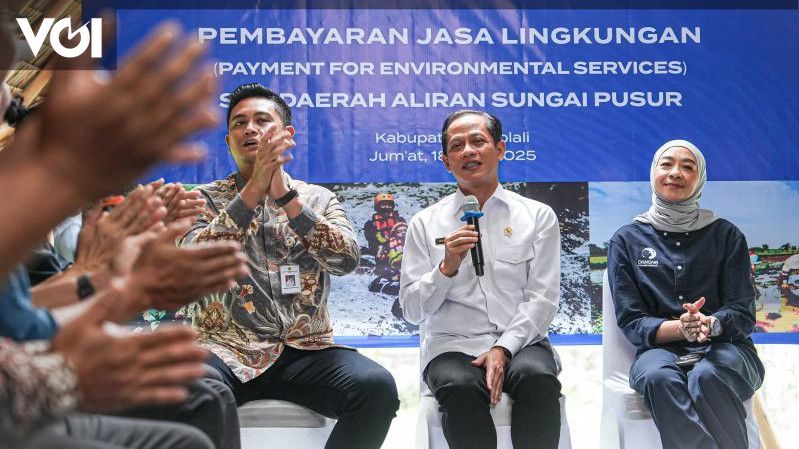
JAKARTA – The Ministry of Environment (KLH) launched the Regulation of the Minister of Environment Number 02 of 2025 concerning the Development of the Environmental Services Payment System (PJLH), marking a new chapter of national environmental policy.
“Indigenous peoples, forest farmers, and the nature guard community who have been working unconditionally, can now receive compensation based on the results of their work to protect the ecosystem,” said Minister of Environment and Environment Control Agency (BPLH), Hanif Faisol Nurofiq in a statement received in Jakarta, Antara, Sunday, April 20.
Hanif called the regulation marking a new chapter in national environmental policy, where conservation is no longer seen as a mere sacrifice, but as an important work that deserves to be calculated, measured, and appreciated.
He emphasized this when he made a working visit to Central Java on Friday (18/4). Minister Hanif was accompanied by Regent Klaten Hamen Untung Ismoyo in dialogue with farmers and the Pusur Institute in Taman Kehati, Klaten and explained the launch of the regulation.
The regulation is a derivative of Article 48 paragraph (5) of PP No. 46 of 2017 concerning Environmental Economic Instruments and becomes a legal framework for transforming conservation from voluntary activities into incentive-based systems.
With that approach, he said, local communities, forest farmers, indigenous communities and all that has been protecting the environment, such as water, carbon, and biodiversity, can receive legal and measurable compensation, based on the results of their work.
The system also opens opportunities for cooperation between the government, private sector, and civil society to build an economic ecosystem that is in favor of sustainability. The launch confirms Indonesia’s position as a pioneer of a green economy that integrates social justice and ecological sustainability.
He stressed that the important role of the rule instrument lies not only in payment schemes, but also in the recognition that conservation is not the remainder of development, but its foundations.
PJLH funds come from the APBN, APBD, corporate social responsibility (CSR), to other legitimate donations. The PJLH national information system will be developed to ensure transparency and accountability throughout Indonesia.
He gave an example of PJLH’s practice, including in Cidanau, Banten, where farmers receive 125 US dollars per hectare from drinking water companies, because they protect upstream forests. However, 71 percent of them have taken care of before payment is made.
The same thing happened in Sumberjaya, Lampung, where 25 years of managed rights were given to farmers who implemented conservation practices, and river sedimentation drastically decreased.
The policy direction of PJLH is not designed as a temporary project, but as a national system that integrates conservation into development planning. The regulation is not only administrative regulation, but an alternative economic framework that unites the preservation of nature with the welfare of the people.

“Who protects, we must protect. We must protect anyone who protects nature, we must protect it. Because protecting nature is protecting our common future,” said Hanif Faisol Nurofiq.
The English, Chinese, Japanese, Arabic, and French versions are automatically generated by the AI. So there may still be inaccuracies in translating, please always see Indonesian as our main language.
(system supported by DigitalSiber.id)