
In 2008, Eliott Behar traveled from Toronto to join the legal team and vividly and shockingly describes a series of crimes and cover-ups, as well as courageous testimonies from survivors who often risked their lives to tell their stories. He presents sequential accounts of the massacres and the mechanism of the disappearance: victims are first buried, then exhumed, transported to another location, and then reburied or burned.
Focusing on the trials for Kosovo, Eliott Behar in his book “Tell the World: International Justice and the Campaign to Hide the Mass Murders in Kosovo”, KOHA Publications, Prishtina, 2018, suggests that the ethnic cleansing of Kosovo Albanians by Serbian forces was pursued in three separate but interconnected trials of the Tribunal. The first and most well-known was the case of the Prosecution against Slobodan Milošević, which took place between 2002 and 2006. Milošević’s trial, as monumental as it was, never ended – because Milošević died before the case was closed. In this context, the author helped to uncover the truth, confront injustices and protect the dignity of victims, by bringing to light the shocking testimonies of survivors and the systematic efforts to hide the traces of the crimes.
In 2008, Behar traveled from Toronto to join the legal team and vividly and shockingly describes a series of crimes and cover-ups, as well as courageous testimonies from survivors who often risked their lives to tell their stories. He presents sequential accounts of massacres and the mechanism of disappearance: victims are first buried, then exhumed, transported to another location, and then reburied or burned – all to hide the clear evidence of the crimes.
The second case was the Prosecution against Milan Milutinović, Nikola Šainović, Dragoljub Ojdanić, Nebojša Pavković, Vladimir Lazarević and Sreten Lukić, which the author here refers to as the “Kosovo 6 Case”, which prosecuted members of Serbia’s senior leadership for participating in what international criminal law refers to as a “joint criminal act” against Kosovo Albanians.
The third case of ethnic cleansing in Kosovo was the prosecution against Vlastimir Đorđević, who had been the head of the Department of Public Security in the Serbian Ministry of the Interior. In other words, he was the chief of police, responsible for all police units and personnel in Serbia, including Kosovo, during the events of 1999. Đorđević was accused of overseeing the operation to hide evidence of ethnic cleansing in Kosovo, perhaps one of the most startling and revealing events that had occurred there.
The “Kosovo 6 Case” and Ethnic Cleansing
To narrate the issue of ethnic cleansing in Kosovo, the author also relied on the testimonies and experiences from the “Kosovo 6 Case” and sometimes on the evidence from the Milosevic trial, adding that the cases were very intertwined. However, the coverage of the Kosovo cases and the closure of this extraordinary chapter in both history and international law, the author says, was followed by little noise. Although he does not make any extensive geopolitical analysis, Behar emphasizes that the events in Kosovo led NATO to enter the war in Europe at the end of the XNUMXth century, a new type of “humanitarian war”, a war that very few Westerners appreciated or understood. But, according to the author, it was the events in Kosovo that had created the basis for the indictment and international arrest of Milosevic, which were later expanded to include other actions in the former Yugoslavia, making the case possible for international criminal law to rise again on the world stage.
Behar does raise important questions, however, about the impact this complex process and legal labyrinth may ultimately have. Drawing comparisons to war crimes from Cambodia to Rwanda, he also explores the ways in which people justify these actions – usually by feeding into a collective historical wound or real or perceived experience of victimization.
The book focuses on international justice, investigations, and efforts to conceal the mass crimes committed during the conflict period, providing an in-depth and nuanced view of the impact of international politics on court and justice processes.
Hiding the bodies
This book explores international efforts to bring justice to war crimes cases in Kosovo, particularly against Kosovo Albanians, and reveals a covert campaign to conceal mass murders and systematic destruction committed by Serbian forces during 1999, which he calls “Operation Dubina II.” According to Behar, the evidence in the Đorđević case documents that the main architects of the campaign to conceal crimes in Kosovo were Milošević’s direct subordinates. According to the testimony of Časlav Gollubović, he was instructed to keep quiet about the truckload of Albanian civilian bodies and to ensure that the media did not report on the case. According to Gollubović, “he could see and identify the wounds very easily: violent trauma, at least three severed heads and a body with its hands bound with wire and a large hole caused by a gunshot at close range. These were signs of execution.” (p. 57).
The court, based on Gollubović’s testimony, found that the people involved in the operation to hide the bodies of executed Albanians were paid a total of 10 dinars for their work. Traces of written communication also documented that it was Đorđević who approved the payments and that the operation was codenamed “Dubina (Depth II)”. “Dubina II”, according to a secret operation by the Serbian Ministry of the Interior, aimed to secretly transport the bodies of Kosovo Albanian civilians to Serbian territory, so that after the establishment of the international administration and KFOR, the extent of the mass killings would not be revealed.
Regarding the discovery of Albanian victims by a local journalist, the author also brings an interesting detail. Already during the war, the writer Christopher Hitchens had received a letter from a Serbian student telling him about a family friend, a truck driver, who had often gone to Kosovo to transport contingents of Albanian troops to Vojvodina. As Behar claims, Hitchens, although he was a strong supporter of NATO intervention, did not publish what he was told. He chose not to publish the letter because “although it seemed to be written with good intentions, it nevertheless seemed very unbelievable and a bit fantastical…” (p. 285).
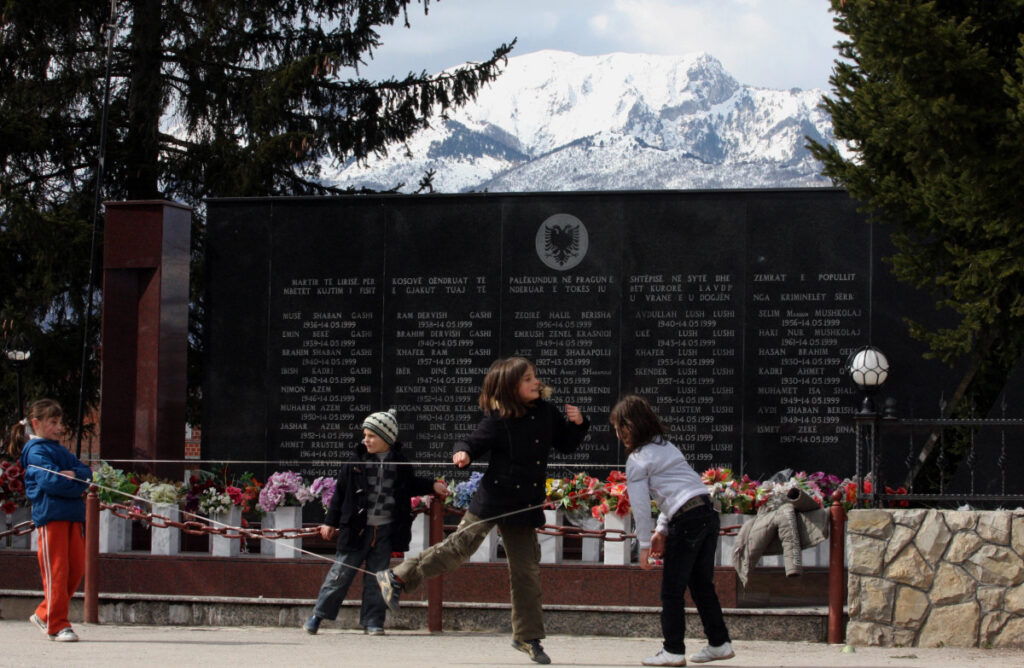
The Qyshku massacre
Behar continues by presenting the accounts of two Albanian men, Tahir Kelmendi and Hazir Berisha, who at the Đorđević trial would provide eyewitness testimony about the massacre that had taken place in the village of Peja, Qyshk, where Serbian forces executed 41 Albanian civilians on May 14, 1999. Drawing on the Tribunal’s voluminous file, the author states that “at 7:00 a.m. on May 14, the villagers heard automatic gunfire. They saw how the houses at the end of the village were burning, and black smoke was blackening the sky. Some of the young and middle-aged men fled to the nearby mountains, because they had already had ‘visits’ from the Serbian police before. Some were killed while fleeing. Others remained behind, unwilling or unable to flee or because they did not want to abandon their families.” (p. 80). Serbian forces were searching for Agim Çeku’s father, who had joined the Croatian Army in 1991 and who had been involved in Croatia’s “Operation Storm” in 1995. After identifying Agim’s father, Hasan Çeku, the Serbian forces killed him and then burned him. The Serbian forces also killed several residents of Qyshku and looted them.
“The villagers were ordered to take everything out of their pockets. They threw their money, cigarettes and identification documents on the ground. They chose two children from the group to collect the things, one to collect the money, the other the identification documents… the women threw their gold and anything of value.” (p. 83). After this detail, the author also describes in detail the survivors’ account of the manner of the execution of the men and the burning of the bodies of the killed and wounded. According to the Tribunal’s findings, to which Eliott Behar refers, the Serbian executioners – satisfied with the killings committed against Albanian civilians – then ordered the women and children to leave the village, expelling them from Kosovo as part of a wider strategy of ethnic “cleansing” the territory. The killings continued in other villages of Peja, such as Zahaqi and Pavlani. In addition to these shocking testimonies, Behar also describes the emotional moments of meetings with witnesses after the sessions, emphasizing the tension and relief they experience after their testimonies in court. The testimony of the survivors is powerful, shocking and very emotional, painting a vivid portrait of the inhumanity and cruelty of the Serbs in this village and in other Albanian villages in Kosovo. But, unlike the trial of Adolf Eichmann, who was responsible for orchestrating the mass deportation of Jews, which was followed by a drama “The Investigation” written by Peter Weiss, whose narrative was built from the testimonies and exchanges in the trial, the Tribunal’s cases have not found any echoes from well-known creators in the country, there are not enough literary or film works about what happened to the Albanians of Kosovo. International criminal trial is of course not a theater, but, as the author says, the judicial context is a competition in itself, where the prosecution’s task is to determine the guilt and responsibility of the accused.
To be continued in the next issue of the Culture Supplement