
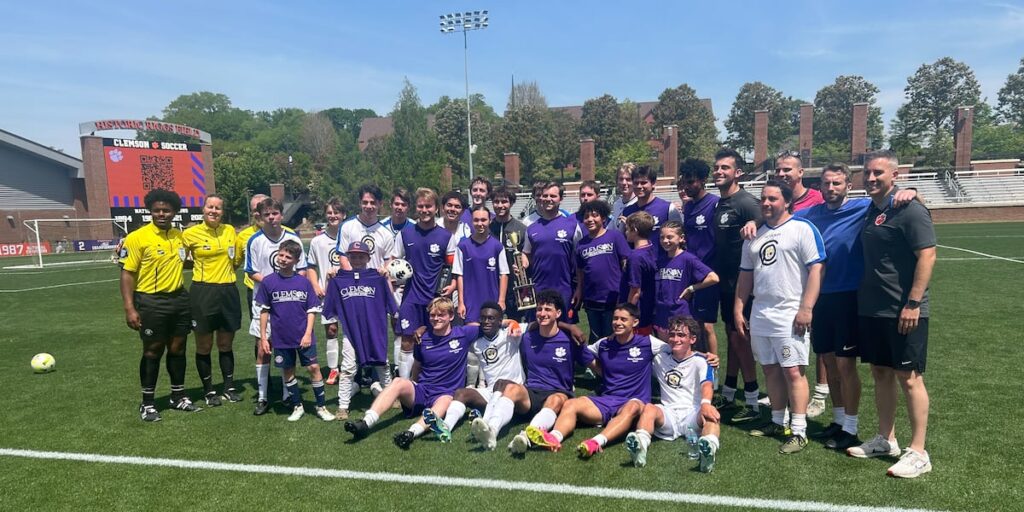
CLEMSON, S.C. (FOX Carolina) – A Tigers team just made history while breaking down barriers at Clemson, but they say doing something that’s never been done in college athletics is just the beginning of the impact they hope to have.
“I had a stroke at birth,” Clemson Paralympic Soccer Graduate Student Shea Hammond said. “Which means I have cerebral palsy.”
The neurological condition affecting most players on the Clemson Paralympic soccer team forces them to expend three-times more energy than able-bodied athletes.
“My entire left side is affected,” Hammond said.
But they still live out the team’s motto, ‘strength through adversity.’
“My first goal was with my left foot,” he said.
They played the first-ever collegiate Paralympic soccer game on Saturday.
“It’s the name of the field, it’s historic,” Hammond said after completing the game at Historic Riggs Field. “It feels incredible to display the sport itself for the first time on this stage in the United States. It’s been incredible, I’m not going to stop smiling for a while.”
After winning 6-1 against an all-star team from the non-profit Hammond started with his father, CP (cerebral palsy) Soccer, those smiles extended to the sideline for Clemson Paralympic Soccer Head Coach Felipe Tobar.
“Our players lived their dreams today,” Tobar said.
Tobar hugged his starting goalkeeper Max Alberici after substituting him out to allow other players to get experience in the historic game.
“I love you, coach,” Clemson Paralympic Soccer Junior Max Alberici said to Tobar.
“I love you too, man,” Tobar replied.
“I didn’t know that I had such an impact on Max,” Tobar said after the game. “He had this dream to play here, to play in a college stadium, and we were able to allow that to happen.”
Cerebral palsy prevented Max from reaching his original dream of playing college lacrosse. He’s the son of longtime Army Men’s Lacrosse Head Coach Joe Alberici.
So he became the Clemson women’s lacrosse team’s first manager. As much as Max loves lax, lax loves Max. Clemson lacrosse players held up a handmade sign with that phrase to prove it.
“It’s been so amazing,” Clemson Lacrosse Senior Demma Hall said. “Just being able to give back what he’s given to us for all these years just feels so good and you can tell we’re so excited to do it and be here for him.”
Hall was one of more than a dozen Clemson lacrosse players who supported Max from the stands Saturday despite having practice later that day.
“Just the kindness that team shows,” Max said about the loudest cheering section at the game. “They showed up for me and I was like, ‘oh my goodness.’ I don’t know whose idea it was to give them those flags, but here we are.”
Clemson has granted Max and the Paralympic team access to the same facilities as the four-time national champion Clemson men’s soccer team.
“The ability to say, ‘hey, we’re a soccer team too. Clemson has three soccer teams.’ Is truly unbelievable,” Max said. “I always say, ‘we’re undefeated national champs every single year.’”
Now that they’ve won their championship, the team wants to help others win as well.
“If the NCAA is listening to us, we want to talk,” Coach Tobar said. “We want to grow the sport. We want to give kids with disabilities a pathway to be college athletes in the future. It brings equality, brings diversity, brings joy, brings hope. There’s only positive outcomes.”
Since its creation in 2017, Clemson Paralympic Soccer is still the only collegiate team of its kind in the country. They’ve taken their contribution a step further by having six players on scholarship.
Coach Tobar is helping his players show similar ‘strength through adversity’ that his mother showed him 15 years ago after she had a stroke.
That’s the same condition many of his players have overcome to make history.
Copyright 2025 WHNS. All rights reserved.