
This study initially explores various scenarios to determine the optimal floor height, building foundation type, foundation height, and roof design, as outlined in Table 1.
A selection of 11 scenarios for designing a room in a school in Dubai was made, showcasing different designs for the construction of the school. The details of these scenarios are outlined in Table 2.
In Table 3, the results of 11 scenarios are presented.
The findings indicated that reducing the floor height and the building foundation height led to decreased building energy consumption. In Dubai, the optimal building foundation type is identified as Pier&Beam with a Flat Roof/Deck. Given the objective of optimizing energy usage in the Dubai school, Scenario 1 was selected for the comprehensive design of the school building. The study involved calculating the thermal and cooling load, as well as the electrical load of a school in Dubai City.
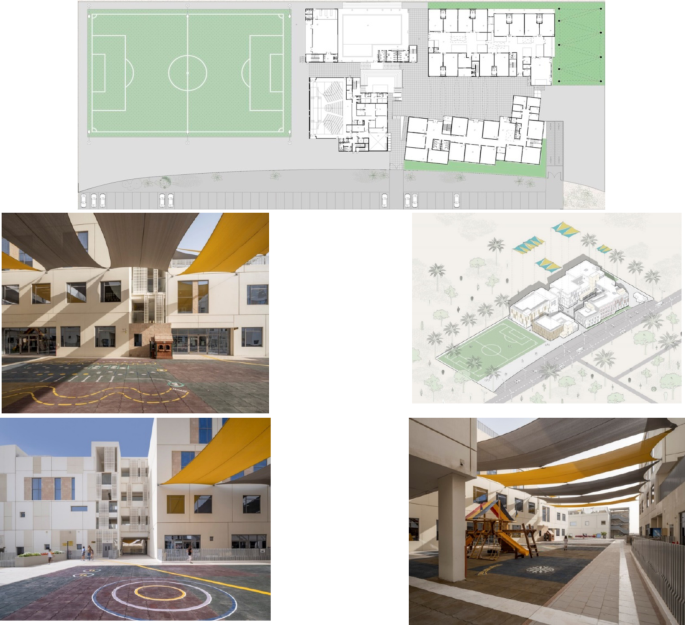
The school building in Dubai (Fig. 1) was designed and evaluated using Building Energy Optimization (BEO) to establish the yearly clean power output load, heating demand, and cooling requirements for the entire school facility. BEopt software serves as a building energy optimization tool, offering cost-effective efficiency enhancement solutions. It evaluates buildings based on dimensions, architecture, occupancy, location, and amenities to simulate energy performance. Figure 2 illustrates the flowchart for analyzing the school building in terms of energy consumption, encompassing electricity demand, heating requirements, and cooling needs.
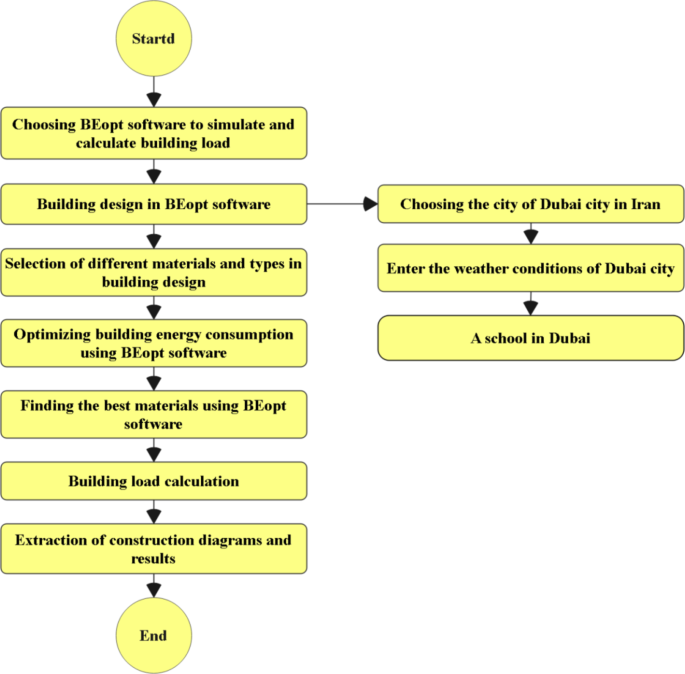
Flowchart of school building analysis.
A range of sizes and materials were chosen for constructing the school building to identify the optimal structure. Notably, the school building is positioned facing north. The study explored various materials for walls and ceilings, featuring the innovative utilization of Phase Change Materials (PCMs), with specific details outlined in Table 4. Furthermore, diverse door products, lighting systems, and components were integrated to enhance the building design from an energy efficiency standpoint. The duration needed for analyzing the building optimization considering various influencing factors is detailed in Table 5.
The study delves into the analysis of weather conditions, concentrating on the impact of variations (weather conditions) in ambient temperature (AT), Wind Speed (WS), Solar Radiation (SR) and Relative Humidity (RH) in Dubai. These environmental factors play a significant role in the Energy usage of buildings over the course of a year. Hourly variations in T0 for Dubai city are depicted in Fig. 3, showcasing temperature fluctuations ranging from 0 to 50 °C, with peak temperatures observed in June and July during the summer season. Furthermore, hourly fluctuations in dew point temp are illustrated, fluctuating between − 5 and 35 °C. The dew point is the temperature at which air must be cooled to become saturated with water vapor, playing a crucial role in both air conditioning and meteorology. The hourly fluctuations in wind speed for Dubai are graphed to illustrate the variations in wind patterns throughout the day and year. The wind speed in Dubai experiences mild seasonal changes, with the windier period lasting from December to June and the calmest period from June to December. The windiest month is March, with an average hourly speed of 9.2 miles per hour, while the calmest month is October, with an average speed of 7.0 miles per hour, the wind speed in Dubai ranges from 0 to 25 m/s, highlighting the city’s significant wind energy potential. This potential can have a substantial impact on building energy consumption by providing an alternative and renewable source of energy. Additionally, the solar radiation intensity in Dubai varies throughout the year, ranging between 0 and 1200 W/h. These findings underscore Dubai’s high solar energy potential, which also plays a crucial role in influencing building energy usage Relative humidity, closely related to dew point in thermodynamics, is crucial for determining air moisture content. Represented as a percentage at a specific temperature, relative humidity reflects the proportion of water vapor pressure to saturation pressure in the air. Monitoring hourly relative humidity levels throughout the year for Dubai city is essential for understanding indoor air quality and comfort. Maintaining indoor humidity around 45% is ideal for creating a comfortable environment; levels below 30% can lead to dryness-related health issues like skin irritation and respiratory discomfort. Therefore, regulating temperature and humidity indoors is paramount for overall well-being and comfort.
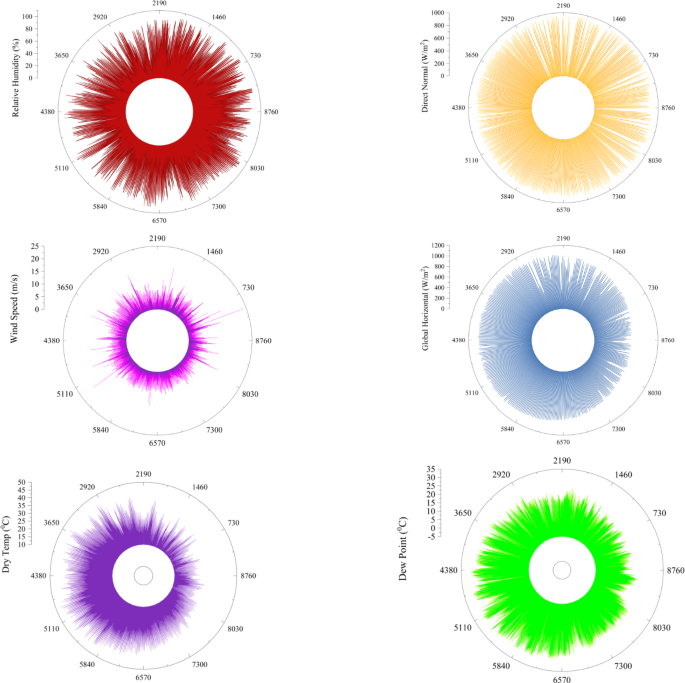
Hourly changes in weather parameters.
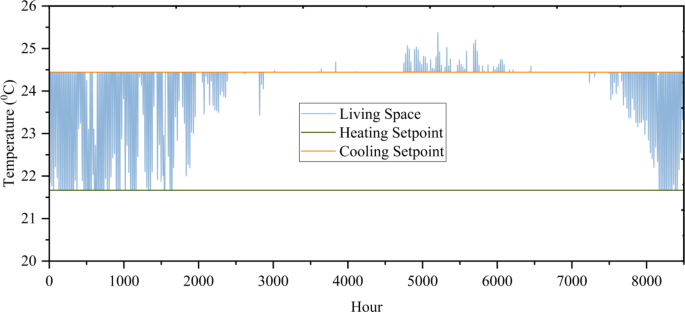
Figure 4 illustrates the temperature levels within the living space. The recommended temperature range for the school building in Dubai is between 70 and 76 °F (21.5–24.5 °C), emphasizing the importance of utilizing central heating and other temperature control methods to establish a healthy and pleasant indoor atmosphere. The graph also displays the adjustment points for cooling and heating loads in the school to achieve the desired living space temperature. Working in excessively hot conditions can lead to physical and mental discomfort, impacting performance. Heat-related illnesses can result in a decline in athletic performance, muscle cramps, exhaustion, fainting, and even loss of consciousness. Heat stroke, a life-threatening condition, can occur due to prolonged exposure to high temperatures or physical exertion in such conditions. Therefore, maintaining an optimal temperature in the living area is crucial for enhancing overall well-being and comfort.
Validation of the building analysis
Figure 5 presents the validation and comparison of electricity consumption in a 30-meter room in Dubai between the actual model and the BEopt software-assessed model. The findings reveal that the real model shows elevated electricity usage during summer and hot seasons, primarily due to heightened utilization of cooling electrical devices. In contrast, electricity consumption decreases in colder seasons as the reliance on cooling equipment diminishes. The software-modeled scenario replicates the powering of cooling equipment by national electricity, aligning with the conditions observed in the actual Dubai model to ensure a thorough validation process.
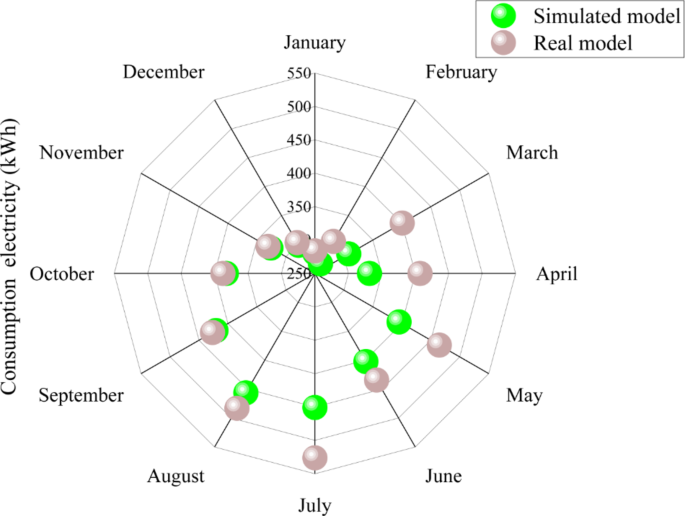
Validation of electricity consumption of a school room in Dubai City and the investigated model.
School building analysis
The initial phase of this research involved a comprehensive optimization process utilizing the Building Energy Optimization Tool (BEopt) to identify the most effective strategy for enhancing the energy consumption, construction costs, and carbon dioxide emissions reduction of a proposed school in Dubai. This optimization process considered a multitude of factors, including the specific geographic location, local weather variations, and the materials selected for construction. Over an extensive analysis period of 17 h, 15 min, and 23 s, BEopt conducted 88 simulation runs to generate a range of optimization solutions tailored to the unique requirements of the school. The BEopt methodology is particularly adept at identifying the best materials and features for building designs by evaluating various combinations of energy efficiency measures and renewable energy options. This approach not only facilitates the selection of optimal construction materials but also enhances overall building performance in terms of energy efficiency and sustainability. By systematically analyzing the interactions between different design elements, BEopt enables researchers to pinpoint configurations that minimize energy consumption while maximizing comfort and functionality. In this study, BEopt’s capabilities were leveraged to assess how different construction strategies could lead to significant reductions in operational costs and environmental impact. The results from this optimization process will serve as a foundation for implementing a biomass-based multi-generational energy system, ensuring that the school meets its energy demands sustainably. Ultimately, this research aims to contribute valuable insights into the design and operation of zero-energy buildings in hot climates, promoting environmentally responsible practices in educational infrastructure development.
Results – optimum building
In Fig. 6 depicts the hourly heating outcomes for the school building throughout the year. In Dubai, the school’s heating needs are significantly lower than its cooling demands, thanks to the region’s ample solar radiation and warm air conditions. The annual heating consumption for the school building falls within the range of 0 to 18 kWh.
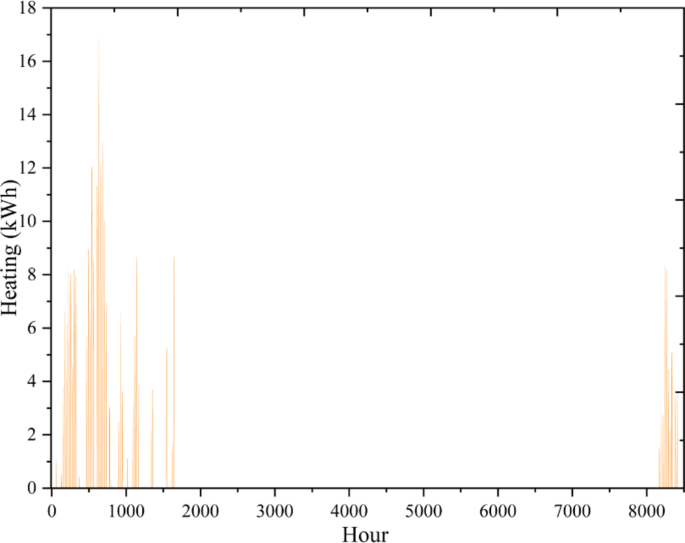
Heating bar consumed by the school.
Figure 7 displays the hourly cooling bar data for the school over a year. The findings indicate that in Dubai, the school’s cooling demand is notably high, primarily influenced by the ambient temperature (T0). The school’s cooling consumption ranges from 0 to 80 kWh throughout the year.
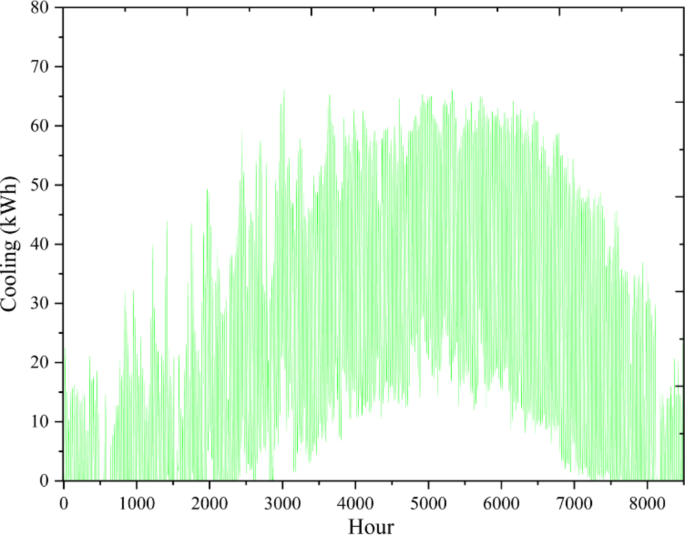
The cooling load of the school.
Figure 8 illustrates the hourly electricity consumption of the school building over the course of a year. The school’s electricity usage ranges from 0 to 80 kWh annually.
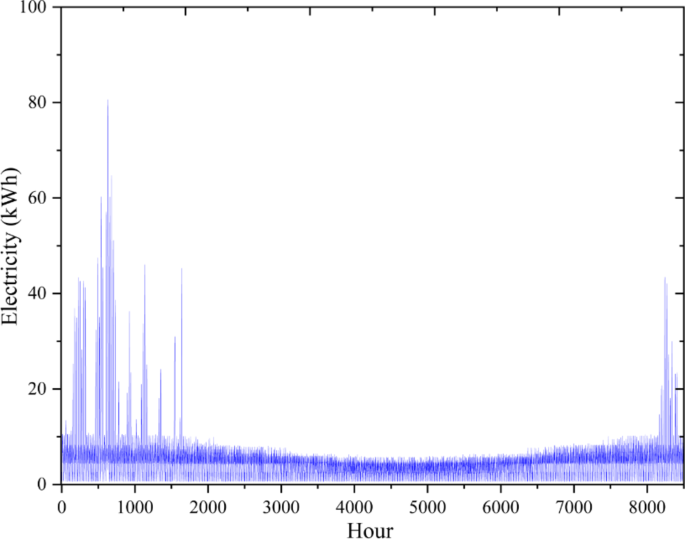
Clean electricity consumed by the school building.
Figure 9 presents the outcomes of reducing CO2 emissions over the span of a year through optimizing the school’s energy usage.
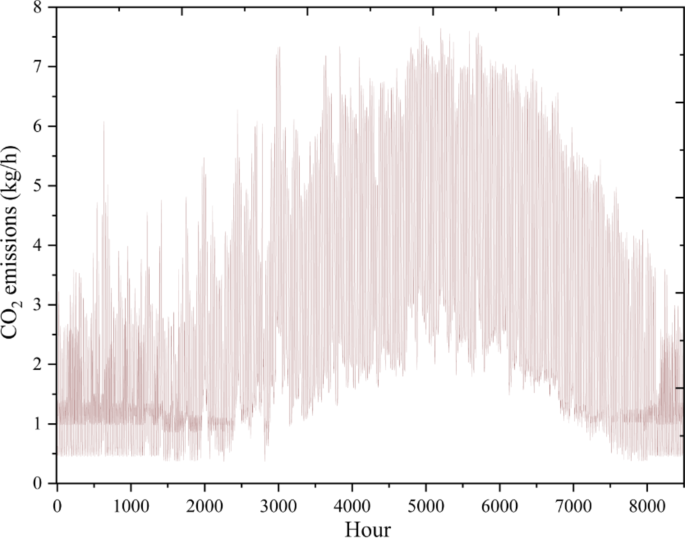
Reduction – CO2 emission.
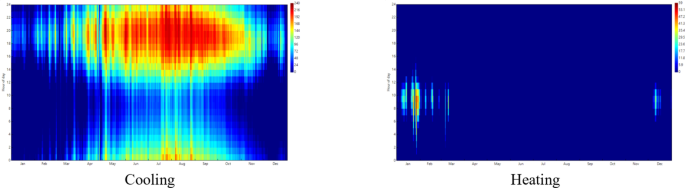
Figure 10 exhibits the thermal contours that represent the energy consumption of the school, illustrating the hourly energy flow and distribution. It visualizes the fluctuations in energy required by the school throughout various seasons based on the construction materials utilized. The figure displays the heating and cooling contours over the year, showcasing variations in their consumption levels influenced by environmental conditions affecting the school.
The effects of changes in environmental factors (Fig. 11) on a school’s heating consumption can have significant implications for student learning and overall well-being. Research indicates that cumulative heat exposure over the school year is associated with lower levels of student learning. In school districts without air conditioning, a 1℉ increase in average school year temperature is linked to a 1% decline in learning. However, the presence of classroom air conditioning systems can mitigate this negative effect, nearly eliminating the adverse impact of higher temperatures on academic achievement., Ambient Temperature (AT) & solar Radiation (SR) & wind speed (WS) & relative humidity (RH) are individually evaluated to understand their impact on heating usage throughout the year in Dubai City.
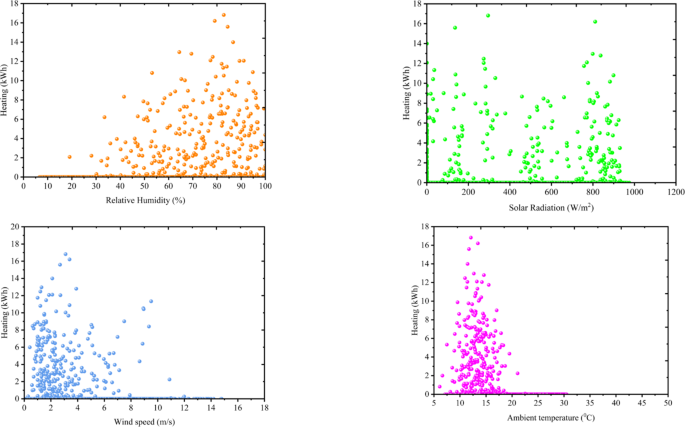
Heating consumption based on weather parameters.
Relationship between variations in environmental elements and cooling usage in a school in Dubai is crucial for understanding energy consumption patterns and optimizing thermal comfort. Factors like AT, SR, WS, and RH are analyzed independently to evaluate their influence on cooling consumption over the course of the year. Research indicates that cumulative heat exposure over a school year is associated with lower levels of student learning, with higher temperatures leading to a decline in academic achievement. The presence of air conditioning systems in schools can mitigate this negative effect, emphasizing the importance of maintaining appropriate indoor thermal conditions for student performance. Furthermore, the quality of the indoor thermal environment in school classrooms is essential for students’ health and performance. Studies highlight the impact of thermal comfort on students’ learning experiences, emphasizing the need for conducive indoor environments to promote teaching and learning effectively. Understanding how environmental factors like temperature, solar radiation, wind speed, and relative humidity affect cooling usage in schools is crucial for optimizing energy efficiency, promoting student well-being, and enhancing academic performance (Fig. 12). By analyzing these relationships, schools can implement strategies to create comfortable learning environments that support both energy conservation and student success.
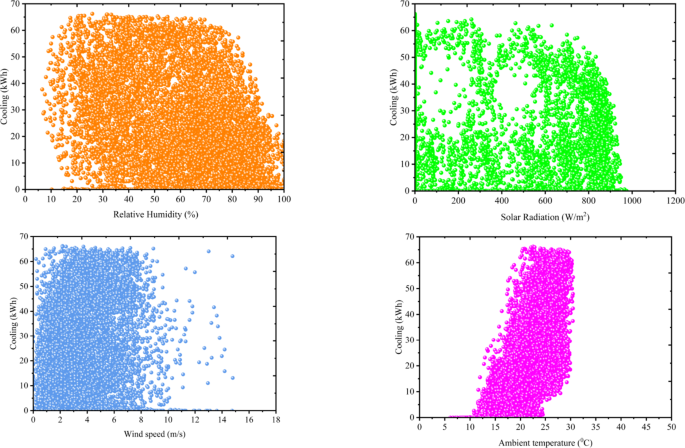
Effects of weather parameters on the cooling bar.
Figure 13 shows distribution of changes in environmental factors affecting of the electricity consumption for ZESB in Dubai is a critical aspect of energy management and efficiency. Understanding how factors like temperature, solar radiation, wind speed, and relative humidity impact cooling usage is essential for optimizing energy consumption and creating comfortable learning environments for students. These factors include temperature (T0), SR, WS, and RH. They are individually analyzed to understand their influence on electricity usage throughout the year in Dubai.
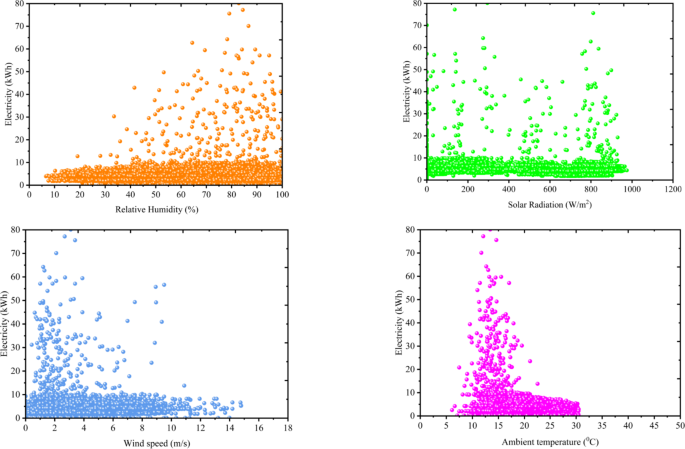
Significant impact on clean electricity consumption.
Table 6 presents the optimal amounts corresponding to the 6 points featured on Pareto figure. These six optimal points, labeled alphabetically, are aligned with the primary goals of lowering building energy optimization consumption (BEOC) and mitigating Carbon dioxide emission (CDE) linked to energy use are a significant concern globally, with implications for climate change and environmental sustainability. The school building attains an annual energy savings rate of 0.34%, resulting in annualized energy cost savings of $18,760.35.