
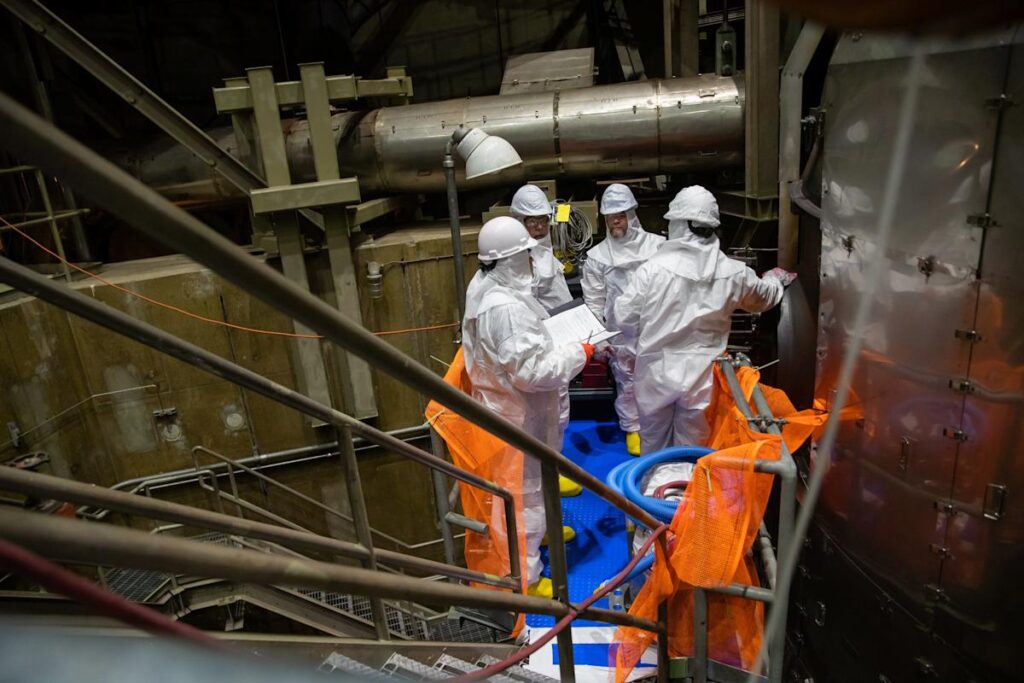
One of the nation’s largest nuclear power plants generates energy for Arizona, New Mexico, Texas and California. It’s almost completely run on other countries’ uranium.
Foreign producers, including Canada, Kazakhstan, Russia, Uzbekistan and Australia, account for 99% of the uranium used by US nuclear generators in 2023, according to the U.S. Energy Information Association.
“We as a country have to rely on the rest of the world. We don’t have the capacity as a country to do everything ourselves,” said John Hernandez, vice president of site services at the Palo Verde Generating Station, one of the nation’s largest nuclear energy producers.
How Trump’s tariffs impact the generation of nuclear energy
In December 2023, 25 countries declared goals to triple the global nuclear generating capacity by 2050. The declaration included plans to curb overall greenhouse gas emissions and keep rising temperatures below a 1.5 degrees Celsius max.
Since President Donald Trump took office, he has instilled a slew of tariffs on numerous countries in an effort to drive manufacturing back to the United States. Uranium is currently exempt from all tariffs imposed by the Trump administration.
Energy Director at the Grand Canyon Trust Amber Reimondo said that other tariffs on United States allies puts the country at a severe disadvantage in terms of gaining nuclear dominance.
“The United States has about 1% of global uranium reserves … If everybody is actually building these nuclear reactors, the United States is way far back in terms of our ability to obtain those uranium supplies,” Reimondo said.
“We’re only making our problem worse by picking enemies with some of our friends. Canada and Australia, if we’re serious about getting uranium, those are the places that have what we need and it is a pipe dream to think we can get it here,” Reimondo said.
The Palo Verde Generating Station sits 55 miles west of Downtown Phoenix. The facility produces nearly 4,200 megawatts of electricity across the Southwest, supplying energy to over 4 million people.
Nuclear energy is harnessed through uranium pellets, which Hernandez compared to about the size of a gummy bear. This pellet accumulates about the same amount of energy as one ton of coal, 17,000 cubic feet of natural gas or three barrels of oil.
Domestic production of uranium has remained stagnant since the 1980s, largely due to the low grade deposits accessible on U.S. soil.
According to the World Nuclear Association, uranium is graded by the average weight percentage found in the ore mined. On average, deposits gathered in the U.S. read about 0.1% of uranium. In comparison, mines in Canada produce ore that has concentrations above 20%.
How uranium becomes fuel
There are four steps to the fuel cycle of uranium pellets:
-
Uranium is purchased as an inert substance.
-
It’s transformed into fuel.
Palo Verde contracts individually for all four of these steps.
“By philosophy we don’t purchase any of the four steps from Russia or China. We haven’t in decades,” Hernandez said. The bulk of their uranium is sourced from countries like Kazakhstan or Canada and they do participate in the spot market – sourced material from independent players throughout the world.
Hernandez did not confirm the exact amount of uranium Palo Verde purchases from other countries.
On May 13, 2024, former President Joe Biden signed into law the Prohibiting Russian Uranium Imports Act, which bars imports of Russian uranium products through 2040. The ban on Russian imports was part of Biden’s investing in America strategy, which distributes private sector investments that would incentivize an increase in US manufacturing.
American uranium production ticks up, still lags behind world market
The Department of Energy was awarded $2.7 billion in an attempt to spur growth of the U.S. nuclear fuel supply chain. The Biden administration tapped six companies to compete for this funding. Each received 10 year contracts that guarantee the disbursement of at least $2 million.
The spending set out to maintain the longevity of the country’s current fleet of 94 nuclear reactors and develop the domestic capacity to produce its own uranium fuel supply.
Nuclear energy provides nearly 20% of the nation’s electricity.
Since the allocation of funds, five U.S. facilities in Wyoming and Texas have spurred a 24% increase in domestic uranium production throughout 2024.
Despite the growth, over 4,000 mines remain inactive in the United States, according to the Energy Department. At last count, the active uranium mines produced about 121,296 pounds. This pales in comparison to uranium production throughout the world market.
Nearly two-thirds of the world’s production is sourced from Canada, Kazakhstan and Australia, which combine to over 33,131 metric tons, or 73 million pounds of uranium.
Amelia Monroe is a junior at Arizona State University, and is part of a student newsroom led by The Arizona Republic.
Coverage of the Society of Environmental Journalists conference is supported by Arizona State University’s Cronkite School of Journalism, the University of Arizona and the Arizona Media Association.
These stories are published open-source for other news outlets and organizations to share and republish, with credit and links to azcentral.com.
This article originally appeared on Arizona Republic: How President Donald Trump’s tariffs impact nuclear energy generation