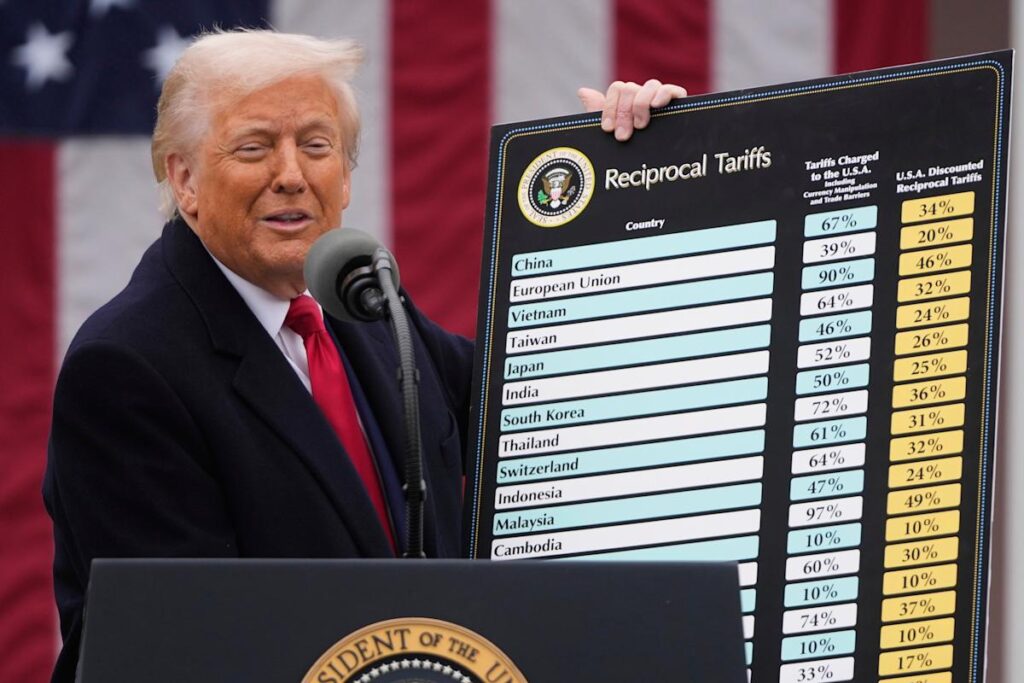
US and China tariff tensions continue to dominate the focus, with signs of deescalation mounting even as President Trump sent mixed signals on the state of relations.
On Monday, it was reported that Asian economies like South Korea, Japan, and India are taking the lead in trade talks with Trump’s administration, while China pledges additional support for tariff-hit exporters.
Trump’s tariff war has disrupted Washington and Wall Street for nearly a month, and if it continues, the impact will soon hit closer to home.
Since the US raised tariffs on China to 145% in April, cargo shipments have dropped dramatically, with estimates suggesting a 60% decline, per Bloomberg.
By mid-May, businesses will need to restock, and retailers like Walmart (WMT) and Target (TGT) have warned of empty shelves and rising prices. Experts predict major supply shortages and layoffs in sectors like trucking, logistics, and retail.
Reports emerged last week that China quietly rolled back tariffs on some US semiconductor products, easing pressure on its tech sector, along with certain US pharmaceuticals. Treasury Secretary Scott Bessent said Monday that those moves showed progress, saying it was “up to China” to deescalate tensions.
China has struck a publicly defiant tone and Trump sowed confusion by claiming that he had spoken with Chinese President Xi Jinping, which Beijing denied.
Trump added to the mixed messages later Friday when he said that he would drop tariffs on China unless Beijing gives the US something “substantial” in return.
Even as the bluster continued, the signs of a walk back have boosted Wall Street hopes for broader tariff deescalation after an intense back-and-forth between the world’s two largest economies. China in recent weeks has raised duties on imports of US goods to 125% from 84%, while US tariffs on Chinese imports have ballooned to, on most imports, 145%.
In an interview with Time magazine, Trump said he expects many trade deals to fall in place over the next three to four weeks.
Investors are also focused on other key tariffs, as well as delays and exemptions. Trump is reportedly planning an exemption on some auto parts levies after suspending duties on some consumer tech, even as he insists these tariffs will eventually come to fruition. The White House also ordered a probe into truck imports, paving the way for tariffs on the sector.
The baseline 10% tariff that went into effect on April 5 remains in place for all affected imports into the US.
Here are the latest updates as the policy reverberates around the world.
LIVE 696 updates
-
Mass layoffs in trucking are coming due to tariffs
Apollo Global Management is predicting a deep US recession sparked by recent tariffs, warning of major job losses in the trucking and retail industries as economic uncertainty grows, according to a report published on its website.
Freight Waves reports:
Read more here.
-
Some Amazon sellers are pulling out of Prime Day amid Trump tariffs
Some Amazon (AMZN) third-party sellers are skipping out on Prime Day, the e-commerce giant’s deal holiday, as tariffs hike prices and lead to fewer shipments from China.
Reuters reports:
Read more here.
-
Bessent: Up to China to deescalate, sees India as one of first trade deals
US Treasury Secretary Scott Bessent is making the rounds this morning, talking about tariffs and the economy at large. A couple of the most notable comments from a CNBC interview:
-
Tariff uncertainty dominated Trump’s first 100 days. The endgame is still cloudy.
Yahoo Finance’s Ben Werschkul reports:
Read more here.
-
Risk of global economic recession surges on US tariff shockwaves
Most economists in a Reuters poll warn that the global economy faces a high risk of recession this year, with many citing US President Donald Trump’s tariffs as a factor that has hurt business sentiment.
Reuters reports:
Read more here.
-
US aviation industry slammed by tariffs, seeks exemptions
-
US shoppers pay for Trump tariffs on Temu, doubling some prices
-
South Korea rules out chance of trade deal with US before June election
-
China re-exports record monthly volume of LNG on weak demand
-
Trump’s China tariffs set to unleash supply shock on US economy
Trump’s tariff war with China has rattled Washington and Wall Street for weeks. Cargo shipments dropped up to 60% since April, with a major impact yet to hit US consumers. By mid-May, many companies, including Walmart (WMT) and Target (TGT), will face inventory shortages and higher prices. Experts warn of potential widespread shortages and layoffs in trucking, logistics, and retail.
Bloomberg News reports:
Read more here.
-
China downplays impact of US tariffs on labor market, claims it will protect jobs
A meeting of major Chinese government officials has resulted in public denunciations of the impact of the Trump administration’s tariffs on the world’s second-largest economy.
AP Finance reports:
Read more here.
-
Sun, April 27, 2025 at 9:05 PM UTC
Trump’s tariff impacts starting to appear at US ports, with sharp drop-off in shipments from China
Air freight managers and container port operators are starting to see the impact of President Donald Trump’s trade war, with both noticing a steep decline in goods shipped from China, the Financial Times reports:
Read more here
-
Sun, April 27, 2025 at 3:00 PM UTC
Trump cabinet members clash on tariff talks with China
WASHINGTON — Members of Donald Trump’s cabinet gave conflicting messages on Sunday about whether negotiations with China over tariffs are taking place, as the Republican president has asserted.
The Trump administration signaled openness last week to de-escalating a trade war between the world’s two largest economies that has raised fears of recession. Trump said talks were under way with China on tariffs and that he and Chinese President Xi Jinping have spoken.
Yet Beijing has denied that any trade talks are occurring.
Treasury Secretary Scott Bessent, a key player in U.S. trade talks with multiple countries, said on Sunday that he had interactions with his Chinese counterparts last week during International Monetary Fund meetings in Washington, but did not discuss the tariff standoff.
In a separate television interview, Agriculture Secretary Brooke Rollins said the United States was holding daily conversations with China over tariffs.
Read more here
-
Sun, April 27, 2025 at 1:33 PM UTC
Trump voters feel tariff pain but most see long-term gain
President Donald Trump’s April 9 decision to hike tariffs on China hit as Steve Egan, a promotional product distributor in Tampa, Florida, was in the middle of ordering 5,000 rubber ducks from a Chinese vendor.
The ducks were for a local non-profit that wanted to hand them out at parades and special events. Overnight, the ducks’ cost jumped from 29 to 45 cents apiece, according to Egan.
That order is now on hold by the customer until the tariff situation is resolved, along with orders from other clients for thousands of other items, from hats to poker chips.
“I kind of feel like we’re back in COVID times because everything’s in limbo,” said Egan, 64, who voted for Trump in November.
His first-quarter sales in 2025 were 70% lower than the previous year, although they ticked up in April.
Trump’s barrage of tariffs against global trading partners has reverberated around the United States over the past few months, affecting the livelihoods of myriad Americans, including many who said they voted for him.
Tariffs were the most common policy cited by 25 Trump voters across the country interviewed by Reuters about the president’s first 100 days in office and what had most impacted their lives. They said they saw the effects at their workplaces and in their investments, especially their 401(k) retirement plans.
Read more here
-
Sat, April 26, 2025 at 5:51 PM UTC
How small US manufacturers could be crushed by Trump’s China tariffs
Small businesses are likely going to suffer under President Donald Trump’s tariffs on Chinese imports, as many of the things they need to keep their businesses going won’t be available domestically, at least not for the foreseeable future, CNN reports.
And while Trump has touted tariffs as a means to boost domestic manufacturing, John Arensmeyer, founder and CEO of Small Business Majority, told CNN it will take a long time for any increase in US production to come to fruition:
Read more here
-
Sat, April 26, 2025 at 3:14 PM UTC
Many ‘cheap goods’ sold on Shein and Temu are now more expensive ahead of new tariffs
With the “de minimis” exemption on shipments of goods worth less than $800 set to expire on May 2, e-commerce retailers Temu and Shein have already started hiking prices, CNN Business found:
Read more here
-
Sat, April 26, 2025 at 2:14 PM UTC
9 ways tariffs could upend stocks’ fundamental story: Chart of the Week
At this point, it’s no secret that tariffs are the leading driver of the stock market narrative. Or, rather, tariffs and their announcements, rumors, and responses.
Any incremental news on tariffs being softer than previously thought has sent stocks higher over the past week. Any signs that the trade war could be escalating have led to more selling.
Recent research from Deutsche Bank chief global strategist Bankim Chadha helps us understand why. On Wednesday night, Chadha — one of the biggest bulls on Wall Street entering 2025 — slashed his year-end S&P 500 forecast to 6,150 from a prior target of 7,000. This call included a detailed look at why the firm now sees S&P 500 earnings per share hitting $240 this year instead of $282.
Chadha listed nine different headwinds weighing on his S&P 500 earnings forecast. Given the escalation of the trade war, exports and imports with China are expected to weigh on profits. Lower oil prices will hurt profits in the energy sector. As tariffs push increased prices on consumers, many expect slowing economic growth. That will bring lower-volume growth for corporates and a hit to earnings. The same could be said for how persistent uncertainty is expected to weigh on growth. Our Chart of the Week has them all.
Read more here
-
Sat, April 26, 2025 at 12:07 PM UTC
Verizon, AT&T, and T-Mobile prepare to raise prices on consumers because of Trump’s trade war
The smartphone ecosystem has avoided the biggest brunt of President Trump’s tariffs — for now, Yahoo Finance’s Brian Sozzi writes.
But recent commentary from three major providers suggests that if the smartphone tariff exemptions come off or additional tariffs make it more costly for Apple (AAPL) to make iPhones, those costs will be fed through to consumers in the form of higher prices.
Here’s what the big carrier CEOs said this week about tariffs and their effects on consumer prices:
Read more here.
-
Fri, April 25, 2025 at 9:38 PM UTC
US plans staggered trade negotiations using template approach
The Wall Street Journal reported on Friday that the US plans to negotiate with 18 major trading partners in a staggered fashion over the next two months using a template that sets common terms for many of the talks:
Read more here.
-
Fri, April 25, 2025 at 6:55 PM UTC
Trump offers more mixed messages on China, says another tariff pause unlikely
President Trump added to confusing messaging on China tariffs Friday, suggesting he wouldn’t drop tariffs unless Beijing offers something “substantial” in return. (Unclear, however, if that means dropping tariffs at all, or completely, from their current 145% level.)
Here’s Trump speaking to reporters aboard Air Force One, per Bloomberg:
Trump also suggested another pause in the so-called “reciprocal” tariffs he announced — then abruptly halted earlier this month — was “unlikely” after their 90-day expiration window.