
Unlock the Editor’s Digest for free
Roula Khalaf, Editor of the FT, selects her favourite stories in this weekly newsletter.
Georgia’s prime minister has insisted the president must step down this month and dismissed US accusations his government acted undemocratically in freezing EU accession talks, as the South Caucasus republic’s political crisis deepened.
Prime Minister Irakli Kobakhidze’s comments on Sunday signalled an intensifying stand-off with President Salome Zourabichvili, a leading opposition figure who declared on Saturday that she planned to remain in office despite her term officially ending on December 16.
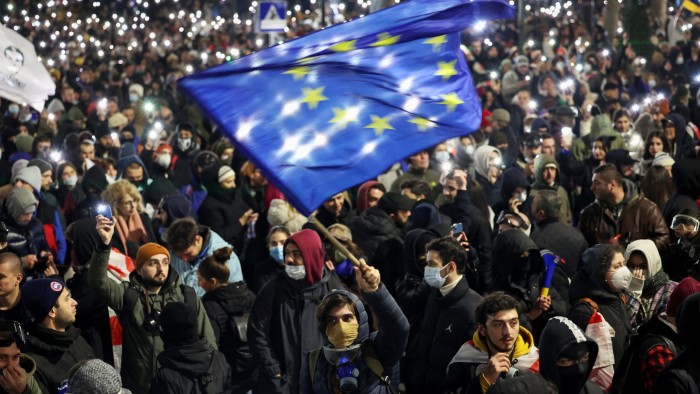
Demonstrators, who have repeatedly clashed with police during what has become one of Georgia’s most intense protest movements in decades, on Sunday rallied against Kobakhidze’s government on city streets across the country for the fourth night in a row.
The prime minister said Zourabichvili would have to leave the Orbeliani Palace residence in the capital Tbilisi and “hand over this building” to a new president after one was chosen by an electoral college that includes members of parliament on December 14.
Zourabichvili had “fought for the radical opposition’s victory” in last month’s general elections, thinking that this would “guarantee her a chance to remain in office, but she lost”, the prime minister said.
In a national address on Saturday night, Zourabichvili had insisted an “illegitimate parliament” could not elect a president.
“Therefore, no inauguration can take place, and my mandate continues until a legitimately elected parliament is formed to elect my successor,” she said.
Earlier this month Kobakhidze’s ruling Georgian Dream (GD) party announced it had won in national elections with 54 per cent of the vote. But Brussels and Washington have expressed concern about the legitimacy of the result because of reports of intimidation, ballot-stuffing and fraud at polling stations.
The European parliament has passed a resolution calling for a rerun of the elections and sanctions against leading Georgian politicians, including oligarch and GD founder Bidzina Ivanishvili.
GD has been in power since 2012 and has gradually expanded its influence over almost all the country’s institutions and steering it back towards Russia’s orbit.
On Saturday, the US state department announced the suspension of the strategic partnership between the US and Georgia, saying that “various anti-democratic actions have violated the core tenets” of it.
“By suspending Georgia’s EU accession process, Georgian Dream has rejected the opportunity for closer ties with Europe and made Georgia more vulnerable to the Kremlin,” the US statement read.
Kobakhidze dismissed the suspension of the partnership as “temporary”, saying his government would “talk everything through” with the incoming administration of president-elect Donald Trump, with which it was already in “indirect contact”.
“Whatever Trump says, that’s what will happen. So for us, the most important thing is the relationship with Donald Trump,” the prime minister said.
 Demonstrators threw fireworks towards police lines during clashes at the weekend © AP
Hundreds of anti-government protesters have been detained in recent days, while the internal affairs ministry said 44 people were hospitalised following Saturday’s protests, including 16 police officers.
The protesters object to the government’s decision to put talks with the EU on hold, and to decline any funding from the bloc until 2028.
Ketevan Chachava, head of Tbilisi-based non-governmental organisation the Center for Development and Democracy, said the crackdown “seems calculated to intimidate dissent but risks further galvanising public anger”.
Many in the Georgian opposition see Russia’s hand in the alleged electoral manipulation. “Russia wants to capture us — this is what is happening,” said Eka Gigauri, head of Transparency international Georgia, another NGO.
Recommended

Brussels halted Georgia’s accession talks this summer because of a controversial “foreign agents” law which critics say is inspired by Vladimir Putin’s Russia. It requires NGOs and media that receive foreign funding to register with the government or face fines.
Over 80 per cent of Georgia’s 3.8mn population support EU membership according to polls by local and international research organisations.
Despite GD’s fierce anti-western rhetoric, GD was in power when Georgia enshrined its desire for EU membership in the constitution in 2017. The party had endorsed EU accession as well as Nato membership as recently as this month’s parliamentary elections.