
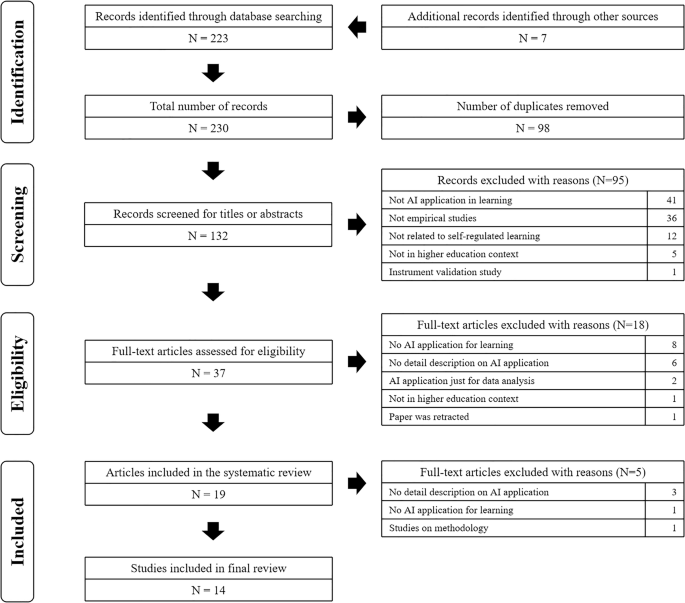
Ouyang, F., Zheng, L. & Jiao, P. Artificial intelligence in online higher education: a systematic review of empirical research from 2011 to 2020. Educ. Inf. Technol. 27, 7893–7925 (2022).
Salas-Pilco, S. Z., Xiao, K. & Hu, X. Artificial intelligence and learning analytics in teacher education: a systematic review. Educ. Sci. 12, 569 (2022).
Park, Y. & Doo, M. Y. Role of AI in blended learning: a systematic literature review. Int. Rev. Res. Open Distrib. Learn. 25, 164–196 (2024).
Crompton, H., Jones, M. V. & Burke, D. Affordances and challenges of artificial intelligence in K-12 education: a systematic review. J. Res. Technol. Educ. 56, 248–268 (2024).
Zhang, P. & Tur, G. A systematic review of ChatGPT use in K‐12 education. Eur. J. Educ. 59, e12599 (2023).
Zawacki-Richter, O., Marín, V. I., Bond, M. & Gouverneur, F. Systematic review of research on artificial intelligence applications in higher education–where are the educators? Int. J. Educ. Technol. High. Educ. 16, 1–27 (2019).
González-Calatayud, V., Prendes-Espinosa, P. & Roig-Vila, R. Artificial intelligence for student assessment: a systematic review. Appl. Sci. 11, 5467 (2021).
Chu, H. C., Hwang, G. H., Tu, Y. F. & Yang, K. H. Roles and research trends of artificial intelligence in higher education: a systematic review of the top 50 most-cited articles. Aust. J. Educ. Technol. 38, 22–42 (2022).
Dogan, M. E., Goru Dogan, T. & Bozkurt, A. The use of artificial intelligence (AI) in online learning and distance education processes: a systematic review of empirical studies. Appl. Sci. 13, 3056 (2023).
Kramarski, B. & Revach, T. The challenge of self-regulated learning in mathematics teachers’ professional training. Educ. Stud. Math. 72, 379–399 (2009).
Zimmerman, B. J. Self-efficacy: an essential motive to learn. Contemp. Educ. Psychol. 25, 82–91 (2000).
Jin, S. H., Im, K., Yoo, M., Roll, I. & Seo, K. Supporting students’ self-regulated learning in online learning using artificial intelligence applications. Int. J. Educ. Technol. High. Educ. 20, 37 (2023).
Bozkurt, A., Karadeniz, A., Baneres, D., Guerrero-Roldán, A. E. & Rodríguez, M. E. Artificial intelligence and reflections from educational landscape: a review of AI Studies in half a century. Sustainability 13, 800 (2021).
Kay, J. Foundations for Human-AI teaming for self-regulated learning with explainable AI (XAI). Comput. Hum. Behav. 147, 107848 (2023).
*Koć-Januchta, M. M. et al. “Connecting concepts helps put main ideas together”: cognitive load and usability in learning biology with an AI-enriched textbook. Int. J. Educ. Technol. Higher Educ. 19, 11 (2022).
*Hare, R., Tang, Y. & Ferguson, S. An intelligent serious game for digital logic education to enhance student learning. IEEE Transac. Educ. 67, 387–394 (2024).
*Zhang, Z. & Xu, L. Student engagement with automated feedback on academic writing: a study on Uyghur ethnic minority students in China. J. Multiling. Multicult. Dev. 1–14 (2022).
*Al-Abdullatif, A. M. Al-Dokhny, A. A. & Drwish, A. M. Implementing the Bashayer chatbot in Saudi higher education: measuring the influence on students’ motivation and learning strategies. Front. Psychol. 14, 1129070 (2023).
*Mai, V., Neef, C. & Richert, A. “Clicking vs. writing”—The impact of a chatbot’s interaction method on the working alliance in AI-based coaching. Coaching| Theorie & Praxis, 8, 15–31 (2022).
*Nguyen, A., Hong, Y., Dang, B. & Huang, X. Human-AI collaboration patterns in AI-assisted academic writing. Studies in Higher Education, 49, 847–864 (2024).
Zhai, C., Wibowo, S. & Li, L. D. The effects of over-reliance on AI dialogue systems on students’ cognitive abilities: a systematic review. Smart Learn. Environ. 11, 28 (2024).
Gerlich, M. AI tools in society: impacts on cognitive offloading and the future of critical thinking. Societies 15, 6 (2025).
Kim, K. & Kwon, K. A systematic review of the evaluation in K-12 artificial intelligence education from 2013 to 2022. Interactive Learn. Environ. 33, 1–29 (2024).
Moher, D., Liberati, A., Tetzlaff, J., Altman, D. G. & PRISMA Group*, T. Preferred reporting items for systematic reviews and meta-analyses: the PRISMA statement. Ann. Intern. Med. 151, 264–269 (2009).
Liberati, A. et al. The PRISMA statement for reporting systematic reviews and meta-analyses of studies that evaluate health care interventions: explanation and elaboration. Ann. Intern. Med. 151, W–65 (2009).
VERBI Software. MAXQDA 2020 [computer software]. Berlin, Germany: VERBI Software (Available from: maxqda.com) (2019).
Card, N. A. Applied meta-analysis for social science research. Guilford Publications, 42-51 (2015).
*Yin, J., Goh, T. T., Yang, B. & Xiaobin, Y. Conversation technology with micro-learning: the impact of chatbot-based learning on students’ learning motivation and performance. J. Educ. Comput. Res. 59, 154–177 (2021).
*Afzaal, M. et al. Explainable AI for data-driven feedback and intelligent action recommendations to support students self-regulation. Front. Artificial Intell. 4, 723447 (2021).
*Fidan, M. & Gencel, N. Supporting the instructional videos with chatbot and peer feedback mechanisms in online learning: the effects on learning performance and intrinsic motivation. J. Educ. Comput. Res. 60, 1716–1741 (2022).
*Zhang, Z. V. & Hyland, K. Fostering student engagement with feedback: an integrated approach. Assessing Writing 51, 100586 (2022).
*Afzaal, M., Zia, A., Nouri, J. & Fors, U. Informative feedback and explainable AI-based recommendations to support students’ self-regulation. Technol. Knowl. Learn. 29, 331–354 (2024).
*Kuzminska, O., Pohrebniak, D., Mazorchuk, M. & Osadchyi, V. Leveraging AI tools for enhancing project team dynamics: impact on self-efficacy and student engagement. Inform. Technol. Learn. Tools, 100, 92–109. https://doi.org/10.33407/itlt.v100i2.5602 (2024).
*Li, L. & Kim, M. It is like a friend to me: critical usage of automated feedback systems by self-regulating English learners in higher education. Aust. J. Educ. Technol. 40, 1–18 (2024).
*Ortega-Ochoa, E., Pérez, J. Q., Arguedas, M., Daradoumis, T. & Puig, J. M. M. The effectiveness of empathic chatbot feedback for developing computer competencies, motivation, self-regulation, and metacognitive reasoning in online higher education. Internet of Things, 25, 101101 (2024).
Van Merrienboer, J. J. & Sweller, J. Cognitive load theory and complex learning: Recent developments and future directions. Educ. Psychol. Rev. 17, 147–177 (2005).
Kalyuga, S. & Liu, T. C. Guest editorial: managing cognitive load in technology-based learning environments. J. Educ. Technol. Soc. 18, 1–8 (2015).
Eitel, A., Endres, T. & Renkl, A. Self-management as a bridge between cognitive load and self-regulated learning: the illustrative case of seductive details. Educ. Psychol. Rev. 32, 1073–1087 (2020).
Pintrich, P. R. & De Groot, E. V. Motivational and self-regulated learning components of classroom academic performance. J. Educ. Psychol. 82, 33 (1990).
Flower, L. & Hayes, J. R. A cognitive process theory of writing. Coll. Composition Commun. 32, 365–387 (1981).
Piolat, A., Olive, T. & Kellogg, R. T. Cognitive effort during note taking. Appl. Cognit. Psychol. 19, 291–312 (2005).
McCutchen, D. A capacity theory of writing: working memory in composition. Educ. Psychol. Rev. 8, 299–325 (1996).
McCutchen, D. Knowledge, processing, and working memory: Implications for a theory of writing. Educ. Psychol. 35, 13–23 (2000).
Sweller, J. Cognitive load theory, learning difficulty, and instructional design. Learn. Instr. 4, 295–312 (1994).
Kellogg, R. T. Training writing skills: a cognitive developmental perspective. J. Writ. Res. 1, 1–26 (2008).
Beauvais, C., Olive, T. & Passerault, J. M. Why are some texts good and others not? Relationship between text quality and management of the writing processes. J. Educ. Psychol. 103, 415 (2011).
Olive, J. L. Reflecting on the tensions between emic and etic perspectives in life history research: Lessons learned. Forum Qual. Sozialforschung/forum: Qual. Soc. Res. 15, 1-13 (2014).
Fredricks, J. A., Blumenfeld, P. C. & Paris, A. H. School engagement: Potential of the concept, state of the evidence. Rev. Educ. Res. 74, 59–109 (2004).
Deci, E. L. & Ryan, R. M. Self-determination theory. In Handbook of theories of social psychology (Sage, 2012).
Zimmerman, B. J. Self-regulated learning and academic achievement: An overview. Educ. Psychol. 25, 3–17 (1990).
Zimmerman, B. J. Becoming a self-regulated learner: an overview. Theory Pract. 41, 64–70 (2002).
Pintrich, P. R. A manual for the use of the Motivated Strategies for Learning Questionnaire (MSLQ) (1991). https://files.eric.ed.gov/fulltext/ED338122.pdf
Butler, D. L. & Winne, P. H. Feedback and self-regulated learning: a theoretical synthesis. Rev. Educ. Res. 65, 245–281 (1995).
Tuckman, B. W. & Jensen, M. A. C. Stages in small group development revisited. Group Organ. Stud. 2, 419–427 (1977).
Berninger-Schäfer, E., Meyer, P. & Geißler, H. Online Coaching (Springer, 2022).
Lovejoy, S. Weather, macroweather, and the climate: our random yet predictable atmosphere. (Oxford University Press, 2019).
Terblanche, N. H. Managers’ responses to the initial stages of the COVID-19 pandemic: An executive coaching perspective. Pers. Rev. 51, 1534–1552 (2022).
Delgado-Gómez, D. et al. Improving the teaching of hypothesis testing using a divide-and-conquer strategy and content exposure control in a gamified environment. Mathematics 8, 2244 (2020).
Kang, S. H. Spaced repetition promotes efficient and effective learning: policy implications for instruction. Policy Insights Behav. Brain Sci. 3, 12–19 (2016).
Yew, E. H. & Goh, K. Problem-based learning: an overview of its process and impact on learning. Health Prof. Educ. 2, 75–79 (2016).
Smiderle, R. et al. The impact of gamification on students’ learning, engagement and behavior based on their personality traits. Smart Learn. Environ. 7, 3 (2020).
Alavi, M. & Leidner, D. E. Knowledge management and knowledge management systems: Conceptual foundations and research issues. MIS Q. 25, 107–136 (2001).