
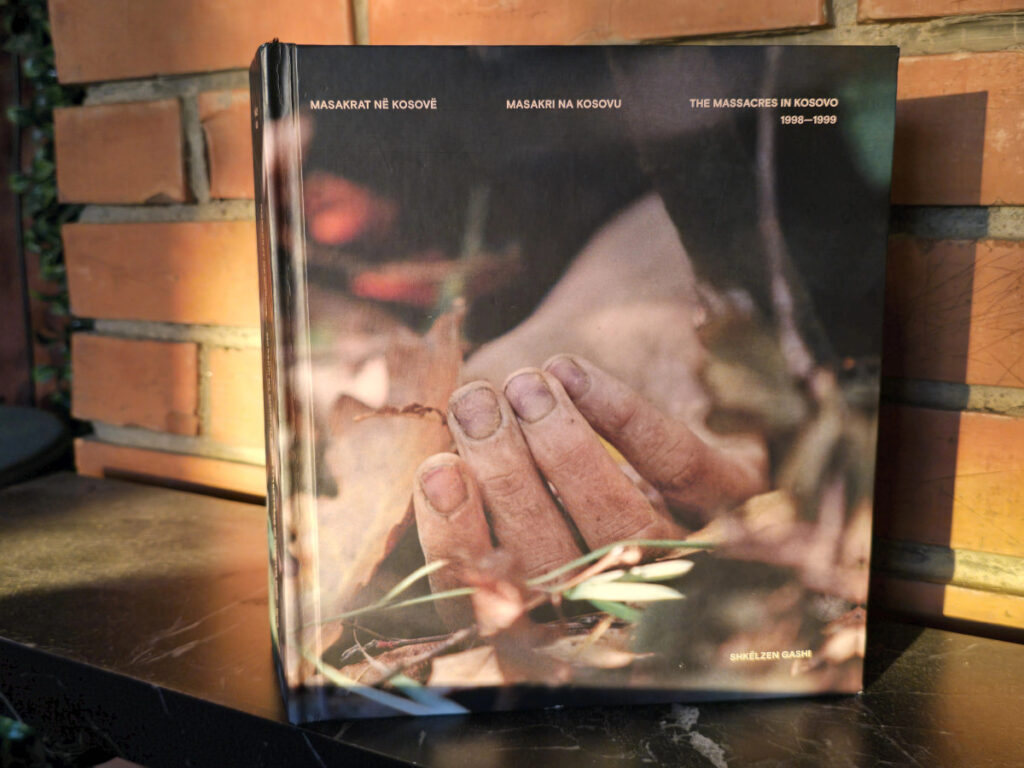
This article presents a critical reading of the book “Massacres in Kosovo 1998-1999”, by Shkëlzen Gashi.
On books about war
This year, 2025, when it will be 80 years since the end of World War II, an online study has found that about 80 books have been published about this war so far. If we distribute this number of titles evenly by dividing it by the years that have passed since the end of that war, it turns out that since the end of World War II and until today, an average of 000 books have been published about it every year. Meanwhile, for more than a century, around 1 books have been published about World War I. On the continent of Europe, where these two wars originated and where most of their biggest battles were fought, the last war in the century of the two world wars was the Kosovo War. Since then, over 000 books about the Kosovo War have been published worldwide, written, translated or edited in 50 different languages. This figure was ascertained during a study conducted over the last two years by me together with the Albanian Holocaust scholar living in Canada, Davjola Ndoja. This study of ours, conducted in 000 libraries in 7 different countries, was finalized with the publication of the book “The Kosovo War 700-28: A Selected Bibliography” – (Durim Abdullahu & Davjola Ndoja).
When this book was being submitted in its final version to prepare for publication, one of the last titles included in it was the book “Massacres in Kosovo 1998-1999”, written by publicist Shkëlzen Gashi, which went on sale in the second week of September 2024. It was published by two non-governmental organizations known, among others, for their transitional justice projects, “Admovere” and “Integra”. The author of this book, Shkëlzen Gashi, is the former executive director of the organization “Admovere”, a civil society activist and a television analyst of political developments in Kosovo. This book, with about 270 pages, was published in a trilingual one-volume edition, in Albanian, Serbian and English, which gave the book a total volume of 824 pages. This book is sold only at the “Dukagjini” bookstore in Pristina, at a price of 30 euros. As a project about the massacres committed during the war in Kosovo, this book was announced several times in public by the author Gashi and, as he explained, work on it began sometime in 2019.
On the morning of September 9, 2024, when I went to buy this book at the “Dukagjini” bookstore, while I was waiting for the book to be registered in the sales system, I learned from the bookseller that I was the first buyer of this book. Since for years I have built a private book collection with hundreds of books about the Kosovo war, hunting for war books in bookstores, at booksellers in the city, on online platforms for old books, as well as from the authors themselves, a book like this about the massacres in Kosovo could not escape my attention nor be missing from my collection. Especially since its publication had been repeatedly announced several months earlier.
I read the book “Massacres in Kosovo 1998 – 1999” within five days, taking notes in its margins and in my notebook for war books. But since it did not present any new results or any innovation in the literature of publications in this field, I did not write anything about it in public. In the following months, seeing the great publicity that was given to this book and its trumpeting as an extraordinary book for the topic it treats, I considered it useful to write this review, although aware that in the public sphere in Kosovo there is generally no welcoming atmosphere for critical readings of new publications. As a historian lecturer at the University of Prishtina who has studied the history and legacy of the 1997 – 1999 war in Kosovo for years, professional and intellectual responsibility towards this field of studies pushed and obliged me to write this text.
What does this book contain?
“Massacres in Kosovo 1998 – 1999” is a book with data on 83 massacres committed during the war in Kosovo from the beginning of 1998 to mid-1999. The book opens with a list of abbreviations, continues with a preface and then continues with an acknowledgment text, before being followed by 83 texts on 83 massacres, which is the central content of the book. The texts on the 83 massacres in question are arranged in chronological order, starting from February 28, 1998, when the massacres in Likoshan and Qirez occurred, until July 23, 1999, when the massacre in Old Grackë occurred.
In these texts, the massacres are described by focusing on the circumstances and general data about them: such as the names of the places where the massacres took place; the dates and duration of the massacres; the police, military or paramilitary structures involved in them; the number of victims broken down into statistical data on their ethnicity, gender and age of the victims; the judicial processes conducted for them in cases where indictments were filed for these massacres, etc. All of these are briefly summarized in one, two or at most three pages in Albanian, which are then translated into Serbian and English. All texts are illustrated with one, two or three photographs relevant to the respective massacres, where mainly the scenes of the massacres, the bodies of the victims, or their belongings, or their burials and graves, or their families, or their homes, or their memorials, etc. are seen. At the end of the book, four appendices have been compiled, with the following captions: “Appendix 1 – List of massacres included in this publication; Appendix 2 – List of massacres for which we have not found materials; Appendix 3 – Abductions of civilians (not included among massacres); Appendix 4 – Killings of civilians from NATO bombings (not included among massacres).”
What is a “massacre”?
In the preface to the book “Massacres in Kosovo 1998-1999”, the author explains that “of all the violations of international humanitarian law during the war in Kosovo in 1998-99, I chose massacres, because they constitute the most serious violation and because a comprehensive publication of them is missing. I documented when and where these massacres were committed, by whom, why and under what circumstances, what was the number of victims and what ethnicity, age and gender they were […] The reader should keep in mind that in order to qualify a crime as a massacre, there are several criteria that must be met. The killing must be cruel, deliberate and politically motivated, targeting a large number of individuals, especially those who are not involved in the conflict as combatants and who cannot defend themselves. Furthermore, the act must be morally unacceptable to be categorized as a massacre.”
The term “massacre” is not self-explanatory, so in every case of its use, it is necessary to accompany it with explanations as was rightly done in this case. However, massacre is not a legal category in international humanitarian law, as stated in the preface to this book. Therefore, it can never be read in any indictment that someone is accused of massacre even if the crimes for which an accused can be accused can be qualified as massacre. In international humanitarian law, there are a multitude of types of crimes committed in times of war, such as mass murder; war crimes; ethnic cleansing; crimes against humanity; genocide; murder; ill-treatment; deportation; enslavement; rape; ill-treatment of prisoners of war; torture or inhuman treatment; biological experiments; plunder of private or public property; destruction of cities, towns and villages; destruction of cultural property and many other similar or related categories.
Since the word “massacre” was first used in the 12th century, it has been given a multitude of meanings throughout history. In genocide studies, the term “massacre” has usually been defined in terms of its context. Writing about the Armenian massacres, scholar Robert Melson suggests that “massacre” refers to the deliberate killing by political actors of a significant number of relatively defenseless people.” Other scholars have used the term “massacre” to refer to killings and executions in very different circumstances, political regimes, sizes, and historical periods. Massacres were also the extermination of indigenous peoples of the Americas by Europeans, but a massacre is also a shooting in a shopping mall that results in the death of a crowd, regardless of the motive of the attacker.
Not being a legally regulated term or defined within certain fixed conditions or criteria, the word “massacre” always needs clarification and specification in relation to the contexts of its use. But the preface to the book “Massacres in Kosovo 1998-1999” does not offer much about the historical context of the Kosovo war and for an uninformed reader who knows nothing about this war, it is not understood why the state of Yugoslavia committed so many massacres and other crimes against Albanians in Kosovo. Furthermore, this book does not have a single line that would explain the final intentions of the perpetrators of these massacres nor their possible connections with the ethnic cleansing or genocide planned by Serbia in Kosovo. This is further confused by the impression that the fact that a massacre allegedly committed by the Kosovo Liberation Army (KLA) is included at the end of the book.
Although the preface briefly explains on what criteria the massacre was conceived and which apply to 83 cases of murder in Kosovo, it is not understood how 22 other cases of murder that are listed in appendix no. 2 with the note “List of massacres for which we have not found materials” were classified as massacres. It is not clear how these 22 cases of murder were classified as massacres, if no materials were found for them?! At this point, the question naturally arises as to who previously classified these 22 cases for which the author has not found materials as massacres?! Since no materials have been found, how is it known that they occurred on those dates and in those places and how is the given number of victims known: such as 22 civilians killed in Samadrexha on 27-28.3.1999; 27 other civilians in Burojë on 28-19.3.1999; 12 killed in Popovë on 4.4.1999; 11 civilians killed in Makërmal on 31.3.199; 14 others in Globar on 14.6.1999, etc.
Without theory and without methodology
In the book’s preface, the author narrates that “Inspired by the way Bosnia and Herzegovina commemorates war crimes (even with extraordinary work, sometimes carried out on a voluntary basis), I decided to identify, research extensively and fundamentally, and summarize in a single volume, the relevant data on the massacres committed during the war in Kosovo from February 28, 1998 to July 23, 1999.” But beyond this paragraph, the author does not provide any explanation of his theoretical position on this atrocious legacy and does not explain at all what the methodology followed for researching and writing this book was. Both of these are covered by a paragraph that indicates that “to compile the texts on the massacres, I took as a basis the reports of prestigious human rights organizations, such as Amnesty International (AI), Humanitarian Law Center (HLC), Human Rights Watch (HRW), International Crisis Group (ICH), Organization for Security and Cooperation in Europe (OSCE), and more rarely any others. […] After searching through various credible newspapers, magazines, books and monographs, published in the country, where more and less, we found materials for 83 massacres, which we included in this publication. […] However, for 22 mass murders we did not find materials in the aforementioned sources.”
Although the reader is warned about the high ambition of this project in the sentence where the author declares it almost as a personal mission, as he writes in the first person that “I decided to identify, research extensively and thoroughly, and summarize in a single volume, the relevant data on the massacres committed during the war in Kosovo”, four paragraphs later, it is understood that by extensive and thorough research, we are simply talking about reading books, reports, newspapers and magazines. If nothing is found among those books, newspapers and magazines as for the 22 murders mentioned above, they are simply grouped as “List of massacres for which we have not found materials”. This is because apparently no field work was done for this book. In this book, data from several books and articles have simply been reproduced, which, in the attempt to synthesize them, have ended up in a compilation of various texts taken from other books. But even those books and articles are numerically few, so few that although they are cited and reprinted in footnotes, they are not summarized as sources in a bibliographical table at the end of the book according to academic principles. Following the footnotes, it is understood that the entire book “Massacres in Kosovo 1998-1999” was written by reproducing data mainly from these books: “Book-Memory of Kosovo” compiled by the Humanitarian Law Center, led by Natasha Kandić; “Under the Power of Orders: War Crimes in Kosovo”, compiled by Human Rights Watch; “Humanitarian Law Violations in Kosovo”, also prepared by Human Rights Watch; “War Crimes in Kosovo 1998-1999 – Monograph I”, published by the Council for the Protection of Human Rights and Freedoms; the two-volume report of the OSCE Verification Mission in Kosovo, “Kosovo/Kosovo as Seen as Told”. These five books are the main sources cited in the book “Massacres in Kosovo 1998-1999”. Meanwhile, the initial claim made in “I decided to identify [the massacres]”, proves unsuccessful, since there is not a single massacre identified in this book that had not been identified earlier.
On the contrary, in the book “Massacres in Kosovo 1998-1999” a multitude of massacres committed against civilian Albanians in Kosovo, especially in 1999, are not identified, which do not even appear in the appendix “List of massacres for which we have not found materials”. To mention just a few such cases is the massacre in the village of Dobratin, where on April 27, 1999, Serbian forces killed 8 civilians, four children and four adults. Or the massacre committed in Keqekollë, Prishtina, where on April 22, 1999, at around 22:00 PM, 10 civilians were killed: seven from the Jakupi family from Orllani, two from the Krasniqi family from Grashtica and one from the Hyseni family from Bellopoja. Nor is the massacre committed in the village of Balloc, where on April 15, 1999, seven people were killed, among them the four Sejdiu brothers. Or the massacre of April 6, 1999 in the village of Miroc, where a grenade thrown among refugees killed five people, including two children from the Hajdari family, aged 10 and 13. Also missing is the massacre committed on March 25, 1999 on “Ramë Obrança” street in Podujeva, where Serbian police executed Zenel Begolli, Salih Begolli, Emin Potera, Ibrahim Potera, Xhevahir Gashi and Qazim Maçastena.
One of the problems with the book “Massacres in Kosovo 1998-1999” is that it does not list the names and personal details of the victims at all, contenting itself with simply counting them as numbers. This reduction of the victims of the massacres to statistical data makes their authenticity easily vulnerable to anyone who thinks of questioning the credibility of these sources. How can the figures with the numbers of the killed be relied upon as accurate and true, when they are not followed by their names or additional data?!
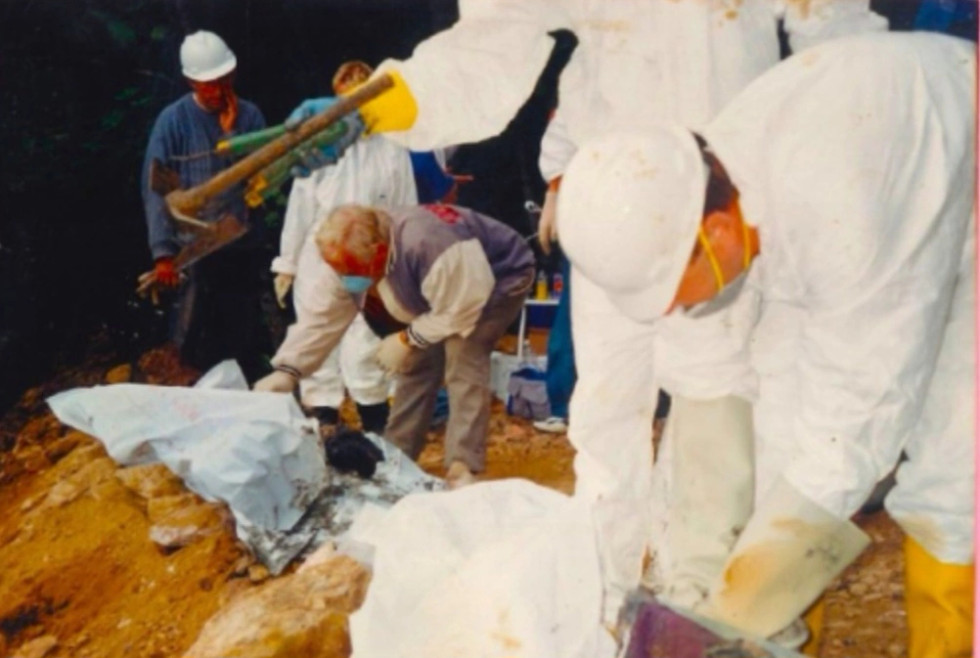 Not being widely known for the many visual sources for the Kosovo war, in some cases, massacres have been illustrated in context rather than in their specific case. For example, this is the case with the Kotlina massacre, which is illustrated with three photographs of refugees in the Kaçanik mountains, although there are at least 15 photographs showing the exhumation of victims of the Kotlina massacre in June 1999 by investigators from the International Criminal Tribunal for the former Yugoslavia, also archived at the Kosovo War Crimes Institute (KWI).
The predicament between massacre and resistance
Among the biggest omissions of the book “Massacres in Kosovo 1998-1999”, is the case of Prekaz. In the text about Prekaz, it is written that “From the HLC data, it results that the Serbian forces in this offensive have killed 59 people in Prekaz, three in Polac, two in Llaushe, two in Turiqec, one in Burojë and one in Tushilë, so a total of 68 people, of whom 40 were unarmed civilians”. Based on this logic, in the table with the graph of the massacres, the number of people killed in Prekaz is marked down to 40. In this case, the author has divided the killed out of a total of 68, into 28 armed and 40 unarmed civilians, of whom only the latter are considered victims of a massacre. According to this criterion, it is concluded that Adem and Hamez Jashari, along with their sons who fought on March 5, 1998 in their homes, were killed as fighters, while the other family members, women and children killed near them and in the same houses were victims of a massacre. Or that Kajtaz, Faik, Sherif and Ali Jashari who fought with them and others that day were also killed in combat, while their family members and cousins killed on March 5, 1998 were simply killed in a massacre committed by Serbian forces. The same logic leads to the equally illogical conclusion that Sala and Hamit Jashari who fought in their homes on those days were killed, while the other members of their family and other cousins in the neighborhood were victims of the Prekaz massacre. This division of the 40 civilian victims of Prekaz as victims of a massacre from others who were armed as two separate categories is, at the very least, a disregard for the context of the Serbian police and military operation in Prekaz during those days in March 1998. The events of the Prekaz case do not meet one of the key conditions of the way the author himself defined the massacre in the introduction, that the killed “were not involved in the conflict as combatants”. The killed in Prekaz were involved in an unwitting and conscious way in an armed and organized resistance. This includes boys and girls under the age of majority, between 13 and 18, like Besimi, Fitimi and Kushtrimi, but also others who were involved in the fighting that day. Especially after the Serbian police attack six weeks earlier, on 22 January 1998, since when the entire Jashari neighborhood and the residents of Prekaz in general had been organized into armed guards, every night, from 21:00 PM to 06:00 AM. Therefore, the above-mentioned criterion cannot serve to divide the killed in two and delineate them into two categories, since the term “massacre” is only valid if it can be referred to the overall circumstances of the case and not by selecting and taking the killed separately.
Given the fact that during those days of March 1998 in Prekaz, many men and women resisted armed mass attacks by countless troops of the Yugoslav police and army, this case cannot be simply categorized as a massacre. The war waged there in defense of their homes and homeland moves this case to another register. Otherwise, absurd and nonsensical issues arise, such as the question of whether, while Adem Jashari was a fighter who was killed fighting, what was his wife Adilja, who was killed on the morning of March 5 while delivering a bag of shells to Adem, and where should she be categorized? The armed and organized resistance of Shaban Jashari’s family and other neighbors in the Jashari neighborhood in Prekaz, excludes the possibility that the Prekaz case can be simply classified as a massacre. Moreover, it dangerously undermines the factual and well-founded account of the inspiring example for the liberation war that the Albanian people took precisely from the resistance of the Jashari family. The operation of the Yugoslav police and army in Prekaz represents an extremely complex case that cannot in any way be described as a massacre, because this would be an oversimplification of the circumstances and an extreme reduction of the possibilities of conceiving and interpreting those events in the context of the time.
However, the problems of this book do not end there. It has inaccuracies in the text about one of the largest massacres in terms of the number of victims, which occurred in the village of Krushë e Madhe in Rahovec. It is written that “On 25-28 March 1999, according to HLC data, Serbian forces killed 205 people in Krushë e Madhe, of whom eight are listed as armed persons, and 197 as unarmed civilians.” The Krushë e Madhe massacre is perhaps the massacre for which the most eyewitness testimonies have been recorded to date, as professors and students from the Department of Anthropology at the University of Prishtina carried out a project during which they interviewed 150 survivors and witnesses, these interviews published by the National Library of Kosovo in 10 volumes. This study results in the fact that on March 25, 26 and 27, 1999, 244 people were killed in Krushë e Madhe, of whom 206 were from the village of Krushë e Madhe and 35 from the surrounding villages.
Equally problematic is the curation of the approximately 200 photographs that illustrate each massacre throughout the book. This is because, for reasons incomprehensible to the reader, all of those photographs have been decolorized and turned into black and white. This interference with their originality undermines the authenticity of the respective photographs as documentary sources. Add to this the fact that perhaps due to a lack of widespread recognition of the numerous visual sources for the Kosovo war, in some cases, the massacres have been illustrated in context and not in their specific case. For example, this is what was done with the Kotlina massacre, which is illustrated with three photographs of refugees in the Kaçanik mountains, although there are at least 15 photographs showing the exhumation of the victims of the Kotlina massacre in June 1999 by investigators of the International Criminal Tribunal for the former Yugoslavia, also archived at the Institute for War Crimes in Kosovo (IKKL).
Finally, the last text of this book concerns a case that has never been explained, apparently in the village of Grackë e Vjetër in Lipjan, where 14 unarmed Serbian civilians, all men, were killed. The case in Grackë e Vjetër is truly a trap for the reader, as it occurred on July 23, 1999, more than a month after the end of the war and the withdrawal of Serbian armed forces from Kosovo. This last chapter of the book almost turns its entire course upside down, since as it is written in it “the Serbian villagers accused the KLA of the murders”. The quotation of the words of the former president of Kosovo, Hashim Thaçi, accompanied by photographs when he visited the village of Grackë in 2016 and paid homage in front of the memorial plaque, leaves room for creating wrong impressions about the history of events in Kosovo during 1999. And this is easily possible since neither this text, nor the entire book, offers a broader background of the historical circumstances of these events.
Returning to the beginning of the last paragraphs of the preface, it is read that “The book “Massacres in Kosovo 1998-1999” is being published for several important reasons. It aims to pay homage to all victims of the Kosovo war from 1998-99, regardless of ethnicity, region, language, religion, gender, social status or political orientation. The book also honors the families of war victims and contributes to the broader efforts for post-war transitional justice. Furthermore, it aims to serve as an educational and informative resource for future generations and to help preserve collective memory. Finally, the book is being published with the aim of helping to shape a more accurate public perception of Kosovo.”
But when reading this book, it is understood that with its content and level, it does not achieve any of these goals. The book “Massacres in Kosovo 1998-1999” cannot pay homage to the victims nor serve as an educational and informative source because it has many inaccuracies and incompleteness, it does not present any serious and in-depth study but only a work compiled from a few other books, without theorizing, without methodology, without bibliography and without comparisons of sources. Even less, it cannot “help in forming a more accurate public perception of Kosovo”, because by reducing the circumstances of the massacres to 200-400 words, without the names of victims and only with numbers, without documentary sources, without presenting the broad historical circumstances and with many other shortcomings and gaps, it only deepens them by textualizing a multitude of half-baked data and unprofessional texts about the massacres in Kosovo committed during 1998-99 and about the long history of the Albanian-Serbian conflict.
As for the public announcement that all the money raised from the sale of this book will be used to build an online website about the massacres in Kosovo, this is the height of the frivolity of this entire project. To create an image of this, it is enough to analyze a Facebook post on the page of the organization “Admovere” that also published this book, made on April 20, 2023, when the book was still being written, which said: “Help for information about the massacres in Fushë Kosovë, March 26, ’99 and April 1, ’99”. Research and study of the massacres committed in Kosovo cannot be done on a voluntary basis and on the randomness of online posts, because this cannot be serious or scientific methodology. However, beyond the publicity given to this book and the sales or distribution it may have, in the vast literature of publications on the war in Kosovo, it will be stacked among many other poorly conceived, poorly written and edited, and frivolous books.
The author is a historian at the University of Pristina.