
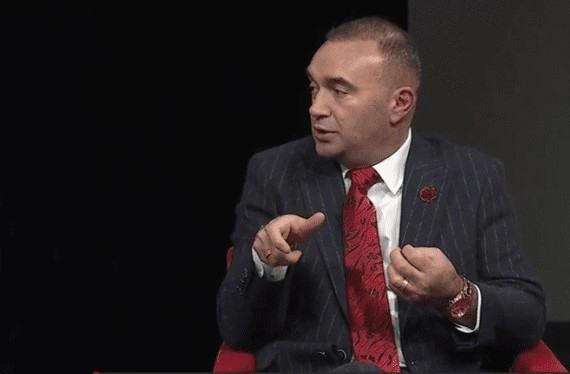
The Kosovo Chamber of Commerce has once again requested from the institutions the suspension of the decision to enter the open energy market for large businesses, as, according to it, this will result in massive bankruptcies. The President of the Kosovo Chamber of Commerce, Lulzim Rafuna, said that this decision will affect the contraction of domestic production. According to him, domestic production has already started to shrink
Domestic production has begun to shrink, according to the Kosovo Chamber of Commerce. This is expected to worsen from June 1st, when large businesses are expected to enter the open energy market, being obliged to choose their own supplier, chamber leaders have said.
The reason for this, according to the president of this institution, Lulzim Rafuna, is the 200 percent higher price offers they received for energy supply.
“The data is showing us that Kosovo’s production is falling. Today, when they have not yet entered the free market, it is falling. The market is not good, not only in Kosovo, but also in the EU market. What is worrying is that inflation is increasing and will hit the citizens of Kosovo. Even though we closed 2024 with 1.6 percent, immediately for four months, inflation has started to trend upwards. And it will continue to increase even more if this request to enter the free market is continued,” Rafuna said at a press conference on Tuesday.
KOHA has contacted some of the 19 companies licensed for supply to see what offers they have made to businesses, but they have said that they are still in the bidding phase and that they cannot talk about the offers.
They haven’t even talked about whether they will be able to provide a stable energy supply for large businesses.
But KCC Chairman Rafuna has repeated the request to the institutions to suspend ERO’s decision to enter the open market for at least another year.
“When we are on the trade balance of goods, these are official data that are very worrying for all institutions of our country and for all political parties present in the Assembly. We demand that institutions be established as soon as possible to take steps to save business, to save the economy of our country… Imports have exceeded the value of over 2 billion for four months, while exports have fallen to 275 million. For these 4 months, the balance has deepened by over 18.83 percent, approximately 19 percent, and this is very worrying, because our production is losing ground,” he said.
Over 1 businesses must choose their own electricity suppliers from June 1st.
But businesses have requested a further postponement, even though such a decision has been postponed since 2017.
The KCC has requested the Ombudsman to address the Constitutional Court to attack the ERO’s decision, due to the country’s economic situation and the inappropriate time to enter the open market.
The American Chamber of Commerce (AACC) has also warned that going public at this time will create difficulties for businesses.
“We have a de facto monopoly position as long as 18 suppliers are unable to provide electricity or operate properly compared to one of the suppliers who probably has the greatest ability to both negotiate and supply energy. Businesses largely think that they will face higher tariffs, when in fact the exit effect and the possibility of finding suppliers in the free market should offer cheaper prices,” said the president of the American Chamber of Commerce of Kosovo, Arian Zeka, a few days ago.
And in a survey that OEAK conducted with its members, according to Zeka, about 80 percent of them stated that liberalization will have a negative impact on business operations.
“Over 70 percent of them expect to lose their competitive ability to a certain extent, especially against other countries in the region. We must bear in mind that Kosovo is still a small market and any impairment of competitive advantage can make companies more fragile in relation to the competition they face,” he stressed.
According to Zeka, ERO’s decisions were accompanied by shortcomings, as according to him, businesses should have been warned at least 1 year in advance to prepare for the proper creation of energy tariffs, as well as licensed suppliers to operate in the market.
KOHA has reported that the Energy Regulatory Office has not clarified how the entry into the open market of consumers with over 10 million euros in turnover or with over 50 employees will affect energy tariffs.
The Institute for Development Policy has also criticized this process. According to it, the timing of the announcement of the decision by ERO raises doubts about the transparency and purpose of this step, as no clear analysis has been provided on the impact that the removal of these customers will have on the tariffs of the remaining customers.
“Despite the importance of liberalization for competition and market development, the way this process has been managed by ERO, with constant delays and uncertainties, seriously undermines consumer confidence and the market’s ability to adapt effectively and sustainably,” the INDEP report states.
Also raised as a concern was the issue of energy stability that will be offered to consumers who enter the open market, since according to experts, the cause of bottlenecks when the power is cut off is the interruption for the entire region.