
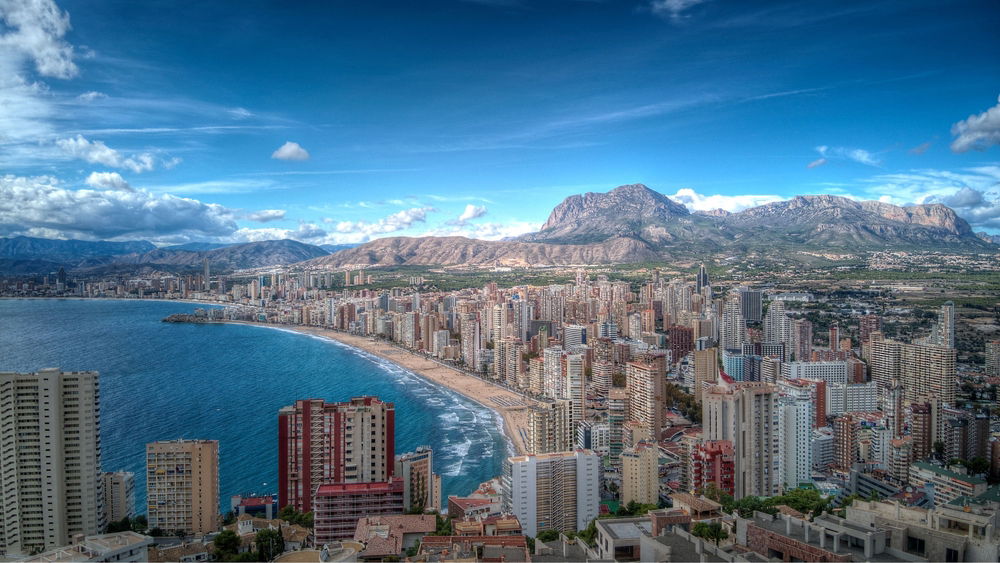
Benidorm was up until the 1960s a tine fishing village | Photo: Wirestock Creators / Shutterstock
It’s hard to believe that, in the early 1960s, it was just a small fishing town with a population of fewer than 6,300. Today, it is Spain’s fifth-most-visited city, and in this article, we will tell you why. In 2023, this beach city in the province of Alicante received about 2.3 million tourists.
It is known as the “New York of the Mediterranean,” because it has over 65 skyscrapers, which is surprisingly more than any other city in Spain, including Madrid and Barcelona. It is today the skyscraper capital of the world by highest density per inhabitant, and second per square metre, preceded only by New York. It also boasts the highest hotel in Europe, the Bali.
“Sandwiched between the mountains and the sea, the only way to accommodate the increasing number of tourists was to build upwards,” CNN said about the city. Yes, Benidorm, a city with a history dating back to the time of the Iberians and Romans. However, it was officially founded as a town in 1325 by Admiral Bernat de Sarria during the reign of James II of Aragon. Once a tiny fishing village, Benidorm’s population is approximately 80,000.
Most Read on Euro Weekly News
CNN interviewed Ramon Martinez Martinez recently. He told the global news outlet that he is originally from Madrid. However, in 1964, Martinez Martinez was a 23-year-old struggling painter who decided to journey over to Benidor in search of new opportunities.
The small seaside town was best known for its tuna fish and orange groves when Martinez arrived. However, Benidorm was beginning to take off as a tourist destination, providing him and his family with a pass to a more prosperous life.
“Everyone came, as my mother and father did, looking for new opportunities,” said Jaime Martinez Gallinar, Martinez’s son and CEO of the Hoteles Benidorm Group of three four-star hotels, told CNN in an interview from an office high in the Benidorm sky. “It was pretty much the story of the pioneers of the American West.”
Martinez first found employment painting the hotels that had begun popping up along Benidorm’s coastline. The owners of the new buildings often didn’t have the cash to pay him, so they would offer him shares in their businesses or a couple of apartments in their buildings.
‘They love tourists here’
Unlike other Spanish cities, locals have not protested against the growing flow of tourists or the ongoing development. They have not expressed a single word against the notoriously wild and boisterous tourist community. Nor have they complained about the increasing issue of rising rents and house prices.
“We love tourists,” Gallinar said. “During Covid, it was like a ghost town; it was so sad. We discovered how much we depend on the people who come here. It’s not like Barcelona; here, everyone is welcome.”
Gallinar is proud of Benidorm’s pubs, which stay open until 3 am, and the melting pot of Spaniards, Britons, and other nationalities enjoying their drinks and the unique atmosphere of a town unlike any other.
“People think Benidorm is for old people, for British people, for hooligans,” he said. “There is a stereotype that Benidorm is a cheap place. (But) there is a Benidorm that nobody talks about.”
However, Gallinar is aware that tourism is threatening to become too big for the landscape, acknowledging that “the challenge now is how to grow with the natural environment.” It’s an issue that authorities will need to address because, for now, demand for the Benidorm experience is growing and fast.
Why Benidorm became a tourist hotspot
Well, according to a University of Alicante 45-page study on Benidorm, there are five key reasons.
- Benidorm has a very midl weather. Summers are clear, hot, and muggy, although the temperature never rises above 31ºC. The city is sunbathed about 300 days a year, and its average yearly temperature is 19º. It rarely rains—45 days during the winter, during which temperatures range from lows of 8º to highs of 13º. January is the coldest month of the year.
- Local entrepreneurship. Only 4 per cent of the 140 hotels are owned by international corporations. National firms own an additional 4 per cent. Approximately 30 percent are from Benidorm regional-level firms. Twelve per cent are owned by local companies, while 50 per cent are owned by independent firms.
- The Benidorm business community and government have successfully established and nurtured loyal, durable, and stable relationships between local hotels and travel companies, as well as governments such as those of the UK, Norway, Netherlands, and others.
- The beach city offers a wide range of great amenities for tourists of all tastes, including a safari, world-class golf courses, water parks, theme parks, and many other attractions. The Costa Blanca party city is home to over 2,000 bars, about 350 restaurants, 160 disco-pubs, and nearly 150 coffee shops.
- Nearby destinations:
- Las Fuentes del Algar – Natural waterfalls, crystal pools, cliff jumps—Nature’s waterpark. 25 mins from Benidorm.
- Limon Express (Vintage Train Ride) – Old-school train through dreamy coastal views and tunnels. Starts in Benidorm or nearby. Best paired with a stop in Altea or Denia.
- Altea – Boho vibes, cobbled streets, beach chill. Whitewashed houses, blue-domed church, artsy vibes. A postcard come to life. 20 mins away.
- Guadalest – Cliff-top castle town, tiny museums. And panoramic mountain views 30 30 mins out
- Villajoyosa – Colourful fishing town plus chocolate heaven. Low-key and local. 15 mins by car or tram.
- Calpe – Home to the Peñón de Ifach rock — hike it if you dare. Beach plus views. 30-35 mins