
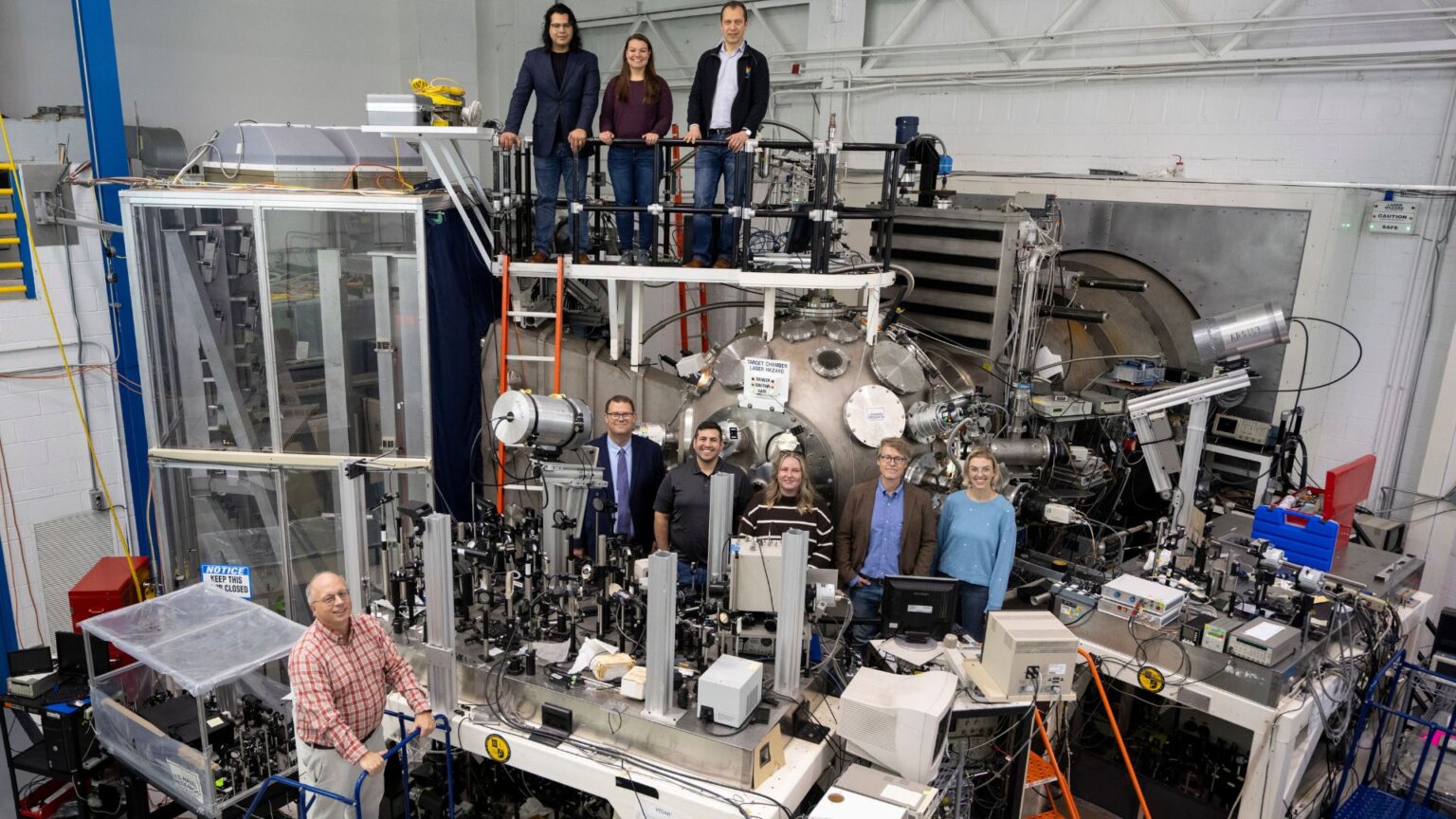
To advance nuclear weapons, the US Naval Research Laboratory (NRL) is changing the focus of its world’s most powerful krypton-fluoride NIKE laser facility.
The facility, used to support missions run by the Department of Energy (DOE), will now help maintain the US nuclear weapons stockpile.
The facility will support the Department of Defense (DoD) and its goals for nuclear defense.
Advancing nuclear weapon with lasers
According to a press release by the US Navy, NIKE will now focus on helping the DoD evaluate and strengthen US nuclear deterrence capabilities.
This means that the US will now use the laser to simulate the extreme physical conditions (heat, pressure, radiation) that nuclear weapons and delivery systems (like missiles and bombers) experience during operation or in hostile environments.
The laser will also test the survivability of nuclear platforms. By creating precise shockwaves and controlled high-energy environments, NIKE will be used to test how well nuclear systems and components survive under these stresses.
This helps ensure US weapons systems remain reliable and functional under combat-like conditions.
In addition, the laser’s capabilities allow researchers to study physical phenomena relevant to nuclear explosions and space environments.
NIKE will help fill in essential knowledge gaps about how materials and systems behave during nuclear events, something essential for maintaining a credible nuclear arsenal without actual testing.
NIKE will continue to be used to refine high-speed imaging and spectroscopy tools (like x-ray diagnostics) to analyze what happens inside nuclear and high-energy experiments.
Utilising plasma
The NIKE laser at the NRL creates and studies plasma, a super-hot, electrically charged state of matter.
Plasma occurs in extreme environments like nuclear explosions and stars.
Using powerful laser beams, scientists can recreate these extreme conditions in the lab and learn how materials and systems behave under intense pressure, heat, and radiation.
The Plasma Physics Division at NRL leads this research. They focus on both experiments and computer simulations to study how plasmas behave.
Their work includes fusion energy, nuclear effects, and space weather.
They also develop advanced tools to measure and analyze what happens during high-energy experiments, which is important for improving national defense technologies.
By studying plasmas with the NIKE laser, researchers help ensure that US nuclear weapons and related systems can survive and work properly in extreme situations.
This research also supports other areas like fusion energy, high-speed weapons, and materials science.
World’s most powerful laser
The NIKE laser, built in 1995, is the world’s most powerful krypton-fluoride laser at a wavelength of 248 nanometers with 2-3 kilojoules of energy.
“These unique capabilities enable researchers to generate strong, stable shock waves and create exceptionally clean experimental conditions for studying extreme physical states of matter,” said Jason Bates, head of NRL’s Laser Plasma Branch.
It creates very smooth, high-energy laser beams, which researchers use to study extreme conditions like those in nuclear explosions or inside stars. It’s especially good at creating clean and stable experimental setups.
For many years, the NIKE facility helped support the National Ignition Facility (NIF), which recently made a breakthrough, getting more energy out of a fusion reaction than the energy used to start it.
NRL scientists also developed important tools and technologies that are now used in other government laser programs.
Now, NRL is working closely with the US Air Force to use NIKE in studying how nuclear weapons and related systems behave in extreme environments.
“This partnership between NRL and the Air Force Research Laboratory represents a vital leap forward in our ability to simulate and understand the extreme environments that nuclear assets must navigate,” Bates said.
“NIKE’s unique laser and diagnostic capabilities are unmatched, enabling us to close critical gaps in assessing the survivability of our platforms.”
With China and Russia developing similar laser systems, the US wants to stay technologically ahead.
Upgrading and maintaining NIKE is part of a strategy to prevent falling behind in this area of defense research.