
4-minute read

NJ Turnpike history and facts you didn’t know: Video
The New Jersey Turnpike is the most heavily traveled toll highway in the U.S. In 1951, it became the third modern-day toll road in the nation.
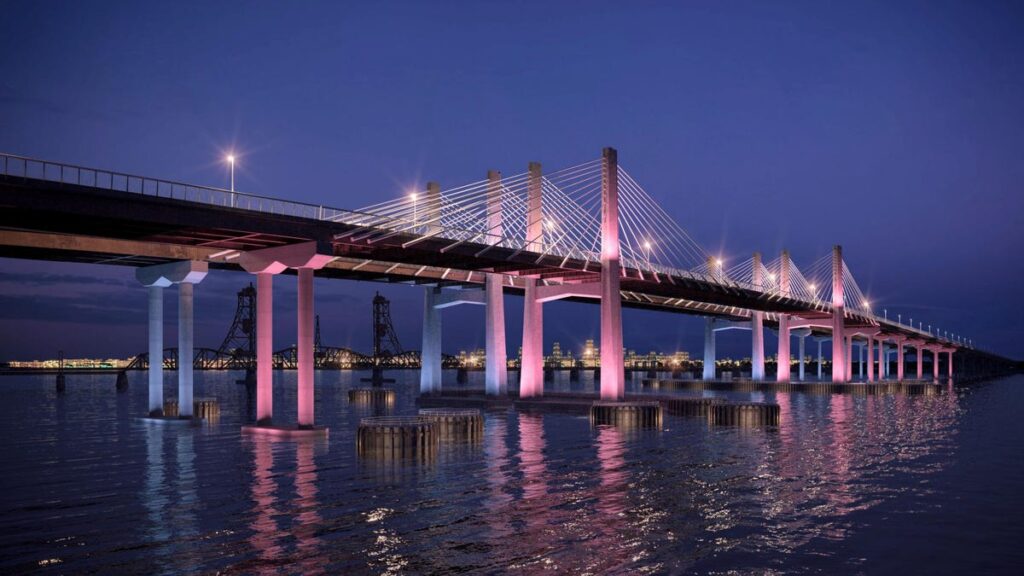
- The first phase of the project, which is from Exit 14 to 14A and connects Newark and Bayonne along Route 78, will replace the current four-lane span over Newark Bay with a twin-span, eight-lane bridge
- Later phases, which have not been approved yet, would replace bridges and highway from 14A to the Holland Tunnel, increasing the number of lanes from four to six along certain segments.
The U.S. Coast Guard said it found there would be no significant environmental impacts from the $6.2 billion first phase of a controversial Newark Bay Bridge replacement and widening project proposed by the New Jersey Turnpike Authority.
The Coast Guard reviewed the federally required environmental documents needed before permits can be secured for construction on the project, which is expected to start next year. The U.S. Army Corps of Engineers will also have to sign off on the project, and its finding is expected in the coming months.
The first phase of the project, which is from Exit 14 to 14A and connects Newark and Bayonne along Route 78, will replace the current four-lane span over Newark Bay with a twin-span, eight-lane bridge.
Story continues below photo gallery.
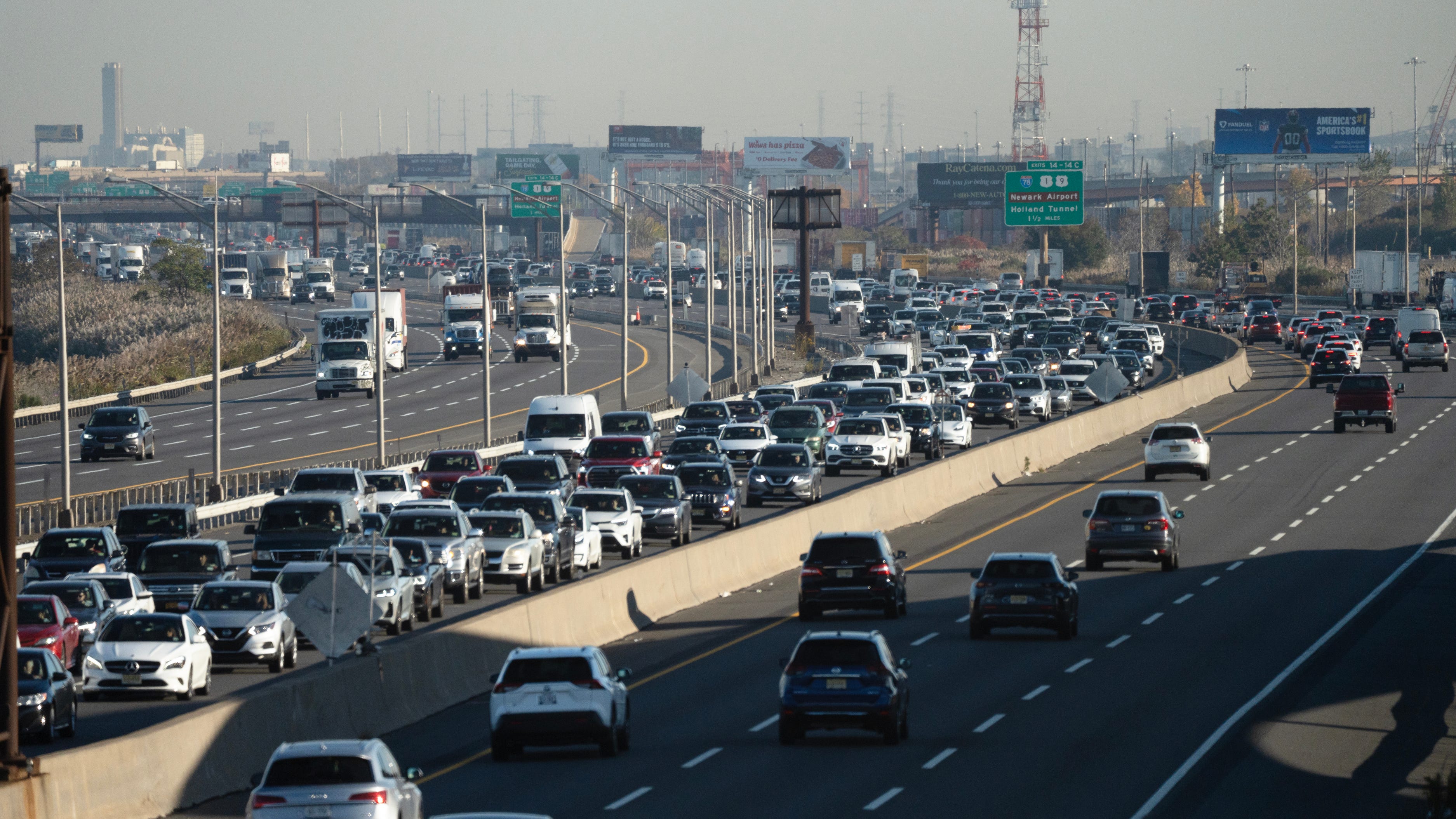
Later phases, which have not been approved yet, would replace bridges and highway from 14A to the Holland Tunnel, increasing the number of lanes from four to six along certain segments.
Lisa Navarro, supervising engineer at the Turnpike Authority, said this project is urgently needed because of “severe deterioration” and that the main focus of the project is safety.
“There’s constant maintenance and repair work” on the current bridge, Navarro said during a call with reporters May 7. “From 2019 through 2024, there was not a single month without a lane closure.”
Questions raised about scope of the project
But residents in Hudson and Essex counties, as well as environmentalists and some lawmakers, have questioned why the Turnpike Authority is expanding the size of the bridge instead of just addressing the safety concerns. The Turnpike Authority said the expansion is needed to address current congestion, especially near the ports. However, the authority’s data predicts the project will increase traffic more than if it opted not to expand the highway.
Mayor Ras Baraka of Newark and Jersey City Mayor Steve Fulop — both of whom are running in this spring’s Democratic primary for governor — have come out against the project or questioned its scale.
Asked how the authority would handle a possible cancellation or downsizing of the project if a new governor chooses to do so, Navarro said, “We would figure out what the question is and analyze it and then figure out what we would have to do.”
“Safety would always be our top priority,” Navarro said.
Turnpike Authority has five years to start and eight to finish project
Once the project is permitted, the authority has five years to commence construction and eight years to complete construction, with the ability to seek extensions.
Residents of the Greenville section of Jersey City have raised concerns about pollution caused during construction. In response, the Turnpike Authority has said it will have air quality, noise and vibration monitoring systems in place and will provide public reporting of the results.
The agency will also prioritize Tier 4 construction equipment, which is the lowest-emission class of vehicles.
If certain pollutants, such as particulate matter, pass a certain threshold, then Dewberry, a subconsultant on environmental issues for the project, will work with the contractor to improve the air quality, said Jim Heeren, a Dewberry associate vice president.
Ways to do that include “wetting down a construction site” or using a DustBoss machine, Heeren said, which uses water through hoses or misters to help “reduce dust so the particulate is not airborne and kind of keeps it contained.”
Navarro said this kind of proactive monitoring is “above and beyond anything we’ve done that I’m aware of at the authority.”
El Sol v. Sanzari
Meanwhile, the Turnpike Authority will continue spending millions to maintain other portions of the largely elevated highway. The program as a whole is expected to cost $10.7 billion to replace 29 bridges and expand parts of Route 78 along 8 miles of highway that link the Holland Tunnel to Jersey City, Bayonne and Newark.
One such contract is an $80.7 million award to Joseph M. Sanzari Inc. to repair 11 bridges, including median replacements, redecking, drainage and lighting improvements.
This contract has been the subject of intense scrutiny.
Sanzari — whose chief operating officer is Paul Sarlo, a state senator from Wood-Ridge who chairs the powerful Senate budget committee — was chosen by the Turnpike Authority last year even though its bid was $10 million higher than the lowest bid of $70.8 million, which came from El Sol Contracting & Construction Corp.
The Turnpike Authority disqualified El Sol over what it described as an “incurable” error, saying its content of surety, or COS, was “invalid” because a power of attorney must accompany the COS.
Liberty Mutual Insurance Co., which provided the surety for El Sol, wrote to the Turnpike Authority’s director of law, Thomas Holl, that it would amend the language to the authority’s liking. Liberty Mutual also cited 13 recent instances when El Sol was awarded contracts by the Turnpike Authority with the same language and process.
After a bid protest hearing, Holl upheld the authority’s award to Sanzari. El Sol then took the matter to the appellate division of New Jersey’s Superior Court, which overturned the Turnpike Authority’s decision. The Turnpike Authority appealed that, and on May 5, the Supreme Court of New Jersey upheld the Turnpike Authority’s decision to award Sanzari the contract and dismiss El Sol’s bid.
Associate Justice John Jay Hoffman, who wrote the majority opinion, said El Sol did not prove the Turnpike Authority acted in an “arbitrary, capricious, and unreasonable manner.” And despite the 13 similar instances cited by El Sol, the Turnpike Authority “was bound to apply the law” when it discovered the flaw, Hoffman wrote.
Four of the Supreme Court justices joined Hoffman, including Chief Justice Stuart Rabner.
Justices Douglas M. Fasciale and Fabiana Pierre-Louis dissented, saying the Turnpike Authority changed its specifications after the bid documents were filed.
Plus, “the NJTA indisputably accepted identical bid bond documents from Liberty Mutual on 13 other projects over the course of two years without ever suggesting that its submissions were deficient … the NJTA therefore knew the [content of surety] here was valid,” Fasciale wrote in the dissenting opinion.
This is the second recent high-profile instance of the Turnpike Authority awarding a contract to a high bidder. Last year, the authority awarded a $1.7 billion contract to TransCore to take over E-ZPass services, $250 million more than the lowest bidder, Conduent. Conduent ranked lower in the agency’s technical scoring.