
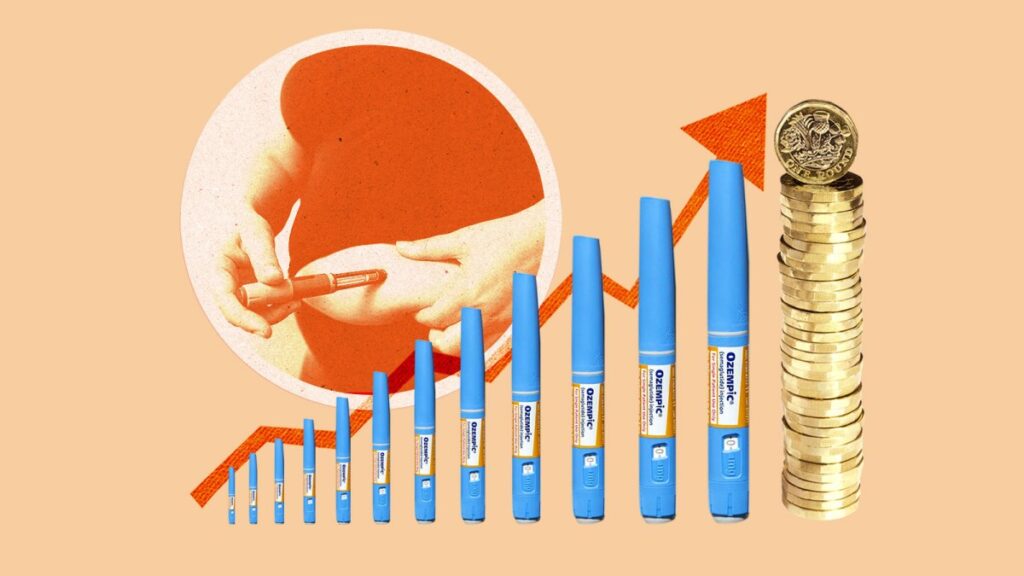
Giving obese people free weight-loss jabs on the NHS could boost the economy by £5 billion a year, research suggests.
Drugs such as Ozempic and Wegovy were found to significantly increase productivity in the workforce, in part because those taking them were fitter and had fewer sick days.
Wes Streeting, the health secretary, said the “important” research highlighted the potential for the drugs to “get unemployed Britons back to work”.
Ministers are examining ways to make weight-loss jabs available to millions more people on the NHS, including via apps and over the counter at pharmacies. Treasury officials are also holding talks on their economic benefits.
Currently the NHS rollout is limited to about 50,000 people a year at specialist weight-loss clinics, although four million people with a body mass index higher than 35 are eligible. A BMI over 30 is classed as obese, and 40 or above is classed as severely obese.
The medications are also available privately for about £200 a month and are taken by about 500,000 in Britain.

Semaglutide, sold as Ozempic and Wegovy, was made available on the NHS in 2023
STEVE CHRISTO/CORBIS/GETTY IMAGES
The study, presented at the European Congress of Obesity in Malaga, Spain, was the first to assess the economic benefits of a type of appetite suppressants known as GLP-1 agonists.
Analysts at the consultancy Lane Clark and Peacock used a model developed by the Department of Health to see how the drugs improve workforce productivity.
Using data from 2,600 people on clinical trials of semaglutide — sold under the brand name Ozempic as a treatment for diabetes or Wegovy for weight loss — they estimated that the medications provided an annual productivity boost equivalent to £1,127 per person.
The drug helped each patient avoid five sick days a year on average, and enabled people to carry out an extra 12 days of unpaid productivity, such as volunteering or childcare, saving the state resources.
• I used to go to Weight Watchers — but I’ve switched to fat jabs
In total this would equate to an extra £4.5 billion a year in British economic productivity if the four million people eligible for the drug on the NHS could have it.
Streeting said: “These drugs could have colossal clout in our fight to tackle obesity and, in turn, get unemployed Britons back to work. We will carefully consider the results of this important research.”
He said obesity was weighing down on our economy and the drugs would be a game-changer for millions.
He added that the NHS would trial new approaches and digital technologies to help patients get medicines faster.

Ozempic is used to treat diabetes
MARCUS BRANDT/DPA/AP
The analysis found that the biggest economic benefit would be for the working-age population, since obesity is linked to high rates of chronic diseases that keep people out of work.
Robert King, the study author and a senior health economist at LCP, said that even a small economic gain from making weight-loss drugs more widely available would “stack up to a large impact at the population level”.
Professor Jason Halford of the European Association of the Study of Obesity said that weight-loss drugs could have a “dramatic impact on the economy”.
“A booming economy will produce revenues which can be put back into the NHS,” he said. “We’re not going to deal with cancer, we’re not going to deal with cardiovascular disease and not going to deal with type 2 diabetes unless we deal with obesity.”
Halford said employers might also want to support staff to get weight-loss injections such as Wegovy and Mounjaro privately as a way to boost workplace productivity and revenues.
• How does Wegovy work for weight loss?
Ministers were being urged to overhaul the National Institute for Health and Care Excellence (Nice) so that it incorporated the “broader economic impacts” of weight-loss drugs into its decision making, which could speed up the pace of the rollout.
Dr Charlotte Refsum, director of health policy at the Tony Blair Institute for Global Change, said: “Obesity places an intolerable strain, not just on our health but on our health system, our benefits system and our economy more widely.
“Tackling obesity through faster, broader access to GLP-1s should be a key priority for any government looking to drive both health and wealth in the economy.”
A separate study, also presented at the conference, found that providing weight-loss drugs via an app was a convenient and quick way to scale up the rollout to millions of patients.
Researchers at the University of Warwick analysed data from 1,666 obese NHS patients in England who received Wegovy through the weight-loss app Oviva.
After six months on the programme, patients lost 8.5 per cent of their body weight on average, similar to the weight lost during clinical trials when patients had in-person care.
The trial found that 41 per cent of patients were working full time when they started on the drugs and 13 per cent were unemployed, which researchers said demonstrated the “urgent need” to speed up the rollout to help people get back to work.
Lucy Jones, the Warwick University study author and chief clinical officer at Oviva, said: “People living with obesity, particularly high levels of obesity, are about twice as likely to be off work.”
She said the model of providing weight-loss jabs via an app could be “scaled up at a fast pace” to meet the needs of the four million people eligible for the drugs on the NHS and make it easier to access care.
Felix Schirmann, the co-author and Oviva scientific director, said: “[Digital access to the drugs] will support patients to get healthier and it will allow them to get back to work, have fewer diseases down the road and then ultimately, all of this will decrease cost for the system.”