
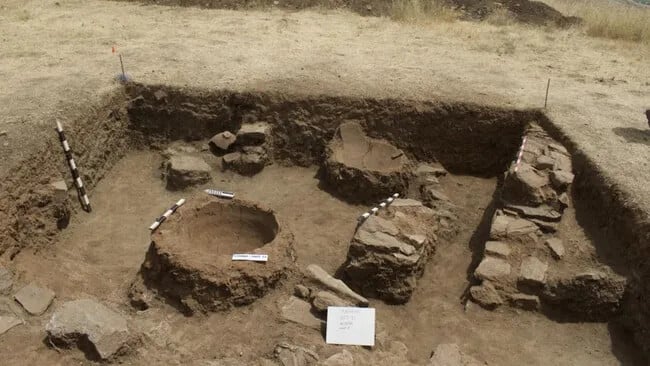
Archaeologists have uncovered the ruins of the ancient city of Lygos in North Macedonia, potentially the birthplace of Eurydice I, mother of Philip II and grandmother of Alexander the Great.
A team from Humboldt Polytechnic University of California, in collaboration with the Institute and Museum of North Macedonia, announced a significant discovery in the Grandiste area near the village of Chernobuchi. The findings may be linked to Alexander the Great.
Researchers believe they have located the ruins of the ancient city of Lynkestis, also known as Lygos, the capital of the Kingdom of Lynkestida. This kingdom was conquered by Philip II of Macedon, Alexander’s father, in 358 BC.
According to a statement from Humboldt Polytechnic University, recent excavations at Grandiste have revealed a far more significant ancient settlement than previously thought. Initially considered a military outpost built to defend against Roman attacks, new evidence suggests a thriving city dating back to at least 360 BC, much older than scholars had anticipated.
The acropolis alone spans at least seven acres. Excavations have uncovered stone tools, coins, a rare clay theater ticket, pottery, toy fragments, and weaving tools, all pointing to a vibrant settlement.
Archaeologist Nick Angelov suggests the site could be the lost capital of the Kingdom of Lynkestida: “All evidence indicates this is Lygos, the capital of Lynkestida,” he said. “This discovery is significant, revealing the complex networks and power structures of ancient Macedonia, especially given its location along trade routes to Constantinople. It’s even possible that historical figures like Octavian and Agrippa passed through this area en route to confront Cleopatra and Mark Antony at the Battle of Actium.”
Lynkestida, also referred to as Lygos, was an ancient region of Macedonia inhabited by the Lynkestians. According to Hecataeus, they were Molossians, while Thucydides identified them as Macedonians. Inscriptions from the region are written in a Doric dialect. Lygos is considered the likely birthplace of Eurydice I, daughter of Sirras and Irra, and granddaughter of Arravaeus, king of Lynkestida. Eurydice’s royal family belonged to the Doric Bacchiadae tribe, known for practicing strict endogamy and avoiding marriage with foreign tribes. This discovery sheds new light on ancient Macedonian history and offers insights into the daily life and culture of the period.
Using LiDAR (Light Detection and Ranging) technology, researchers identified a fortified city with a citadel, a textile workshop, and numerous archaeological finds, including coins, pottery, and toys. The discovery of a clay theater ticket, a rare find in North Macedonia, suggests the presence of a theater in the region. Based on the fortress’s size, Angelov estimates that Lygos housed up to 10,000 people at its peak. “LiDAR technology has shown that the fortress was designed to enclose an entire city,” he explained. “We see the full range of infrastructure needed to sustain a city within fortified walls during an attack, particularly from Rome.”
Researchers plan to continue excavations immediately, aiming to uncover further evidence about the region’s history and culture.
Before their submission to the Macedonian Kingdom, the Lynkestians had a distinguished history with their own royal dynasty and were known for viticulture. The most significant city of Lynkestida was Heraclea, founded by Philip II south of Monastir (modern-day Bitola) in 358 BC to control Illyrian raids.
The Grandiste region, with its rich history and archaeological discoveries, is emerging as a key center for understanding ancient Macedonia. The collaboration between international researchers and growing interest in the area may lead to further discoveries, enriching our knowledge of the region’s ancient history.
Source: Euronews, Humboldt Polytechnic Institute of California