
Norway hosted the leaders of nine fellow NATO-member countries in the alliance’s core North Atlantic region this week, all of them keen to coordinate their security and defense needs. Several made it clear they don’t trust Russian President Vladimir Putin, that they all support Ukraine and hope they can trust US President Donald Trump.
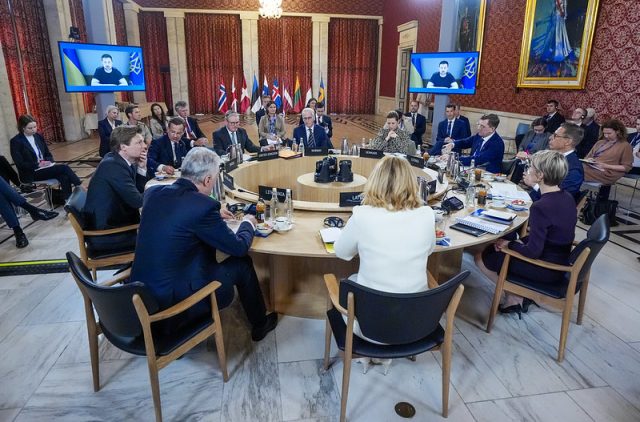 Joining the Joint Expeditionary Force summit in Oslo via video link on Friday was Ukraine’s president Volodomyr Zelensky. He still needs all the help he can get, but could also finally report signs of some new support from the unpredictable US President Donald Trump. PHOTO: SMK/Lise Åserud/NTB/POOL
The prime ministers and presidents of Norway, Sweden, Denmark, Iceland, Finland, Latvia, Lithuania and Estonia all share Nordic and Baltic ties, are good neighbours and have their individual reasons for viewing Russia as a major threat. They work together through an alliance within the NATO alliance that’s called the Joint Expeditionary Force (JEF), to enhance “practical and flexible cooperation” among the Northern European countries, all of which are now NATO members.
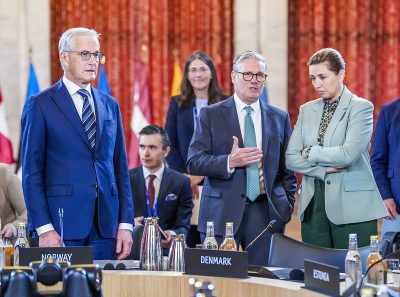 The prime ministers of the UK and Denmark, Keir Starmer and Mette Frederiksen at right, shared concerns at the summit. At left, Jonas Gahr Støre. PHOTO: SMK/Lise Åserud/NTB/POOL
The UK and the Netherlands are also taking part in JEF, with British Prime Minister Keir Starmer joining the summit in Oslo while a British frigate was tied up not far from the Norwegian defense ministry. The Netherlands’ prime minister and defense minister also joined in, first at a dinner at Norwegian Prime Minister Jonas Gahr Støre’s official residence Thursday evening and then for a roundtable discussion at the Oslo City Hall on Friday.
They all arrived at City Hall Friday morning, made some opening remarks in the alphabetical order of their countries and answered a few questions in the room where the Nobel Peace Prize is awarded. “It’s nice to be back,” said Finland’s President Alexander Stubb, noting that he’d been at Oslo City Hall when his country’s late president Martti Ahtisaari won the Peace Prize in 2008. The world has changed dramatically since then, with war in Europe once again.
Most all, though, repeatedly stressed the good relations among themselves, their commitments to Ukraine and how they still think they can make a difference even though, as Stubb put it, “small guys like me and Jonas Gahr Støre” can be relegated to helping out the efforts of bigger NATO members France, Germany and the UK.
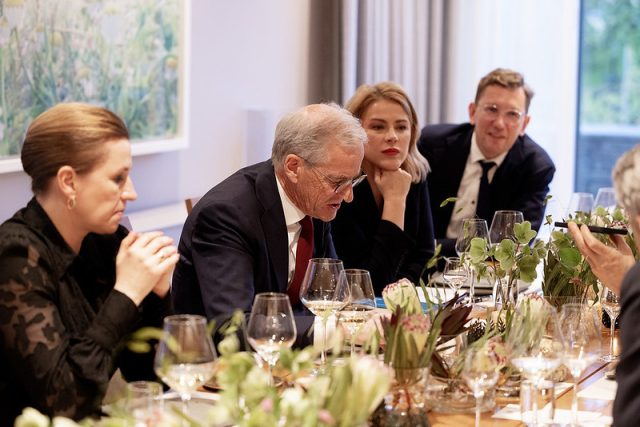 The prime ministers of Denmark (Mette Frederiksen, far left), Latvia (Evika Silina) and Estonia (Kristen Michal, far right) listened intently while Jonas Gahr Støre spoke with US President Donald Trump on the phone at their dinner Thursday night. PHOTO: Statsministerens kontor/Stine Østby
They could all report on joint telephone conversations during and after Thursday night’s dinner with both Trump and Zelensky, and that there’d been new telephone contact between Trump and Zelensky. The JEF members, along with Ukraine, want a 30-day cease-fire in Ukraine, and more sanctions against Russia if they don’t get it or if Putin violates it. Støre said their message to Trump was clear, noting with a smile that “his English is very good and ours isn’t bad either.”
The JEF summit took place just as Putin was putting on his own show of force in Moscow, with both sides jockeying for US favour. It was important, commented several of the JEF leaders, “to see who’s there and who’s not there” with Putin. Europe, remarked Støre, has been “remarkably united” in shunning Putin at every opportunity, and its combined support to Ukraine is “bigger than all our own defense budgets were” just a few years ago.
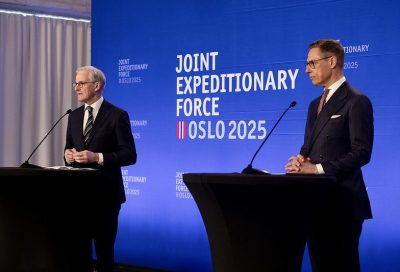 Norwegian Prime Minister Jonas Gahr Støre (left) hosted the JEF summit in Oslo. At right, Finland’s president, Alexander Stubb. PHOTO: Statsministerens kontor/Stine Østby
“The message to Putin is very simple,” said Støre at the summit’s first press conference of the day. “End this war.” Few trust Putin, though, with Danish Prime Minister Mette Frederiksen stating bluntly that “I don’t trust Russia, no one really trusts Russia will respect an agreement.”
Kristen Michal, prime minister of Estonia, agreed, adding that “we know our neighbour” and that’s why Estonia is now spending fully 5 percent of its GNP on defense. “I would say Russia absolutely poses a threat,” Michal added. “For him (Putin), the break up of the Soviet Union was the greatest mistake ever made.” Even if his war on Ukraine does end, Michal thinks Russia “will look for new conflicts.” Since its economy is shattered and hundreds of thousands of Russian soldiers will need something to do, Putin may respond by invading another country, “but we should not be afraid, we should be prepared.”
While the US Trump administration has often seemed keen to appease Putin, the JEF leaders noted that his tone was different during Thursday night’s phone meeting. Michal went so far as to call the conversation with Trump “excellent,” and thinks “we’re getting closer every day” to a solution. Finland’s Stubb said he thinks “the US is now seeing Putin for what he is” and that Trump’s patience with Putin “is running out.”
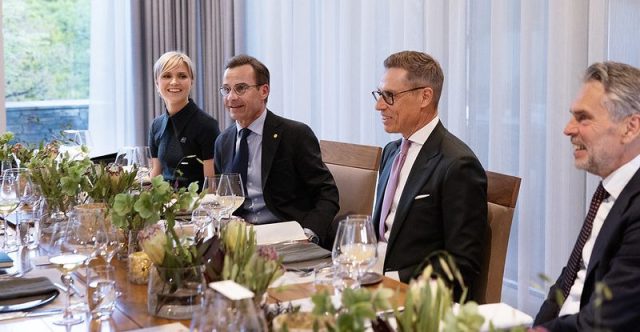 The JEF leaders seemed to get along well and also agreed to further strengthen their security cooperation and crisis response capabilities. From left: Iceland’s prime minister Kristrun Frostadottir, Sweden’s Ulf Kristersson, Alexander Stubb of Finland and Dick Schoof of the Netherlands. PHOTO: Statsministerens kontor/Stine Østby
Iceland’s Prime Minister Kristrun Frostadottir said she thinks Russia “is isolated,” while Latvian Prime Minister Evika Silina called the new conversation with Trump “a significant moment” and called on all NATO allies to keep boosting their defense. “Then we are much stronger together,” she said. “Together we are stronger than Putin.”
The leader of neighbouring Lithuania, which like Estonia and Latvia were once repressed in the Soviet Union, could report spending 4 percent of GNP on defense this year, 5 percent next year and as much as 6 percent by 2030 on “ensuring the safety and security of our borders,” which run along those of both Russia and Belarus. Lithuanian President Gitanas Nauseda declared that “the fate of Ukraine is also the fate of our own countries” and that it’s still “very important” to keep a visible US presence in Europe.”
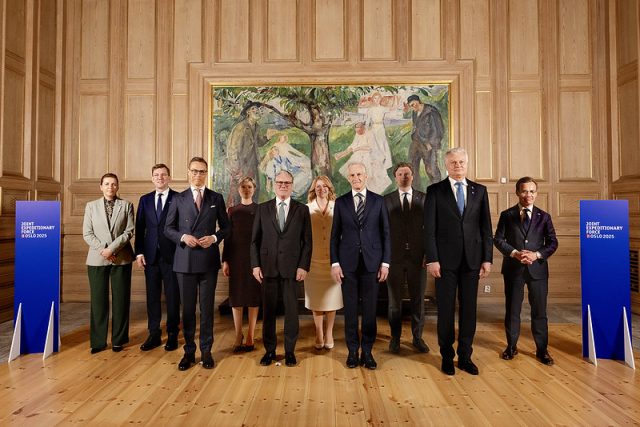 All 10 JEF leaders posed for a group photo after their summit in Oslo. From left: Danish Prime Minister Metter Frederiksen, Estonian Prime Minister Kristen Michal, Finland’s president Alexander Stubb, Iceland’s prime minister Kristrun Frostadottir, British Prime Minister Keir Starmer, Latvian Prime Minister Evika Silina, Norwegian Prime Minister Jonas Gahr Støre, The Netherlands’ defense minister Ruben Brekelman (stepping in for Dutch Prime Minister Dick Schoof), Lithuania’s president Gitanas Nauseda and Swedish Prime Minister Ulf Kristersson. PHOTO: Statsministerens kontor/Stine Østby
All 10 of the JEF leaders seemed encouraged after their conversations with both Trump and Zelensky, with Swedish Prime Minister Ulf Kristersson calling them “very good.” When Støre and Stubb met the press again Friday afternoon, they reported agreements on new joint training exercises, more aid to Ukraine and stressed the importance of a message Trump sent out late Thursday night Norwegian time that the US is now calling for “a 30-day unconditional ceasefire” with both countries being “held accountable for respecting the sanctity of these direct negotiations. If the ceasefire is not respected, the US and its partners will impose further sanctions.”
Other topics discussed at the JEF summit included the sovereignty of Denmark and the “absolute rules” that Støre claims remain valid in the Arctic region that respects borders and territorial waters. The group also had phone conversations with leaders in Greenland (which Trump has wanted to take over) and the Færoe Islands, also part of Denmark.
“We’re not just here (in Oslo) because we’re good friends and like getting together,” Stubb said. It’s because of the need for cooperation and coordination on defense operations in their region. Finland will host the next JEF meeting, aimed at ensuring adequate forces in the Arctic, strengthening NATO’s presence in the Arctic and securing Ukraine’s sovereignty. Stubb thinks that will ultimately require getting Ukraine into both the EU and NATO, despite Putin’s efforts to prevent that.
“We are moving in the right direction,” Stubb said. “There is a will for peace.”
NewsinEnglish.no/Nina Berglund