
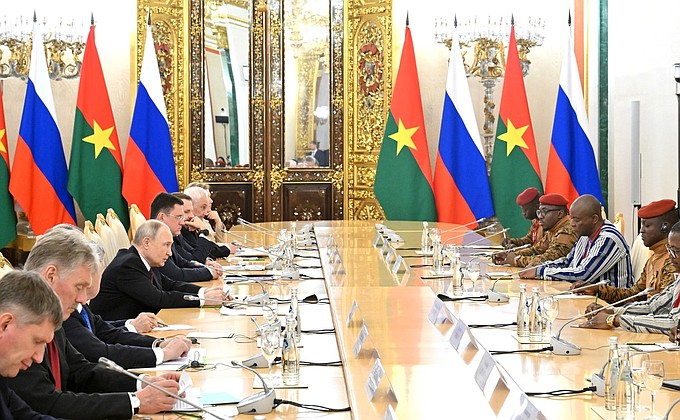
On the Russian side, the meeting was
attended by Foreign Minister Sergei Lavrov 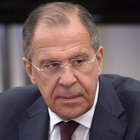 Lavrov SergeiMinister of Foreign Affairs of the Russian Federation , Deputy Prime Minister Alexander
Novak 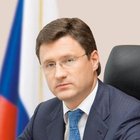 Novak AlexanderDeputy Prime Minister of the Government of the Russian Federation , Deputy Chief of Staff of the Presidential Executive Office Maxim
Oreshkin 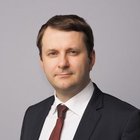 Oreshkin MaximDeputy Chief of Staff of the Presidential Executive Office , Deputy Chief of Staff of the Presidential Executive Office –
Presidential Press Secretary Dmitry Peskov 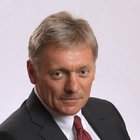 Peskov DmitryDeputy Chief of Staff of the Presidential Executive Office, Presidential Press Secretary , Presidential Aide Yury Ushakov
 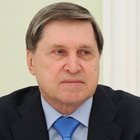 Ushakov YuryAide to the President , Defence
Minister Andrei Belousov 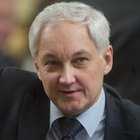 Belousov AndreiDefence Minister of the Russian Federation , Minister of Economic Development Maxim Reshetnikov
 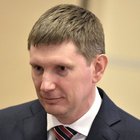 Reshetnikov MaximMinister of Economic Development of the Russian Federation , Head
of the Federal Service for the Oversight of Consumer Protection and Welfare
Anna Popova 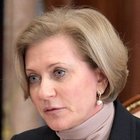 Popova AnnaHead of the Federal Service for the Oversight of Consumer Protection and Welfare (Rospotrebnadzor) , and Director General of State Atomic Energy Corporation Rosatom
Alexei Likhachev 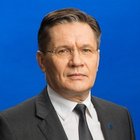 Likhachev AlexeiDirector General of State Atomic Energy Corporation Rosatom .
* * *
President of Russia Vladimir Putin: Mr President, friends,
We are delighted to see you. Before
we begin, I would like to thank you once again for your decision to take part
in celebrations marking the 80th anniversary of Victory in the Great
Patriotic War.
I remember our constructive and productive
conversation when you first visited our country in 2023 to participate in the Russia–Africa Summit in St Petersburg. Your current visit to Russia to attend celebrations
of the 80th anniversary of Victory is deeply symbolic and reflects
the friendly nature of the Russia-Burkina Faso relations.
I would also like to mention your
country’s contribution to defeating German Nazism and its satellites. About 30,000
people from modern-day Burkina Faso fought as part of the anti-Hitler Coalition,
in the Free France formations led by the legendary son of the French people
General Charles de Gaulle.
Today, we are united by a common
goal of fighting terrorism and extremism. We will continue to help the Republic
in restoring the rule of law and constitutional order and to assist in suppressing the radical groups that are still active in certain parts of Burkina Faso.
Over the past two years, we have
made significant progress in expanding mutually beneficial cooperation across
various areas. In late 2023, after a pause that lasted over 30 years, the Russian Embassy in Ouagadougou resumed its operations. A regular political
dialogue was established.
Even though bilateral trade remains
modest, it is nonetheless on the rise, which is a promising trend that should,
of course, be encouraged. We will work together to further strengthen economic
ties and diversify mutual trade.
The Burkina Faso Economic Days in Russia in October 2024, which were attended by a high-ranking Burkinabe
delegation headed by the Prime Minister, were beneficial in this regard.
Work is under way to create an intergovernmental commission. A dedicated working group was formed in late 2024.
We will continue to help your
country in training national personnel. The Russian government scholarship quota
for Burkinabe citizens has been more than doubled for the 2024–2025 academic
year. This year, we are prepared to take 27 more students from your country.
The tuition will be covered from Russia’s federal budget. In all, about 3,500 students
from Burkina Faso received their education in Russia.
Cultural and humanitarian ties have
been promoted since 2024 by the Ouagadougou-based Russia House, which offers
Russian language classes, among others.
Cooperation in healthcare and sanitation holds a lot of promise. On April 24–25, Ms Popova visited
Ouagadougou. We are ready to carry out joint scientific research, develop
laboratory infrastructure, and train specialists.
We prioritise humanitarian aid to Burkina Faso as well. Last year, we shipped to your country 25,000 tonnes of wheat free of charge. This month, a large shipment of other foods will arrive
in Ouagadougou.
We appreciate close coordination
with Burkina Faso in the international arena, including at the United Nations
and other international organisations. Consultations between Russia and the Confederation of Sahel States have become a valuable new cooperation format.
The first such meeting took place at the level of foreign ministers in Moscow
in April.
I think our prospects are good
across many areas. We have an opportunity to discuss some of them today.
President of Burkina Faso Ibrahim Traore: (Speaking
Russian.) Good afternoon, Comrade President.
(Retranslated.) Thank you very much.
I am honoured to be able to take
part in the Great Victory celebrations. I would like to thank you for the invitation. It is very symbolic for us.
I must say that during this visit I learned a lot about the culture and history which were the foundation of the resistance of the Russian people. I learned about the sacrifices made by your
people which made it a free nation today.
I would like to thank you once again
for inviting me. This particular moment and this meeting give us a chance to think
about what is happening now and to think ahead.
Today’s obstacles should not stop
us. To some extent, these obstacles even play into our hands, because despite
the sanctions that have been imposed against the Russian Federation by many
countries, Russia occupies a prominent place in the international arena, and we
take this into account, we understand that it is not easy.
I watched soldiers marching in front
of us, I saw the military equipment, including tanks that took part in the Great Patriotic War, and I saw modern equipment as well. We would like cooperation
between us to develop exponentially and to take new forms.
We thank you for your attitude
towards Burkina Faso. Today, I visited the Mendeleev Institute, and we
understand that in addition to defence and security, there is another important
sphere, namely, science and education. We would like Russia to help us educate
our young people and teach them science, so that we can develop our own
production, industry, and engineering, because it is very important for Africa.
We believe that the terrorism we are
witnessing today comes from imperialism, and we are fighting it. If we put an end
to this war, if we have a strong army, we will be able to engage in developing our
homeland. That is what we see as the purpose of our struggle. This is why it is
utterly important to build and train staff.
Very often in Africa there are a lot
of expectations, a lot of needs in terms of equipment and hardware, which is
why we have much to do. We would like to ask for help, and the main thing you
can help us with is the transfer of technology and know-how.
We need to understand how we can
spread the universities that exist in Russia to Burkina Faso, how we can open university
branches in Burkina Faso, to train our citizens, our students in a more
practical way. This is our fundamental objective. We would like Burkina Faso to develop and for many students to come to us and to study science.
We see the wonderful youth of the Russian Federation. There are many young researchers among them. And we would
like you to share your experience.
<…>