
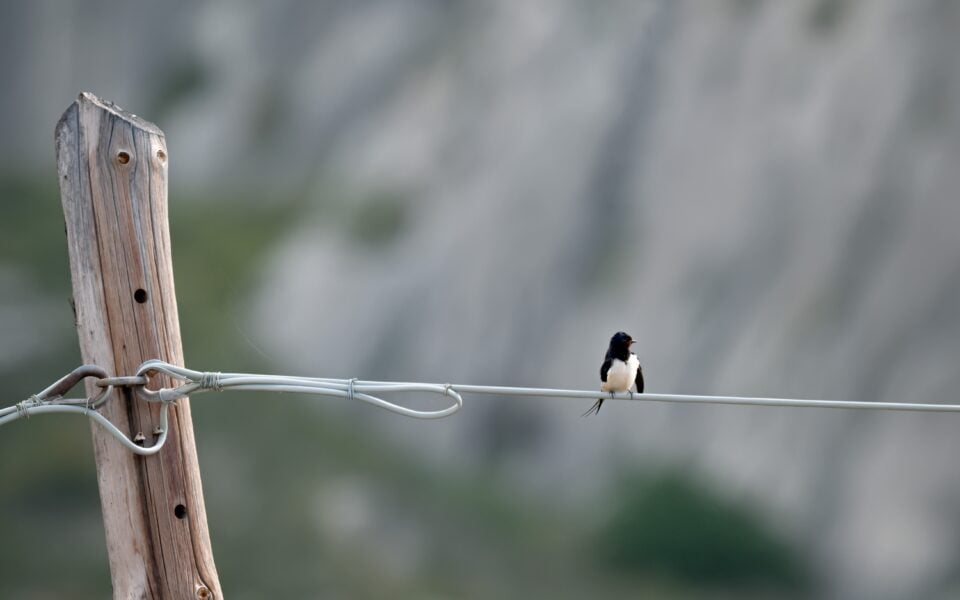
The Hellenic Ornithological Society is mapping the locations where the birds are spotted so as to better estimate their numbers. [InTime News]
There was a time not so long ago when we looked to the skies for the heralds of the returning spring, but swallows appear to have become increasingly scarce in both urban and rural parts of the country in recent years.
The gnawing feeling that their cheerful chirping from the rooftops is fading by the year is indeed a bad omen, as, according to Giorgos Drosopoulos, head conservation officer at the Hellenic Ornithological Society, there has been a gradual decline in swallow and swift populations in recent years across Greece and Europe, and particularly in cities.
‘Migration is an incredibly demanding process, so much so that birds may have to change course or may not even survive the journey’
According to Drosopoulos, this decline is due in part to the fact that swallows struggle not only to build nests in cities – where green spaces are scarce – but also to find enough food for themselves and their young. At the same time, there are also instances of people deliberately destroying their nests, which is, of course, illegal.
As for swifts – known in Greek as “rock swallows,” even though they are more closely related to hummingbirds than to swallows – their “traditional” urban nesting sites are in the recesses of old buildings, but modern architecture often lacks such features, leaving these birds without shelter. “The Development Ministry has long been a regular nesting site for migratory birds in the center of Athens. We hope to see them return again this year,” says Drosopoulos, referring to the building in downtown Kaningos Square, with its recessed windows and multitude of ledges.
The climate crisis has played an even bigger role in the shrinking populations of migratory birds, as extreme weather events often prevent the exhausted travelers from reaching their destination.
“Swallows and swifts may never make it to Greece because of unfavorable weather phenomenon along their migratory path. Migration is an incredibly demanding process, so much so that birds may have to change course or may not even survive the journey. Nevertheless, swallows like to return to the same nesting sites every year – conditions allowing,” says the expert.
Keeping record
In response to the declining number of swallows and swifts in Greece, the Hellenic Ornithological Society this year began counting their numbers in the country’s cities. Even though there are databases keeping track of bird populations in Europe and around the world, there is not enough data on the activities of migratory birds in Greece, which is why this new initiative is focused on mapping active nests in a bid to put a number to the populations and start making comparisons. Mapping is scheduled to start on May 10 and last until August 1 – and the public can help make sure it is successful.
 A child builds a clay nest for swallows at a school event in Thessaloniki. Providing shelter for migratory birds is something everyone can do with little effort. [AMNA]
“Everyone can take part in this effort,” says Drosopoulos. “Apart from the organized network of volunteers who will help with systematic monitoring based on a specific protocol, individuals will also be able to report single sightings using a form created for this purpose. So even if someone spots just one nest, they can still get it on record.”
The Hellenic Ornithological Society is also exploring the possibility of installing artificial nests. This is also something individuals can do – there are plenty of tutorials online – to help birds struggling to find a safe shelter.