
Construction of perhaps the largest power substation in the world — when completed it will span an area larger than 250 football fields — is underway at NV Energy’s Fort Churchill substation near Yerington.
Expansion of the substation is a crucial element of NV Energy’s Greenlink West Transmission Project, which will connect the existing 525 kilovolt Harry Allen Substation in Clark County in Southern Nevada to the expanded Fort Churchill substation complex under development in Lyon County in Northern Nevada.
NV Energy’s Greenlink North project, which is still in the permitting stages, will connect Ely to Yerington via approximately 235 miles of new 525 kV transmission line. All told, there is expected to be about 700 miles of new high-voltage transmission line crossing Nevada’s basins and ranges by the year 2030. Additional lines from the expanded Fort Churchill substation would deliver additional power to the Reno area.
While Ely is currently connected to Southern Nevada via the 525 kv One Nevada Transmission Line, which was completed in January 2014, there aren’t any high-voltage transmission lines connecting the Reno region to Southern Nevada (Ely is connected to Reno via a 345 kV line).
The approximately $4.3 billion Greenlink West/North project creates a 525 kV triangle that connects the entire state with high-voltage transmission lines, said Shahzad Lateef, senior director of transmission development and policy with NV Energy.
The triangle shape provides increased reliability and power delivery since the state is still fully connected if any one leg of the triangle goes down, Lateef said. It also allows NV Energy to better move power from where it’s being generated to where it’s needed most, he added.
“It allows us that flexibility,” Lateef said. “Power could move from Northern Nevada to Southern Nevada in the summer when it gets very hot, and we can go the other way around (in the winter) when we have solar production in Southern Nevada and Northern Nevada has increased power needs.”
Construction of Greenlink North is planned for early 2027. The new transmission lines from both projects could open vast swaths of remote land in rural Nevada for renewable energy production since those projects would have a way to add power to the energy grid from the multiple new substations that are scheduled for construction.
Greenlink West, for instance, includes new substations in Nye, Esmeralda and Lander counties that are expected to make potential renewable energy projects more feasible in those remote areas. Lateef likened the new substations as on- and off-ramps to the state’s new energy highway.
“This creates that highway for those energy projects in rural Nevada counties so they can actually get power to the population centers in Nevada. Without those substations, there is no way to get onto Greenlink,” Lateef said.
Greenlink West is a massive undertaking that includes more than 470 miles of new 525 kV and 345 kV transmission lines. Since the Fort Churchill substation sits on private land, NV Energy was able to begin work in September, Lateef said. Expansion of the 120 kV portion of the substation is almost complete, Lateef added. When complete, work will begin on the 230 kV, 345 kV, and 525 kV portions of the substation complex that’s situated on about 360 acres.
Construction for the entire Greenlink project was awarded to T&D Power, a subsidiary of Coral Gables, Fla.-based MasTec, one of the nation’s leading power transmission, distribution and substation construction companies. Lateef said that the remainder of 2025 includes a great deal of surveying to plot out the exact path of the transmission lines, which will loosely mirror the path of U.S. Route 95.
Construction of transmission towers will begin in Southern Nevada later this year, Lateef noted. It typically takes three crews to build transmission lines, he added: one to build the concrete foundations; another to construct the towers; and a third to pull wire.
Work in Northern Nevada will focus on cutting in access roads from U.S. 95 to NV Energy’s right of way where the new lines will be, as well as extensive staging of materials such as steel, poles, wires, insulators and related hardware. Toward the latter half of 2025, materials will start being delivered at materials yards across the project landscape, and perimeter fencing will be erected.
“I traveled U.S. 95 a few times over the last few weeks, and you can already see some ground clearing in a few areas,” Lateef said.
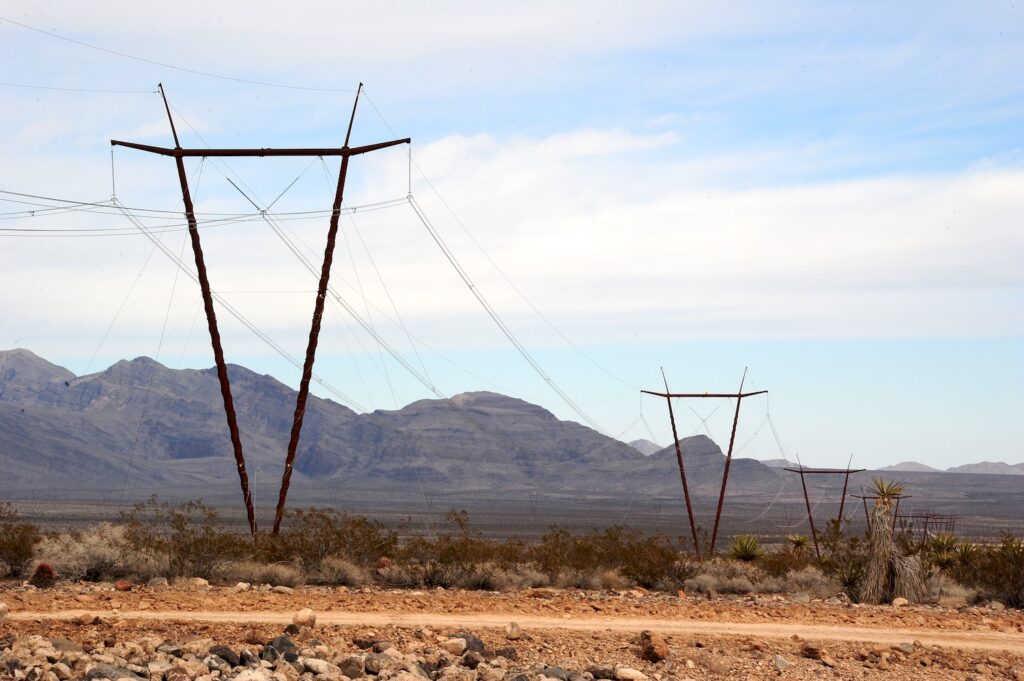
Although the new 525 kV transmission lines will be strung on steel structures, the new towers will look much different than the bright steel that’s often used to carry high-capacity power lines. In order to make the structures blend in with the brownish tones of Nevada’s desert landscape, the structures have rustic tones that are incorporated into the design of the steel from a coating that chemically bonds to the steel, Lateef said.
The number and spacing of the towers will vary depending on topography. Certain areas, such as Walker Lake, post significant engineering challenges, Lateef added.
“Nevada is the most mountainous state in the lower 48,” Lateef said. “It all depends on the terrain we are going over – it’s not a uniform line.”
Along the way, he added, there will be different styles of structures in environmentally sensitive areas that won’t allow predators to perch on the towers and search for their next meal.
Tariffs on imported steel could potentially impact the Greenlink project, Lateef noted. Although contracts are in place, legal experts are reviewing contracts to see how unforeseen changes in government regulations could impact pricing from suppliers.
“Tariffs are continually moving. The date of implementation, which countries are impacted, are still moving, and we are evaluating those tariffs,” Lateef said.
The construction workforce in Lyon County is expected to peak at 150 people in 2025. The entire project is built under IBEW Local 1245 Northern 396 in Southern Nevada. Traveling workers will stay in RV parks and hotels — there are no man camps in the field, Lateef noted.
“There are a lot of dynamic parts to this project – biological, environmental, and cultural sensitivity of the land. It’s a lot of moving pieces,” he said.