
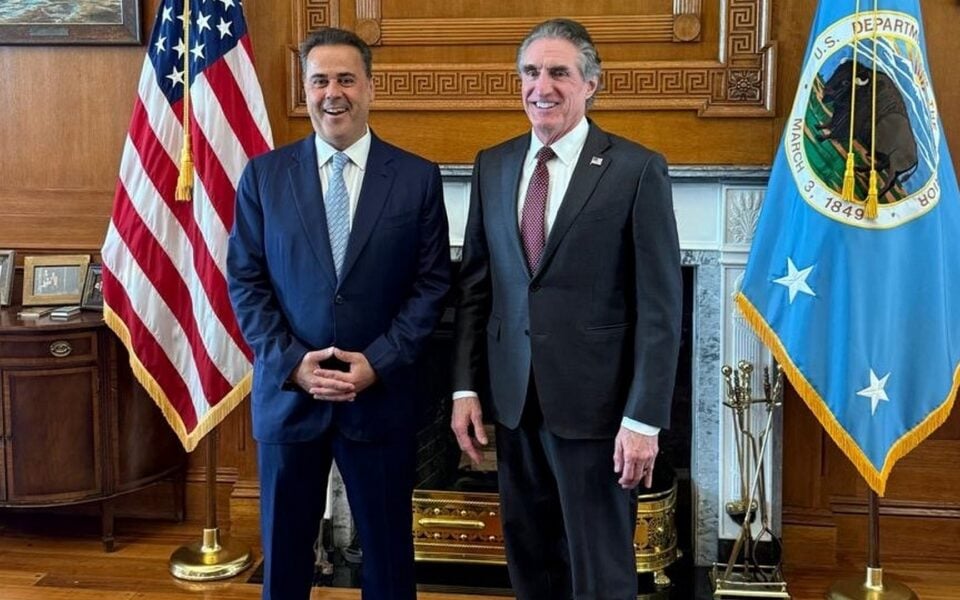
Greek Minister of Energy Stavros Papastavrou and US Secretary of the Interior and Chair of the National Energy Sovereignty Council Doug Burgum, reaffirmed the strategic depth of US-Greece relations, which both officials acknowledged are currently at their most robust and dynamic point in history, during a constructive meeting in Washington.
Defense, security, and energy cooperation were reaffirmed as the two core pillars of the US-Greece bilateral relationship. Burgum expressed his strong appreciation for Greece’s role in promoting regional stability, highlighting in particular the strategic importance of Souda and Alexandroupoli. He also emphasized the significance of Greece’s naval presence in the Red Sea, noting its critical role in safeguarding international maritime trade routes.
On the energy front, the two officials engaged in a substantive discussion on the current state and future prospects of cooperation in the Eastern Mediterranean, emphasizing the interconnection of energy networks as a catalyst for economic growth and geopolitical stability. They also reviewed the so-called vertical energy and trade corridor originating in Alexandroupoli and extending through Northern Greece to Central and Eastern Europe-an initiative that has already garnered significant international interest.
Particular emphasis was placed on the India-Middle East-Europe Economic Corridor (IMEC) and Greece’s prospective role as a strategic gateway. Papastavrou reaffirmed Greece’s commitment to assuming a significant role in advancing this ambitious initiative, which Washington considers a strategic priority of the highest order.
During the meeting, Papastavrou presented Burgum with a detailed map of the offshore exploration blocks currently tendered by the Greek government. Major US energy companies, including Chevron and ExxonMobil, have already expressed strong interest in these areas, underscoring both the geopolitical importance and the investment potential of Greece’s energy reserves.