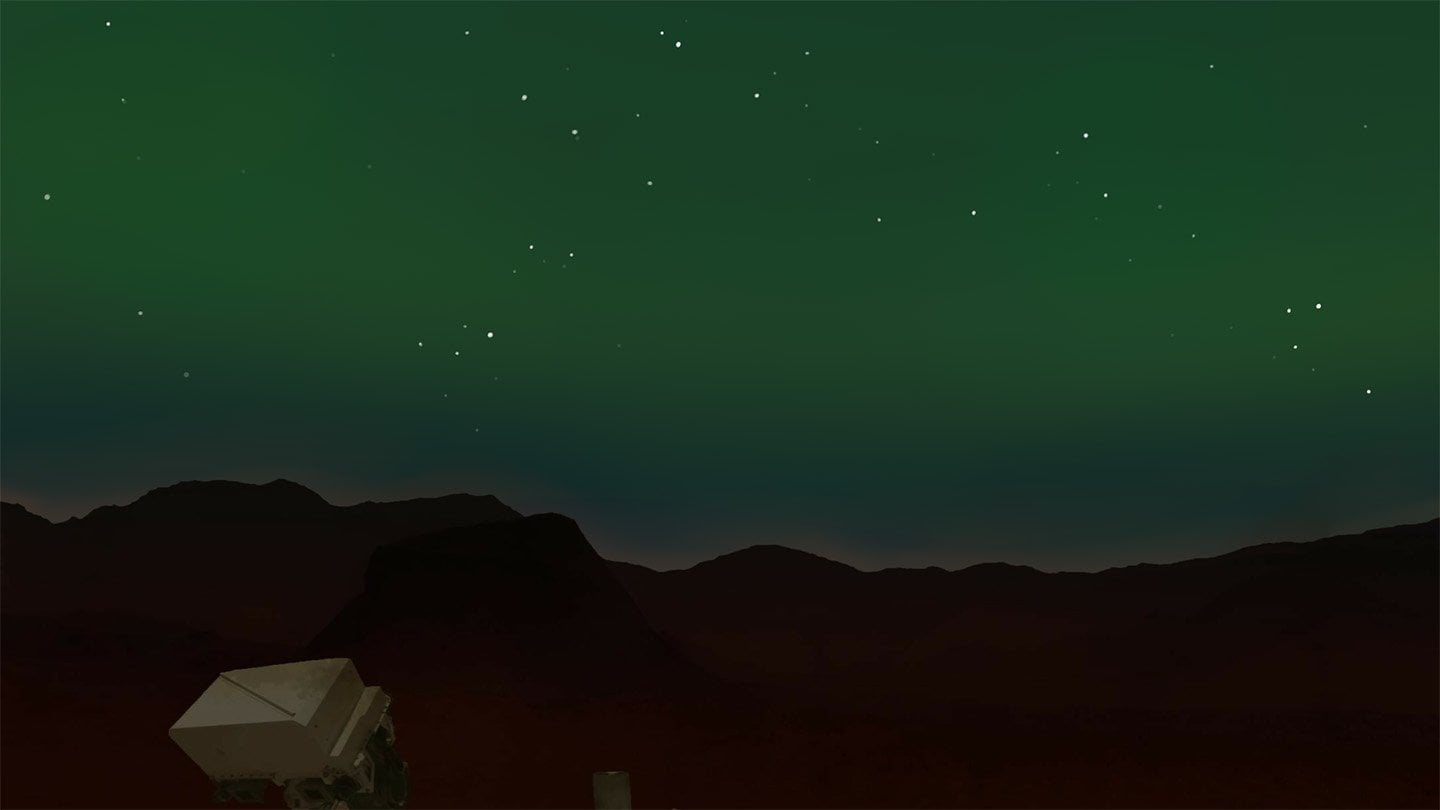
Perseverance takes the first picture of a visible Martian aurora
Perseverance takes the first picture of a visible Martian aurora

Perseverance takes the first picture of a visible Martian aurora
Perseverance takes the first picture of a visible Martian aurora
2 Comments
>On some Martian nights, a subtle, green glow hangs low in the sky, wreathing the horizon in every direction.
>[A visible Martian aurora](https://doi.org/10.1126/sciadv.ads1563) has finally been observed for the first time, researchers report May 14 in *Science Advances.* The observation, made March 18, 2024, by the [Perseverance rover](https://www.sciencenews.org/article/nasa-perseverance-rover-potential-life-setting), is also the first of an aurora from the surface of a planet that isn’t Earth. Moreover, it suggests future astronauts may witness ethereal Martian auroras with their own eyes. “It would be a dull or dim green glow to astronauts’ eyes,” says Roger Wiens, a planetary scientist at Purdue University in Lafayette, Ind.
>[Auroras can appear](https://www.sciencenews.org/article/sun-auroras-solar-maximum-2024) when [charged particles from space](https://www.sciencenews.org/article/sun-solar-storms-earth-havoc-space-weather-forecasts) interact with a planet’s atmosphere. They’ve already been spotted on [Mercury](https://www.sciencenews.org/article/rain-electrons-mercury-xray-auroras), [Jupiter](https://www.sciencenews.org/article/jupiter-aurora-poles-super-heat-upper-atmosphere) and every other non-Earth planet in our solar system, but only from orbit.
[Read more here. ](https://www.sciencenews.org/article/perseverance-picture-martian-aurora)
So cool that Mars allows for them to form! I wonder if the Aurora is more spread out due to the thinner atmosphere.