
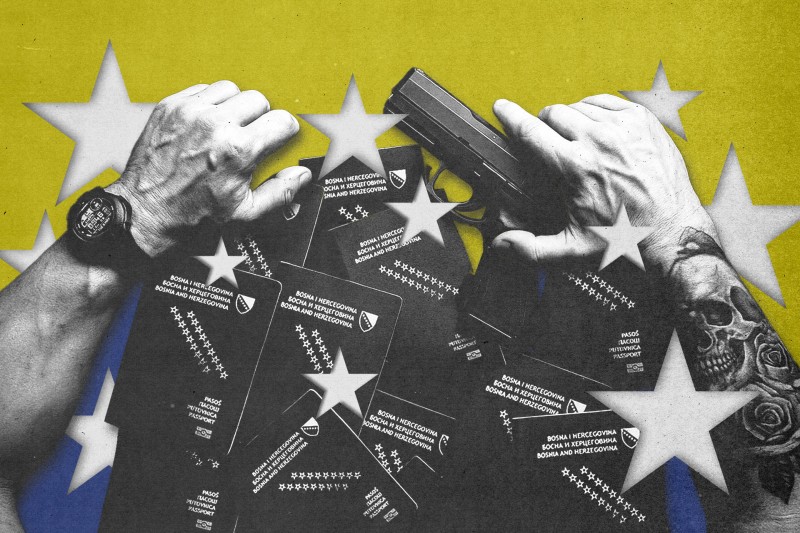
Živković had allegedly paid a former police officer, Dalibor Ćurlik, to help him pose as “Jović,” according to a subsequent police investigation.
Ćurlik — who was arrested in August 2021 and is still under investigation — had already falsely declared that Živković lived at his mother’s house in Banja Luka so the Serbian could obtain the residency certificate he needed for his Bosnian passport, police records from the investigation show. An associate, meanwhile, picked up a citizenship certificate.
When all the documents were ready, Ćurlik accompanied Živković to the city’s police station and helped him fill out the paperwork for his passport application. Surveillance footage obtained by CIN shows Živković being fingerprinted and photographed for his new Bosnian documents.
Shortly afterwards, in July 2021, the passport was ready and Živković authorized Ćurlik to fetch it for him. With his clean passport and new name, Živković flew from Sarajevo to Istanbul before the end of the month, according to border control records.
The following year, two men riding a motorbike in Istanbul’s upscale Şişli district opened fire on a car carrying the leader of the rival Škaljari gang, Jovan Vukotić, who was killed instantly. (His wife and child were also in the car, but were not injured.)
The assassination had been organized by Živković, according to the Turkish court that sentenced him to life in prison earlier this year. When Turkish police arrested him, they found the Bosnian passport bearing his photo and the name Andrej Jović.
Živković was not the only criminal who Ćurlik helped obtain a Bosnian passport, according to the police records obtained by CIN. He is also accused by police of working with four other would-be Bosnian citizens to obtain fraudulent documentation.
The method was always the same: Ćurlik falsely registered his clients at his mother’s address in Banja Luka to provide proof of residence, while an accomplice provided the necessary citizenship certificates. Ćurlik then escorted his clients to the police department, guided them through the paperwork, and was authorized to collect their passports.
In mid-June 2021, for instance, surveillance cameras in the Banja Luka police station recorded Ćurlik alongside Marko Petrović, a Serbian who had been convicted of violent behavior and endangering public safety, as he submitted a passport application under the name Đorđe Suša. Ćurlik collected Petrović’s new passport on June 17.
Several months later in August, another member of the Kavač clan, Almir Jahović, also appeared at the Banja Luka police station with Ćurlik to apply for a passport. At the time, Jahović was wanted by Interpol for his alleged role in the attempted murder of two rival gang members in Bar, Montenegro.
The very next day, Ćurlik collected the documents on his Montenegrin client’s behalf. But Jahović never got a chance to use his freshly issued passport. During the handover of the new document, Jahović, Ćurlik, and a man who had been providing citizenship certificates were arrested in Banja Luka. The Montenegrin national was soon extradited to his home country.
The Škaljari Clan’s Passport Pipeline
While Kavač relied on their network in Banja Luka to secure false identities, the rival Škaljari were also getting their hands on clean passports using their own intermediaries in Bosnia’s north.
According to an investigation launched by prosecutors in 2020, their key contact was Nikola Vein, a Serbian national who himself possessed a forged Bosnian passport. Thanks to Vein’s connections in Brčko, a small autonomous district along Bosnia’s border with Croatia, at least 12 members of the Montenegrin gang received Bosnian passports in 2020.
Prosecutors allege Vein charged roughly 5,000 euros per passport. (He is still under investigation and hasn’t been indicted.) His method was allegedly almost identical to the one Ćurlik used in Banja Luka: The criminals presented forged ID cards, with their own photographs but the names of Bosnian citizens whose identities they had stolen.