
Recently, several research groups have focused on air pollution, which is the leading cause of respiratory and pulmonary diseases worldwide. Sustainable Development Goal 3 (SDG 3) is directly related to health and well-being. Additionally, the challenge of coping with natural solutions is limited. Lee and Kim (2018) reported that the mortality rate due to air pollution was more than 4.5 million worldwide in 20151. The WHO 2024 report also states that household air pollution is responsible for 3.2 million deaths per year, including 0.2 million child deaths. The criteria for estimating the mortality rate due to air pollution were attributed to the burden of diseases caused by PM2.5, PM10, and nitrogen dioxide (NO2)2. The magnitude will worsen in 2025, as predicted. The study also discussed the segregation and conjugate effects of indoor and outdoor air pollution. Odo et al. (2022) reported a link between acute respiratory disease and air pollution among children younger than 5 years old in 35 developing countries3. This finding replicates the adverse effects of air pollution on younger and future generations. Goldstein et al. (2020) reported and discussed the effects of the indoor environment on exposure to air pollution4. They followed a narrative of questions and answers to determine the entangled relationship between the indoor environment, air pollution, and exposure. They linked the concentration of PM2.5 indoors to outside air pollution and presented the challenge of exposure to more organic compounds due to enclosed spaces.
A review on harnessing plant phytoremediation capabilities to prevent air pollution in indoor spaces. Phytoremediation is a remedial process that uses various plants to remove, stabilize, and destroy contaminants in soil, air, and groundwater5. In this case, we are leveraging phytoremediation to clean air pollutants. Kumar et al. (2023) also presented a review highlighting the need for natural solutions to the air pollution problem. In addition, they discuss the different mechanisms for phytoremediation to explore the molecular-level settlement of pollutants through root penetration techniques6. A few studies have been related to predictive measures to quantify AQI depending on multifactorial functions, including AI and machine learning algorithms7,8. The prediction algorithm focuses on finding the weight of the dominant parameter on the AQI but still focuses on finding worthy solutions. A few studies have focused on finding nature-based solutions to address air pollution, but they have focused on managing the outdoor environment or spatial arrangement9,10,11. Additionally, most of the work in AQI management needs to integrate preventive and curative changes with technological/nature-based changes applied for improvement. All the cited works have shaped the current research in this field. This study aims to bridge the gap between using plant-based natural solutions to address air pollution indoor air quality (IAQI) and the environment. We propose a novel technology based on the Breathing Roots Technology, “Ubreathe Rain.”
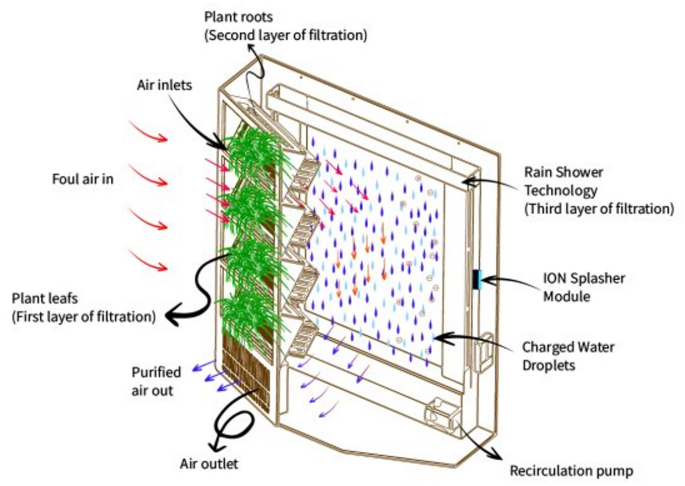
Ubreathe Rain is an innovative, nature-inspired air purification system designed for large semi-open regions experiencing heavy population influx. The semi-open regions are different from the indoor regions because they also include openings towards the outside for intentional ventilation. The system developed by Urban Air Labs, uses a modular, wall-mounted design and introduces pioneering technologies to overcome the limitations associated with existing air purification methods. Standard air purification technologies, such as HEPA-based mechanical filtration and charcoal filtration, rely on fan-driven suction systems, leading to issues such as high-power consumption, frequent filter replacements, environmental impact, increased noise, and inefficiency outdoors. Urban Air Labs addresses these challenges with a modular system incorporating “Breathing Roots Technology” and “Rain Shower Technology.” These technologies leverage phytoremediation capabilities and simulate wet deposition during rainfall to efficiently purify air in semi-open spaces.
The first layer of filtration involves “Breathing Roots Technology,” inspired by the process of phytoremediation, and builds upon research findings from those by12,13,14, which support NASA’s findings15,16,17 on the ability of plants to clean pollutants. ‘Breathing Roots Technology optimizes the breathability of the soil‒root zone, enhancing the phytoremediation process and improving overall pollution mitigation efficacy. In conventional wall planters, the soil root zone remains enclosed, limiting its exposure to ambient air and reducing its effectiveness in air purification. In contrast, Ubreathe Rain incorporates an innovative planter design with strategically placed open slits, allowing for direct interaction between the soil-root zone and the surrounding air. To prevent soil loss through these slits, the planters are internally lined with a mesh-like cellulose material, which serves as both a structural support and a functional filtration medium. This technology also increases oxygen and controls carbon dioxide levels through photosynthesis. In the implementation of the “Breathing Roots Technology”, a carefully chosen selection of plants establishes a layer comprising plant leaves and exposed root zones. The implementation of “Breathing Roots Technology” involves a reasonable selection of plant species, strategically composing a stratum characterized by the symbiosis of foliar structures and exposed root systems. The curated assemblage, distinguished for its exceptional phytoremediation ability, encompasses Dieffenbachia compacta, Epipremnum aureum, and Hedera helix18, as well as Ficus elastica, Pachira aquatica, Syngonium podophyllum19, Ficus benjamina, Gerbera jamesonii, various Philodendron species, Sansevieria laurentii, and Spathiphyllum ‘Mauna Loa’20. The second filtration layer mimics the cleaning effect of rainfall through “Rain Shower Technology.’ Wet deposition, a natural process in which atmospheric pollutants are removed by precipitation, is scientifically explained by parameters such as droplet size and charges present in the droplets21. Accordingly, rain optimizes the droplet size and charge balance to maximize wet deposition ability. This technology effectively absorbs gases and breaks them down into simpler, non-harmful forms.
The rain shower system consists of strategically placed holes in a pipe fed with water through a submersible pump. Nozzles with optimized diameters facilitate the formation of droplets, thereby ensuring maximum effectiveness. The ion-splasher inside the module strategically emits positive and negative ions, which charge the droplets that interact with the suspended particles and harmful gases, thus increasing the coagulation capacity of the droplets. In natural ecosystems, wet deposition is critical in reducing airborne pollutants by leveraging ions to enhance particulate aggregation and removal. Ions, whether from rainwater, humidity, or artificial sources like ionizers, help neutralize charged airborne particles, causing them to cluster together and settle out of the air more efficiently. This mechanism significantly improves gravitational settling and deposition, making air purification systems more effective. Without ions, pollutant removal relies solely on passive filtration and microbial breakdown, which can be slower and less efficient in capturing fine particulate matter. Figure 1 shows a schematic of Ubreathe Rain shows a cross-sectional view. Ubreathe Rain, provides a novel solution for controlling air quality in large, semi-open spaces with unpredictable pollutant loads. The modular design allows for scalability, and the energy requirement per unit module is significantly lower than that of conventional air purifiers with similar specifications and coverage areas. This innovative air purification system offers a sustainable and effective solution for improving air quality in densely populated areas. Throughout the fabrication and testing, the space was very selective due to the focus on the vicinity of stubble burning. In addition, the timing and duration were chosen, especially to target the stubble burning. These specific choices may pose limitations with variations in demographic conditions adding to fluctuations in the efficacy of the products deployed. However, the efficacy of the proposed technology is limited in highly ventilated spaces due to the large air change rate, timely sunlight, which rejuvenates plants follicles, and dependency on water splashing.