
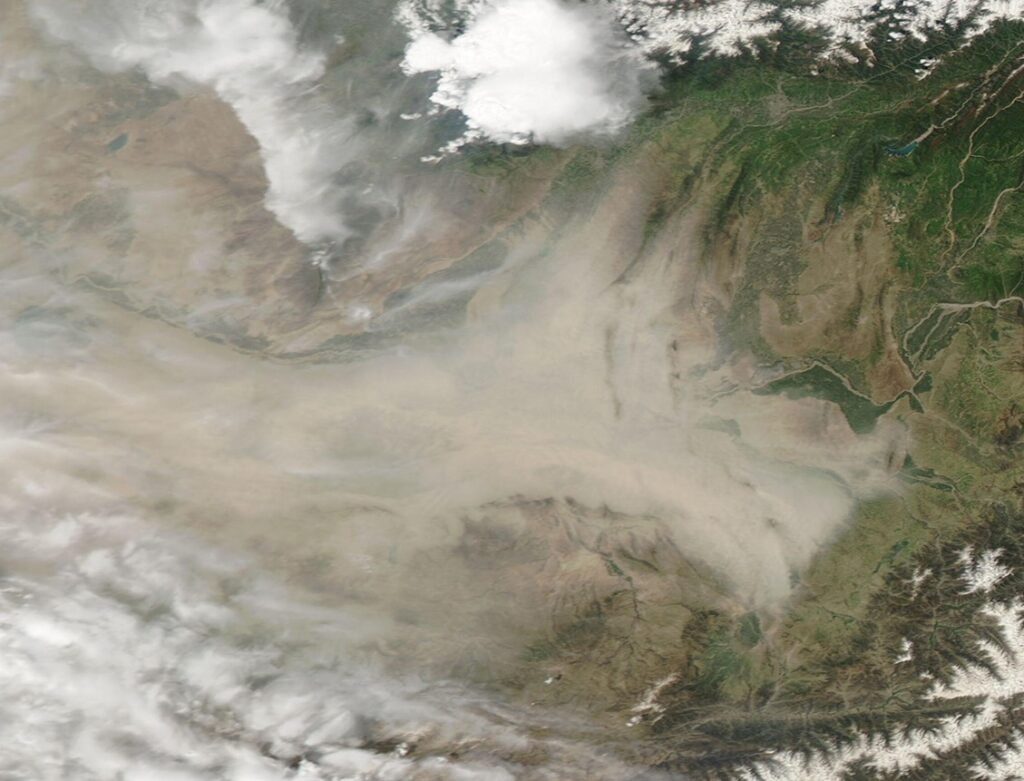
Satellite imagery indicates that a severe dust storm has impacted the country’s northern, western, and southwestern regions. These storms have engulfed northern provinces in recent days and are expected to affect all areas of Afghanistan. NASA satellite images also reveal that strong winds transport large dust masses from Central Asian deserts toward Afghanistan. According to NASA studies, storms originating from Turkmenistan and Uzbekistan carry salt particles that cause greater harm to soil, vegetation, and human health. Environmental and water experts note that, in addition to causing health issues, these storms weaken vegetation and agriculture, while also affecting water resources, snow, and glaciers, accelerating their melting. They add that forecasts from reputable global meteorological organizations suggest that wind speeds this year will be stronger than last year, impacting the entire country. Experts urge the public to prepare for dust storms to reduce their vulnerability.
NASA satellite imagery shows that a severe dust storm will affect northern Afghanistan on Saturday and Sunday of this week. It is also predicted that these dust storms will impact all regions of Afghanistan. NASA images further confirm that strong winds are carrying large dust masses from Central Asian deserts toward Afghanistan.
Environmental experts attribute dust storms in Afghanistan, particularly in the northern regions, to drought, land degradation, and desertification. They state that reduced vegetation cover and exposed sediments in downstream areas lacking sufficient water have become the primary sources of dust storms in the country. According to them, drought and land degradation have enabled seasonal winds to carry significant amounts of dust. They also predict that the upcoming summer in northern Afghanistan will be much hotter and windier than usual.
Experts note that if the concentration of dust particles in the air reaches up to four micrograms per cubic meter, it poses minimal health risks. However, current concentrations have reached approximately 400 micrograms per cubic meter, causing serious damage to lungs, eyes, vegetation, and agriculture. Additionally, these storms, which carry salt particles, accelerate snowmelt as they pass over the Hindu Kush mountains and expedite the melting of natural glaciers beyond normal rates.
The World Health Organization (WHO) has reported that dust concentrations in these storms can reach up to 400 micrograms per cubic meter, up to 100 times higher than the permissible level set by the organization, potentially leading to respiratory, eye, and cardiovascular diseases.
Najibullah Sadid, a researcher on water and environmental resources, told the Hasht-e Subh Daily that two main factors have made dust storms in Afghanistan more intense and distinct compared to previous years. He explained that over the past four years, drought has affected Central Asia and Afghanistan, leading to weakened vegetation cover in the region. Parts of the plains in Turkmenistan, Uzbekistan, and northern Afghanistan have become virtually devoid of vegetation. He added that the soil in these areas has been degraded and contains not only ordinary soil but also salt particles, which are highly detrimental to human health, vegetation, agriculture, water resources, snow, and glaciers.
Sadid noted that wind speeds this year have been stronger than in previous years. He stated that reputable global meteorological centers have forecasted stronger-than-usual winds for northern Afghanistan this year. He explained that Afghanistan has two major natural wind corridors: one in the southwest, passing through Herat, Farah, Nimruz, and parts of Helmand, and another in the north, where wind speeds have intensified to the extent that resulting dust storms have crossed the Hindu Kush mountains. Last year, these storms affected cities such as Kabul, Jalalabad, and Peshawar in Pakistan.
Sadid also referenced the Qosh Tepa Canal project, noting that soil stabilization during its excavation was not properly executed. As a result, loose soil from the project is lifted by winds, contributing to the intensification of dust storms in northern Afghanistan and becoming a primary short-term source of increased dust storms.
Referring to the novelty of this phenomenon in Afghanistan, Sadid said that people must prepare to confront dust storms, as is done in countries facing similar challenges, to reduce their vulnerability. He added, “This issue is entirely unfamiliar in the northern regions and affects both agriculture and public health. People do not know how to cope with it. Government programs also lack specific measures for such conditions, and orchards and agriculture in the north are suffering.” He emphasized that, given the scale of these storms, in addition to global solutions like reducing greenhouse gas emissions, there is a pressing need for regional solutions. He stressed that actions such as soil stabilization, mechanized agriculture, and dialogue and cooperation among regional countries must be prioritized to develop scientific and coordinated solutions to address this environmental crisis.
Meanwhile, Zabihullah, a resident of Mazar-e-Sharif, the capital of Balkh province, said that on Sunday, from early morning until noon, a dust storm engulfed the city. He noted that due to economic hardships and unemployment, people are more preoccupied with these concerns and pay little attention to the devastating impacts of these storms, often neglecting medical recommendations.
Satellite data and forecasting models from the World Meteorological Organization and NASA research centers indicate that dust storms in 2025 will be more severe and widespread than in previous years, particularly in the arid and semi-arid regions of Central Asia, including Afghanistan. According to NASA studies, some of these storms, especially those originating from Turkmenistan and Uzbekistan, contain salt particles that cause greater damage to soil, vegetation, and human health.
You can read the Persian version of this report here:
بادهای مرگبار؛ طبیعت افغانستان زیر زخم توفانهای خاکی | روزنامه ۸صبح