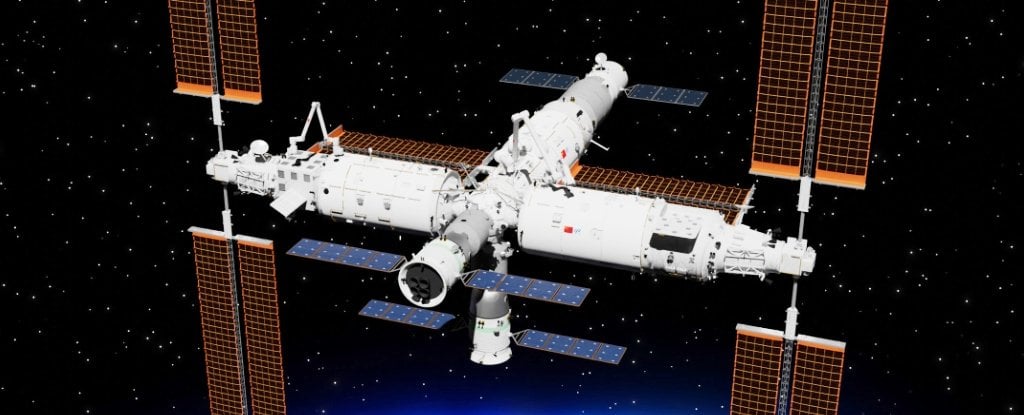
Unknown Species of Bacteria Discovered in China’s Space Station
https://www.sciencealert.com/unknown-species-of-bacteria-discovered-in-chinas-space-station

Unknown Species of Bacteria Discovered in China’s Space Station
https://www.sciencealert.com/unknown-species-of-bacteria-discovered-in-chinas-space-station
23 Comments
> Swabs from China’s Tiangong space station reveal traces of a bacterium unseen on Earth, with characteristics that may help it function under stressful environmental conditions hundreds of kilometers above the planet’s surface.
> Naming their discovery after the station, researchers from the Shenzhou Space Biotechnology Group and the Beijing Institute of Spacecraft System Engineering say the study of Niallia tiangongensis and similar species could be “essential” in protecting astronaut health and spacecraft functionality over long missions.
> The new species appears to be a close cousin to a known strain called Niallia circulans – a rod-shaped, soil-dwelling bacterium that just a few years ago was reallocated to a new genus classification, having previously been regarded as a pathogenic form of Bacillus.
> According to the recently published analysis on its genes and functions, the new species has a unique ability to break down gelatin as a source of nitrogen and carbon, a knack that comes in handy when it needs to construct a protective coat of biofilm to bunker beneath when conditions get a little rough.
Oh for crying out loud. Nuke the site in orbit, it’s the only way to be sure.
Not sure how surprising this is, since discovering a new type of bacteria will happen basically anywhere you look – when a new dna identification technique was invented a few years ago, they discovered about ten thousand straight away, and there are so many now that tens of thousands don’t even have names yet- but it sounds like it could yield useful information about how they behave in this environment.
Could come in handy for future bases which have their own complex ecologies.
Who has space bacteria causing the next pandemic on their apocalypse bingo card?
Unknown hostile lifeform detected. Proceed with extreme prejudice
Do you WANT a zombie apocalypse, because that is how you get a zombie apocalypse.
Ooh maybe Trump can deploy the Space Force to go and destroy it /s
I would see this headline right after finishing The Andromeda Evolution…
Great. Irradiated super space COVID, coming to a grocery near you. /s
Can we have the ISS check for presence of the same bacteria?
Maybe it originates from earth, but simply thrives in LEO?
It’s very possible that Bacteria exist in low earth orbit.
The Andromeda Strain was not on my bingo card for 2025.
I saw a movie that revolved around this premise. It didn’t end well.
Does it find a happy host in humans, and if so… is it a human killer?
As someone very knowledgeable about Typhon lifeforms, I say we should not let anyone on that station come back down to Earth.
I have always envisioned Earth orbiting in a smoke-ring of life blown off the top of the atmosphere as it moves round the sun. No reason not to suspect we have exported Earth life to nearby planets and we in turn collect additional life dropped off from comets as they come in from the Oort Cloud.
Wuhan labs are shaping up to drop an epic comeback album
I, for one, can’t wait to be swathed in a gelatinous goo so that I may pass through the downtown wormhole to the Berungarious-7 shoooping district to beat crowds on Dark-matter friday.
Oh nice, space aids. Happy 2025 everyone. Good luck.
Soon we will have invasive species of bacteria lol..
Ofc it’s in the Bacillus family. I wouldn’t be surprised if one colonized the TRAPPIST-1 system at this point.
I’ve seen too many horror movies to know how this ends.
China is really trying to speedrun the world ending disease achievement.