
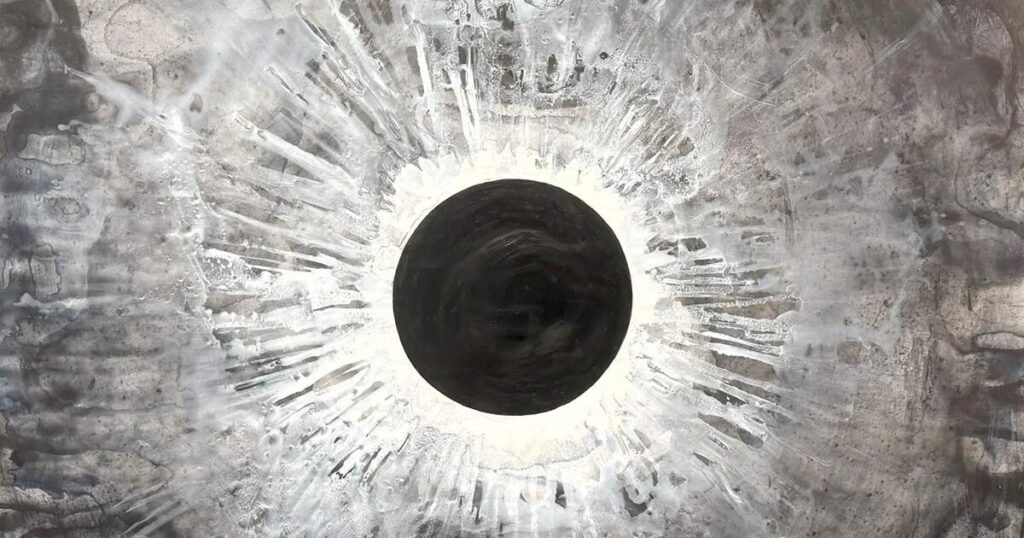
From the dairy farm to the studio, from Vermont to Iceland, change dominates artist Elizabeth Nelson’s life and work.
Nelson brings disparate corners of the world back to the canvases she paints in her Northeast Kingdom studio. Her art was exhibited in South Burlington City Hall this spring. Nelson also frequently exhibits work at The Front in Montpelier, where she has a display coming in January.
Growing up, Nelson remembers visiting the Metropolitan Museum of Art with her parents. She saw a “magnificent” exhibit of Vincent Van Gogh’s work.
After that day, Nelson strove to be an artist, attending Rhode Island School of Design and getting her master’s degree in art from the University of North Carolina Chapel Hill.
In the late 1960s, Nelson was attracted to Vermont in the hopes of living “a life closer to the land,” she said. Opting out of urban life, she moved to the Northeast Kingdom and to run a dairy farm with her husband. Operating the farm for 26 years, Nelson gained an intimate awareness of Vermont’s changing landscape. She compared the rapid changes of the state’s horizon to a “sped-up film.”
“If you look at Vermont that way, they have trees, and there’s no trees, and there’s some trees and there’s cheese, and now it’s getting more forested again,” Nelson said.
Nelson’s farm grew from just 10 cows to 300 at its conclusion. Today, she lives down the road from that farm, with her son and his family continuing the operation.
In 2012, Nelson began work on a series of paintings dedicated to the I Ching, the ancient Chinese “Book of Changes.” Nelson had been introduced to the book during her time in graduate school, but its usefulness emerged decades later.
“I was at loose ends because you have to keep inventing yourself, if you’re an artist. Something needs to pull you in and make you want to express something about them. So, I thought, ‘Oh, I’ll ask the I Ching,’” she said. “It didn’t give me an answer, but the next morning, I woke up and looked out my window, way out in the country, and for some reason I said, ‘Oh, that’s what I’ll do.’”
In addition to the Northeast Kingdom, Nelson has been inspired by Icelandic landscapes. She visited there in 2012, and returned in 2017 as a resident at SIM, the Association of Icelandic Artists. That’s where her artistic process changed yet again.
“Because of the physical requirements of the studio I was working in, it was more convenient to work flat on a table, not up on an easel,” she said. “So, I was sort of playing around with paint. Things were more fluid than they can be when you have your work vertical.”
Her paintings from this period are much more abstract, demanding a collaboration between her and the canvas. The paintings reflect Nelson’s sentiment toward the I Ching.
“It’s like a spotlight from a different angle on whatever your question is, so you see it in a different light,” she said.
On a recent weekday, UVM sophomore Natalie Richardson-Wymore was viewing Nelson’s exhibit in City Hall. She was taken by Nelson’s use of color and space.
“Her colors contrast and bring each other out while making a really cohesive image, almost like a blur,” Richardson-Wymore said.
She particularly enjoyed Nelson’s “Eclipse,” having viewed the event herself in Burlington.
“She doesn’t seem super concerned with making a perfect replica. The surrealism makes the environment feel more real,” she said.
Nelson hopes her paintings invite the viewer to slow down and appreciate the landscape for what it is. Having traveled across the globe, her work has a worldliness that resonates beyond her studio in the Northeast Kingdom.
“I really am very interested in how our environment affects us and how it’s changing,” she said. “I just hope that people appreciate what’s around them in the present. Don’t throw it away too easily.”
Via Community News Service, a University of Vermont journalism internship, on assignment for The Other Paper.