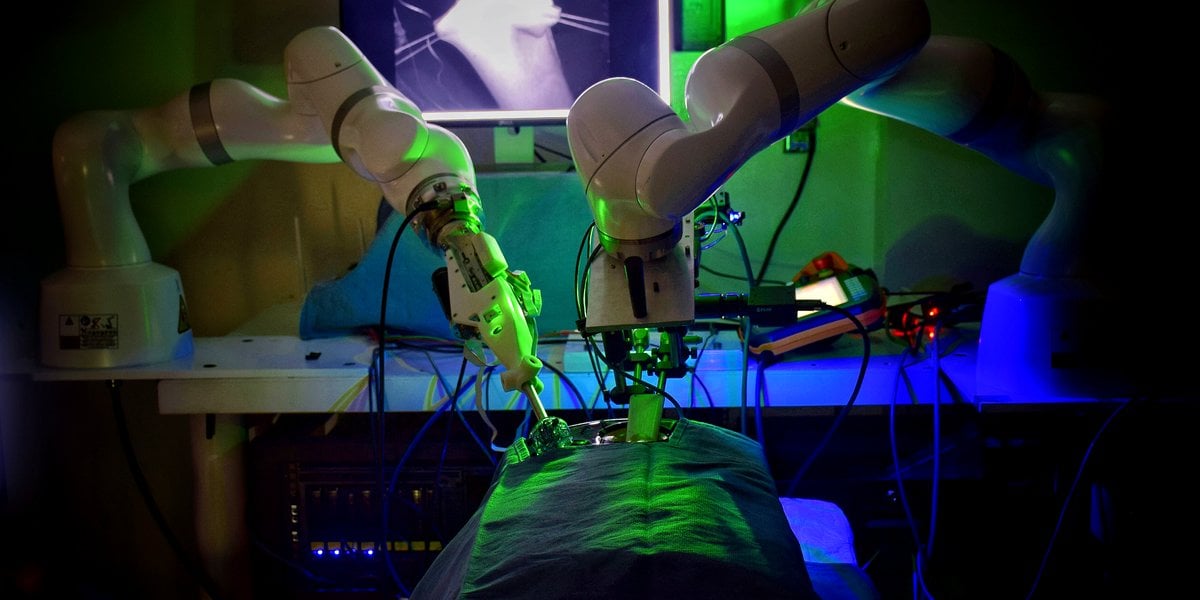
Robots Are Starting to Make Decisions in the Operating Room – Next-generation systems can suture soft tissue with minimal human input
https://spectrum.ieee.org/star-autonomous-surgical-robot

Robots Are Starting to Make Decisions in the Operating Room – Next-generation systems can suture soft tissue with minimal human input
https://spectrum.ieee.org/star-autonomous-surgical-robot
2 Comments
From the article
Its patient is one of [more than 150,000 patients](https://colorectalcancer.org/basics/facts-and-statistics) diagnosed with colon [cancer](https://spectrum.ieee.org/tag/cancer) in the [United States](https://spectrum.ieee.org/tag/united-states) alone each year. The only curative treatment is to remove the diseased part of the colon—ideally in a minimally invasive laparoscopic procedure, performed with [surgical tools](https://spectrum.ieee.org/tag/surgical-tools) and a thin camera inserted through small incisions. But the [surgery](https://spectrum.ieee.org/tag/surgery) tends to be challenging. The surgeon’s skills, experience, and technique are the most [important factors influencing surgical outcomes and complications](https://pubmed.ncbi.nlm.nih.gov/23222282/), which occur in up to [16 percent of cases](https://pubmed.ncbi.nlm.nih.gov/26137968/). These complications can diminish the patient’s quality of life and increase the risk of death. The hope is that an autonomous surgical robot will improve these odds.
During surgery, this robot will perform tasks that require the utmost accuracy. The surgeon will first control its motions by hand to remove the cancerous tissue, then supervise the robot’s motion as it independently sews the remaining healthy colon back together. Using several forms of imaging and real-time surgical planning, the robot will place each stitch with submillimeter precision, a feat not possible with human hands. As a result, the resulting suture line will be stronger and more uniform, making it less likely to leak, a dangerous complication that can occur when the connection doesn’t heal properly.
While [autonomous robots](https://spectrum.ieee.org/tag/autonomous-robots) aren’t yet being used to operate on people in the way we’ve just described, we now have the tools capable of this futuristic style of surgery, with more autonomy on the way. Our team, centered around coauthor [Axel Krieger](https://engineering.jhu.edu/faculty/axel-krieger/)’s [robotics lab](https://imerse.lcsr.jhu.edu/) at [Johns Hopkins University](https://spectrum.ieee.org/tag/johns-hopkins-university), in Baltimore, is dedicated to developing robots that can perform complex, repetitive tasks more consistently and accurately [than the best surgeons](https://spectrum.ieee.org/in-fleshcutting-task-autonomous-robot-surgeon-beats-human-surgeons). Before too long, a patient may expect to hear a new version of the familiar greeting: “The robot will see you now.”
This is absolutely f amazing!!!!!
If mankind doesn’t kill itself, the future is looking f dope!!!!