
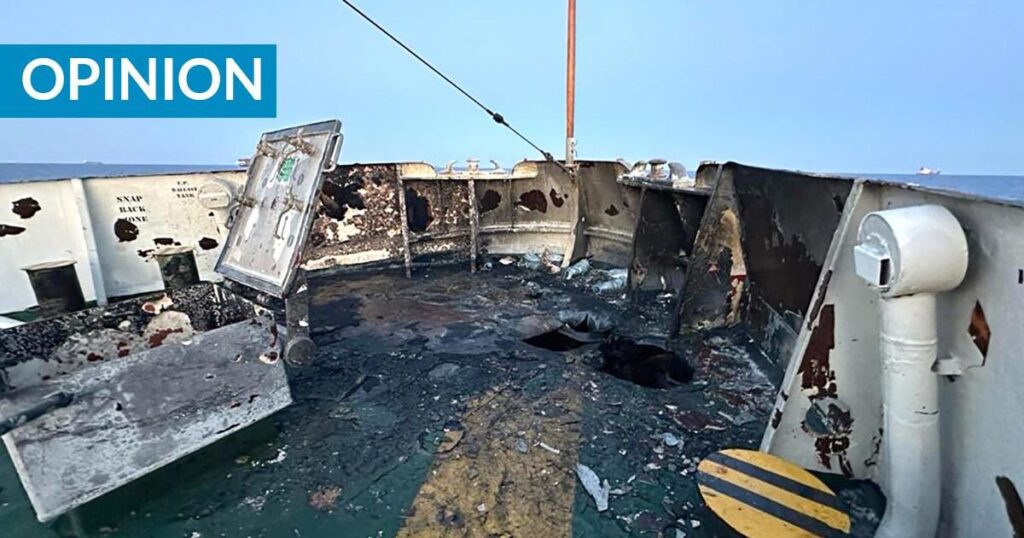
The Conscience episode is of grave concern in relation to maritime security and Malta’s coastal maritime interests, and it merits reflection.
Under international law, coastal or island states are in a privileged position as they are entitled to a range of rights in the waters adjacent to their coast.
Many are familiar with the 12 nautical mile territorial sea. Beyond this is the less known contiguous zone. The Conscience episode does not seem to give rise to issues relating to Malta’s enforcement powers in the area.
More importantly are Malta’s potential rights resulting from its entitlement to an exclusive economic zone (EEZ) located adjacent to the territorial sea. Malta has been over the last years carefully preparing to exploit the rights associated with this maritime area.
Under the Law of the Sea Convention (UNCLOS), once Malta declares an EEZ, it would enjoy sovereign rights to engage in various activities such as the production of energy from the water, currents and wind and carry out marine scientific research. It would be entitled to construct, authorise and regulate the construction of artificial islands, installations and structures. Malta will also have exclusive jurisdiction over such structures.
Malta is actively looking offshore to enhance its energy mix to mitigate greenhouse gas emissions. There seems to be significant interest from the private sector for offshore renewable projects. The 2024 National Policy for the Deployment of Offshore Renewable Energy indicates that offshore wind floating technologies are more feasible. It also suggests that due to several constraints floating structures are to be located within the EEZ area. Naturally, besides the generation of energy, other activities within the EEZ may be carried out like fishing and aquaculture.
The Conscience incident brings back memories of the Saipem case. In August 1980 a Libyan Suva class warship, accompanied by a submarine, ordered an Italian oil rig, Saipem Due, duly authorised under Maltese law, to stop offshore exploration and drilling activities.
This took place in an area situated beyond Malta’s territorial sea but which Malta claimed as forming part of its continental shelf. Libya, which contested Malta’s claim, threatened the use of force should the oil rig’s master not stop operations. This threat exposed personnel on the oil drilling platform to danger of physical harm. Malta’s plans were halted.
At the time, Malta had equally set its sights on the sea to sustain its economic development. During the post-independence period, amid a global economic crisis, rising oil prices and following the closure of the military base, one of the initiatives taken by Malta was to explore this offshore potential for economic self-sufficiency. The Saipem incident was unexpected. Following some intense diplomacy the matter went before the International Court of Justice.
The Saipem and Conscience episodes show some of the risks, and dangers, that certain activities carried out at sea may be exposed to. The actions carried out in the Saipem case had one purpose – a show of force intended to warn of what the consequences might be if certain behaviour persists.
The dynamics of the Conscience episode are less clear. The alleged drone attack remains unconfirmed. However, if it did happen, in all probability it took place within an area which Malta aspires to declare as its EEZ. Live fire in an area intended for civilian purposes is an unnecessary danger to life and infrastructure. Within some areas of Malta’s potential EEZ there is a high volume of shipping traffic taking place. Certain types of projects in offshore areas require substantial investment and a basic tenet for such ventures is security.
If the attack did happen, in all probability it took place within an area Malta aspires to declare as its EEZ- Antoine Grima
Indeed, security concerns regarding terrorism, intentional vandalism and unintentional damage through collision were raised during a public consultation carried out by the Energy and Water Agency some time ago on the proposed national policy on the deployment of offshore renewable energy.
The expectation is that this will be covered by the developer of the project and insurance cover. The same consultation also reveals that an area within the EEZ is a preferred fishing zone by locals.
Admittedly, international law does not offer much solace on such matters. The UNCLOS provides that artificial structures located within the EEZ are allowed a 500-metre safety zone. All ships must respect these safety zones and comply with international standards regarding navigation once in the vicinity of these structures.
There are also a range of contrasting views on whether military activities by a state can be carried out in the EEZ of another country. For some states the freedom of navigation includes carrying out military activities. Some states are also against coastal states being entitled to notification of any military exercises carried out in the area. However, the UNCLOS includes a crucial principle, that the high seas, which includes the EEZ, “shall be reserved for peaceful purposes”.
Malta and like-minded states need to find ways to ensure that their rights within an EEZ conferred to them under international law can be exercised safely and, when it comes to the supply of
energy, uninterruptedly. It would be useless to have international treaties which seek to enhance economic progress or increased accessibility to clean energy sources if these benefits cannot be enjoyed properly by coastal communities.
Regrettably, matters became complicated in international relations as the landscape changed and became more diversified and unpredictable. Sailing through uncertain times exposes the natural limitations of small states like Malta when it comes to maritime security matters.
However, diplomacy, including the conduct of international relations, remain crucial and perhaps forging alliances with likeminded states on such matters, even beyond EU structures, may be a step worth considering.
Malta still needs to send a message that any ventures putting at risk life, the marine environment, offshore resources and its economic development are unacceptable.
Additionally, once Malta declares its EEZ, or part thereof, it may also reaffirm that the enjoyment of freedom of international navigation within the EEZ excludes activities intended for non-peaceful use or which may affect its rights and interests.
In the meantime, Malta may also consider whether to invest in its surveillance systems to monitor its interests located beyond the outer limits of the territorial sea.
 Antoine Grima
Antoine Grima lectures at the Faculty of Laws of the University of Malta and is also a guest lecturer at the International Maritime Law Institute. He published a book entitled Sea Level Change and Maritime Boundaries.