
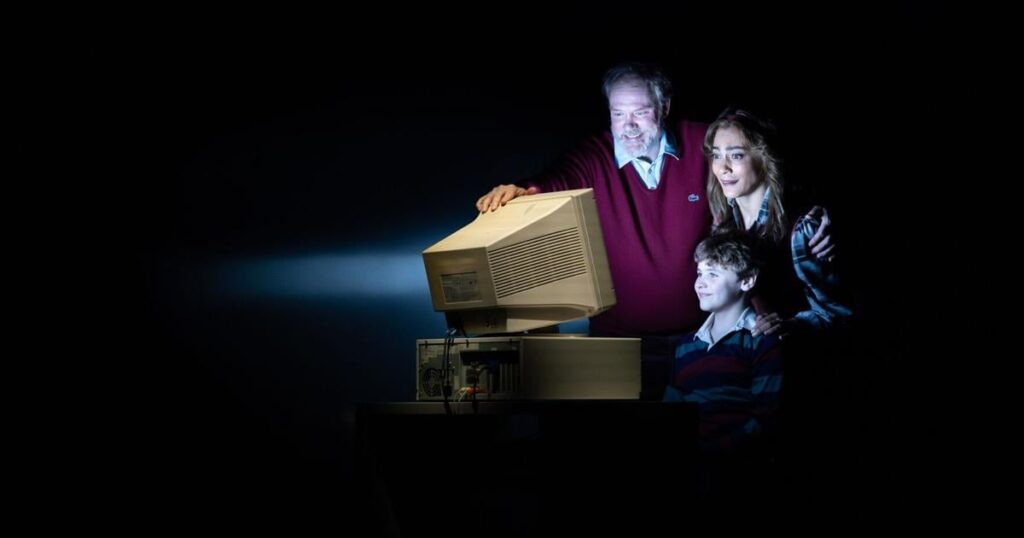
The best thing about Jordan Harrison’s “The Antiquities” is the mind-bending concept.
Fully titled “A Tour of the Permanent Collection in the Museum of Late Human Antiquities,” the world-premiere co-production by Goodman Theatre, Playwrights Horizons and Vineyard Theatre is set far in the post-human future but asks us to imagine that we’re back in time seeing how things got the way they are.
Two women in early 19th-century garb introduce us to the presumably digital museum and explain why they’ve decided to let the dead speak for themselves. Like the humans had museums to understand the dinosaurs, now that the humans are the dinosaurs, the “inorganics” hope by understanding them they can better understand themselves.
The exhibits — tableaux vivant as we experience them — start in 1816 with the gathering of Mary Shelley and friends on the shore of Lake Geneva (leading to her creation of Frankenstein’s monster) and extend to 2240 and the last humans in a primitive encampment. Most of the exhibits involve technological innovation, but the consequences aren’t always clear, and the drawbacks sometimes outweigh the advances. Human achievements range from an artificial finger to replace one cut off by an industrial age machine to an AI chip implanted in a writer’s brain.
Directed by David Cromer and Caitlin Sullivan, nine actors — Marchánt Davis, Layan Elwazani, Andrew Garman, Helen Joo Lee, Thomas Murphy Molony, Aria Shahghasemi, Kristen Sieh, Ryan Spahn and Amelia Workman — play 47 characters. Many show up in only one exhibit, but a few appear in several, creating story arcs that, among other things, show the museum curators’ complicated reactions to humans.
One such human is Stuart, a shy young man obsessed with robots. In a 1978 exhibit set in a bar, he is elated that he’s created life: A metal box on wheels he built has, after years of trial and error, taught itself to maneuver around an obstacle rather than crashing into it. But in the next scene, set in 1987, we learn that an emaciated Stuart is dying offstage, most likely of AIDS, and his sister Joslyn is trying to explain the mysteries of life and death to her son Noah. In one of the sparsely designed show’s many arresting cues, she does this solely by the light of the opened refrigerator door in a darkened room.
After the exhibit set in 2240, a female voice-over welcomes us to the Reliquary, the centerpiece of the exhibition. Here in lighted cases, one for each exhibit, are artifacts representing some of the “proudest achievements” of the “complex civilization” of the “late human era.” They include an electric light bulb, a rotary phone, a Betamax tape, a 1994 personal computer and modem, a circa-2000 flip phone and an early generation iPhone.
The voice-over describes them as “prosthetics, of a sort – intended to make the owner more powerful, more intelligent, more efficient, more immortal. More like us.” It goes on to discuss the debate about how to responsibly display the objects and their role in the humans’ mass extinction.
But there’s more. As lights rise on five more objects, the voice-over muses on the “human relics that continue to defy our understanding”: a threadbare teddy bear, a signature-covered arm cast, a pitcher of juice, a busted clarinet, a crop top that says “The Warriors.” Unable to discern their utility or religious significance, it speculates: “Much of human life seemingly existed in the chasm of accident between a Zero and a One. A Yes and a No. Gazing upon these mute objects, we try to imagine the life that took place in between:The chance encounter. The hurt feeling. The fumbling desire. The private thought. The shared secret. The awkward pause. The good cry. The bad night. The laugh. The prayer. The surprise … Did the humans consider it essential to their being, this messy in between? Did it serve any function, their evolutionary predisposition toward wanting, and needing, and harming, and being harmed?”
Finally, the voice-over wonders: “Has it truly been lost, this human in-between? Is it still humming for us, between the zeroes and the ones, if we listen closely enough?”
The museum tour continues with visits to the exhibits in reverse chronological order, and each scene seems to take place slightly after the previous one in that year. But I admit to being upset by Harrison’s dystopian vision, and the production’s elegiac tone. I can appreciate the cleverness and humor, such as the clunkiness of technology once considered cutting-edge, but if this is what the future has in store, what has it all been for? Or maybe the point is that the “inorganics” don’t understand the humans they superseded at all.