
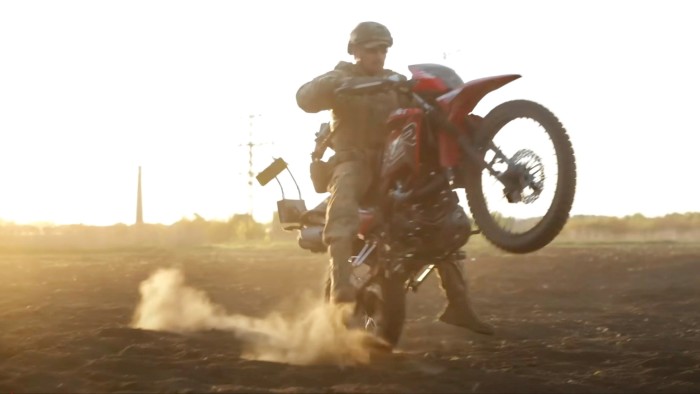
As Ukraine and Russia race to outmanoeuvre each other on a fast-changing battlefield, one Ukrainian assault regiment is putting its faith in horsepower — of the two-wheeled kind.
The 425th Skala Assault Regiment earlier this month said it set up the country’s first combat unit on motorcycles, training soldiers to ride hard, strike quickly and disappear before Russian drones can lock on.
It is a response born of necessity along the 1,000km frontline, where Ukrainian officials say drones now account for more than 70 per cent of combat deaths on both sides. The regiment’s approach signals a shift towards nimbler tactics as Ukraine braces for a renewed Russian push this summer.
“The Skala regiment is always looking for new approaches to stay one step ahead of the enemy,” said a soldier in the biker squad, who like others in the unit spoke to the Financial Times on condition of anonymity for security reasons.
Skala’s dedicated biker squad mirrors similar tactics introduced on the battlefield more than a year ago by Russian forces, who began using motorcycles and other two-wheeled vehicles — including e-scooters and bicycles — as well as some four-wheel all-terrain vehicles, in an effort to dodge Ukraine’s aerial surveillance and growing army of killer drones.
Since announcing the creation of Ukraine’s very own “modern cavalry” on two wheels, there has been plenty of criticism — including from within the ranks of Ukraine’s military.
The detractors argue that motorcycle deployments are extremely risky and contradict Kyiv’s emphasis on preserving soldiers’ lives, unlike Russian commanders who see the lives of their troops as expendable. Indeed the Russian biker units are called “suicide” squads.
But as killer drones increasingly dominate the skies above the battlefield — with hundreds in the air at any given time, according to soldiers and analysts — both sides are rethinking how they manoeuvre on the ground, seeking ways to stay mobile, unpredictable and harder to target.

Kyiv’s tactical shift comes as Russia has stepped up its offensive in Donetsk region and advanced westwards, closing in on neighbouring Dnipropetrovsk region. Were they to cross that symbolic border, Russian forces would deal a blow to Ukrainian morale, since Moscow could lay claim to an area it has not previously occupied.
Michael Kofman, a senior fellow at the Carnegie Endowment for International Peace, says that despite recent Russian advances, the front is not at risk of collapsing. “However, it is not stable either,” he added, noting that recent advances around Kostyantynivka threatened to encircle Ukraine’s forces.
At a training ground not far from the frontline in Ukraine’s east, soldiers of the Skala regiment have spent long days learning how to operate in pairs. It’s part biker gang, part assault squad, with one soldier driving, while the other is firing.
They are not the first Ukrainian troops to ride bikes in combat, but they are the first to be assigned to a dedicated unit.
They ride Forte Cross 300 Pro motorcycles — a Chinese-made off-road model. The bikes feature high ground clearance, durable suspensions and a petrol engine capable of reaching speeds up to 98km/h. And at around $1,500, the bikes are more affordable than four-wheel vehicles.
Videos published by the company show troops practising hit-and-run tactics and fast extractions across terrain that replicates the cratered areas along the frontline.
“You get in, hit the target, and move before they can respond,” said a Skala soldier. “The bikes are quick, light and reliable — it’s like riding through a storm.”
 Detractors argue that motorcycle deployments are extremely risky and contradict Kyiv’s emphasis on preserving soldiers’ lives © Ukraine’s 425th Skala Assault Regiment/Youtube
Skala, which means “rock” in Ukrainian, was founded in 2022 by its namesake commander, Major Yuriy “Rock” Harkaviy, whose brawny physique resembled that of former American pro wrestler turned action film star Dwayne “The Rock” Johnson. The regiment has fought in several frontline battles and quickly adopted novel tactics and equipment.
Soldiers told the FT their biker company had already proven its worth in real combat. “The initial deployments confirmed our concept — speed, surprise, and the ability to quickly change positions yielded positive results both in assault operations and in reconnaissance and direct engagements,” said a second soldier.
A video released last week by the unit purported to show several Skala bikers storming a Russian position under cover fire and darkness and quickly securing it.
The unit’s early success has caught the attention of other Ukrainian brigades who are considering forming their own biker companies and have reached out to Skala for advice.
But Bohdan Krotevych, a lieutenant colonel who until recently served as chief of staff of the Ukrainian National Guard’s Azov brigade, strongly disagrees.
“For the love of God, start thinking about defence and building reserve forces,” he wrote in a post on X that sparked public debate. Until Ukraine’s fortunes shift on the battlefield, he added, it should “forget about assault”, he added.
The first Skala soldier agreed that in addition to heavy artillery and killer drones, motorcycle troops face “mines, rough terrain, weather” that can put them in harm’s way.
“Yes, it’s fast. Yes, it’s mobile. But it also leads to higher casualties due to a complete lack of protection,” Oleksandr Kovalenko, a Ukrainian military analyst, wrote on Telegram. Bikes were “useful” for logistics, unit support, or reconnaissance and sabotage missions.
“But for assaults?” he said. “This is a path we shouldn’t have taken. Better to turn back while we still can.”