
Friday, May 30, 2025

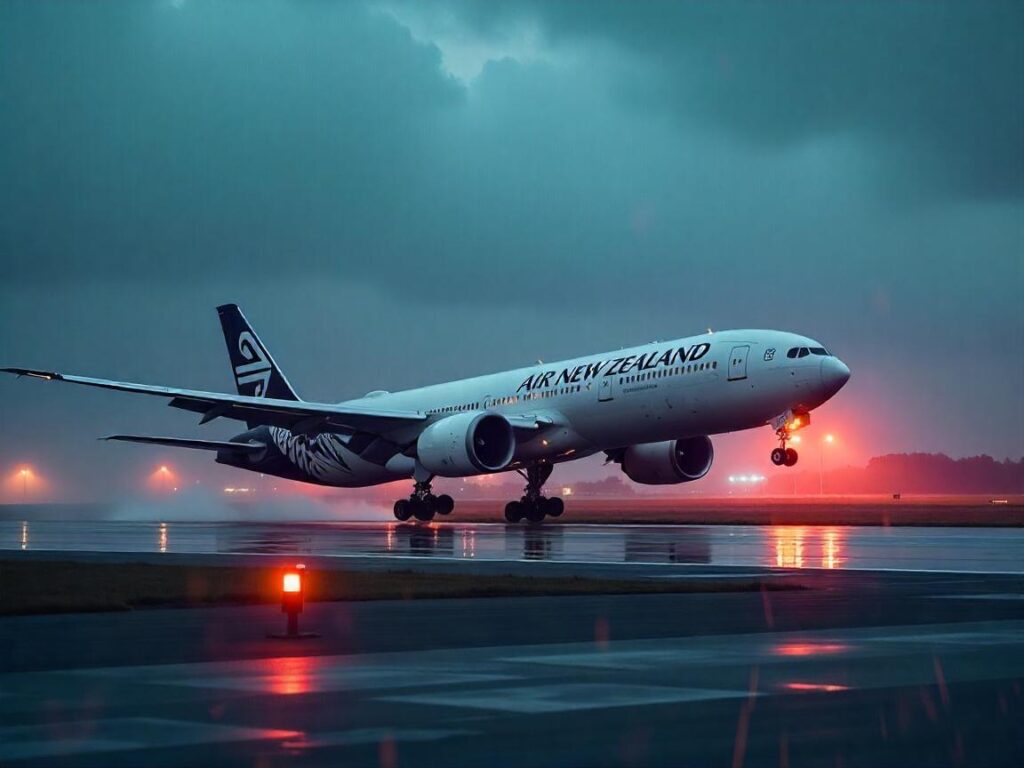
Air New Zealand’s Boeing 777 veers off the runway—and the skies over Auckland won’t forget it. The incident unfolded in heavy rain at Auckland Airport, turning a routine landing into a tense emergency. According to the latest TAIC report, a late switch from autopilot to manual control was the critical factor behind the veer-off.
This wasn’t just turbulence or a slippery runway. It was a split-second miscalculation in the middle of a severe weather event. The Boeing 777 veered from the centreline, hit runway lights, and suffered tire and brake damage. Fortunately, no one was hurt.
However, the report’s revelations raise urgent questions. Why was the autopilot disengaged so late? Could this have been prevented? And what does this mean for future operations at one of the busiest airports in New Zealand?
Air New Zealand’s Boeing 777 veers off. Heavy rain. Auckland Airport. TAIC report. Autopilot switch. And now, the full story demands attention.
Air New Zealand 777 Skids Off Auckland Runway in Torrential Rain, Investigation Reveals Critical Timing Error in Autopilot Disengagement
The skies over Auckland were dark with storm clouds on January 27, 2023—the night of the city’s historic Anniversary Day floods. But inside Air New Zealand Flight TZK-OKN, the danger came not from lightning, but from a critical delay in shifting from autopilot to manual control.
As the Boeing 777 approached Auckland Airport in severe weather, what should have been a standard landing spiraled into a near-disaster. According to the recently released Transport Accident Investigation Commission (TAIC) report, the aircraft veered off the runway after touchdown, damaging six runway edge lights and suffering significant tire and brake damage.
No passengers were injured. But the findings are a stark reminder of how even small deviations from standard procedure can escalate in extreme weather.
What Went Wrong: A Late Autopilot Disengagement at Low Altitude
At the core of the incident was the pilot’s late transition from autopilot to manual control. The TAIC report revealed that the disengagement occurred at just 20 meters above ground.
Standard operator procedures recommend switching to manual between 90 and 180 meters. By waiting too long, the pilot had only seconds to react to wind shifts and heavy rain.
Moreover, the aircraft began drifting right of the runway centerline just before touchdown. And with insufficient time to correct the course, the plane veered further after landing—eventually striking six edge lights before the pilot regained control and taxied to the terminal.
The Weather Wasn’t the Only Challenge
Auckland was in the grip of an unfolding flood crisis that night. Visibility was limited. Winds were shifting. And heavy rainfall made flight operations especially demanding.
Still, investigators noted that the weather, while intense, never dropped below the minimums required for safe landing. The issue wasn’t runway flooding—it was the transition between flight systems.
Once the autopilot was disengaged, all automated control inputs stopped. The pilot’s manual inputs did not match the settings the autopilot had maintained, causing the plane to roll right and stray from its path.
Structural Damage Revealed on Inspection
After safely taxiing to the gate, the aircraft was inspected. The findings were serious. Six right-side landing gear tires had suffered damage. One was completely deflated. The right brake assembly and associated wiring had also taken a hit.
Runway lights were found shattered along the aircraft’s landing path, confirming the extent of the veer-off. But thanks to expert handling in the final moments, the incident did not escalate further.
Still, the event triggered widespread internal reviews and sparked public concern, given the high-profile nature of Boeing 777 operations and the ongoing global scrutiny of aircraft control systems.
Air New Zealand Responds With Safety Reforms
Air New Zealand, in coordination with the TAIC, responded promptly. Operational procedures were revised. Specific emphasis was placed on training pilots to execute smoother transitions from autopilot to manual control—especially during high-stress approaches.
The airline also reiterated its commitment to safety, praising the crew for maintaining professionalism under unpredictable and fast-changing conditions.
This wasn’t just a procedural slip—it was a test of how training and real-time decision-making intersect in modern aviation.
Global Aviation Watching Closely
As global air traffic rebounds post-pandemic, the spotlight on flight safety grows ever sharper. This incident, although resolved without injury, sends a strong signal to airlines and regulators worldwide.
Flight automation systems, while powerful, require precise human interaction. And in moments of chaos—weather disruptions, visibility loss, or sudden wind shifts—the margin for error narrows dramatically.
With more aircraft now reliant on blended automation and manual inputs, aviation safety training is adapting. Emphasis is shifting from basic skill refreshers to scenario-based decision-making under pressure.
What This Means for Travelers
Passengers may not always see the intricate systems at work during flight. But reports like these are a reminder of the complexity—and vulnerability—of aviation.
It underscores the importance of strict procedural adherence, constant crew training, and real-time weather adaptability. It also highlights how fast technology has evolved—often requiring pilots to make split-second transitions from machine-led flight to manual control with near-perfect accuracy.
For travelers, this event reinforces why aviation remains one of the most highly regulated and constantly refined industries in the world.
Looking Ahead: Operational Resilience in a Changing Climate
As climate change leads to more volatile weather, incidents like Auckland’s runway veer-off are likely to become more common. Airlines must future-proof their procedures to handle extreme weather with greater consistency.
This includes updating autopilot disengagement thresholds, real-time weather forecasting integrations, and runway condition monitoring.
Airports, too, must adapt. Surface water drainage, lighting durability, and emergency response coordination are all under review in major global hubs.
The Auckland incident may have ended safely—but it has triggered ripples of change that will affect aviation standards far beyond New Zealand.
Conclusion: Safety Starts in the Smallest Details
The TAIC report is clear: the late switch from autopilot to manual, combined with stormy conditions, led to a runway veer-off that could have been worse.
But thanks to swift crew action and robust aircraft systems, disaster was averted. The lesson is simple but powerful: every detail in aviation matters. Every second counts. And every standard exists for a reason.
As Air New Zealand updates its systems and the industry learns from the event, one thing is certain—aviation’s pursuit of safety never lands.
Tags: Air New Zealand, aircraft automation risks, Airline News, airline safety procedures, Auckland Airport, autopilot systems, aviation incidents 2023, aviation regulation New Zealand, aviation safety, boeing 777, global aviation standards, pilot training, runway veer-off, TAIC report, weather-related incidents
