The Nobel Prize Winner Who Thinks We Have the Universe All Wrong
https://www.theatlantic.com/science/archive/2025/05/adam-riess-hubble-tension/682980/?utm_source=reddit&utm_medium=social&utm_campaign=the-atlantic&utm_content=edit-promo

The Nobel Prize Winner Who Thinks We Have the Universe All Wrong
https://www.theatlantic.com/science/archive/2025/05/adam-riess-hubble-tension/682980/?utm_source=reddit&utm_medium=social&utm_campaign=the-atlantic&utm_content=edit-promo
12 Comments
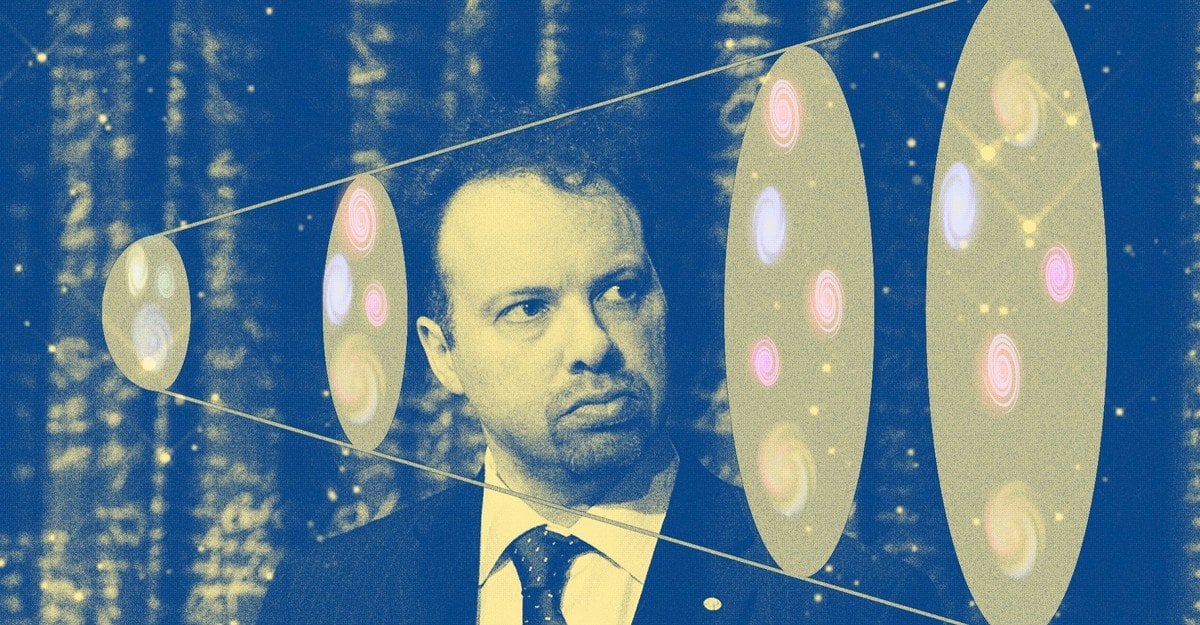
Adam Riess won a Nobel Prize for his contributions to the “standard model of cosmology.” Now he says that model might be wrong. Ross Andersen reports:
“For nearly a century, astronomers have known that the universe is expanding, because the galaxies that we can see around us through telescopes are all rushing away. Riess studied how they moved,” Andersen writes. “The farther away that galaxies were, the faster they were receding. This ‘immediately suggested a profound conclusion,’ [Riess] said in his Nobel Prize lecture. Something is causing the expansion of the universe to accelerate.”
“Few people played a larger role [than Riess] in establishing the standard model as the field’s dominant theory of how the universe began, how it organized itself into galaxies, and how it will end,” Andersen writes. But after his Nobel Prize win, Riess continued his research, and found major discrepancies with the standard model.
“Whenever a big theory of the universe is teetering, the old guard tends to close ranks; hence, the classic joke about science progressing one funeral at a time. Riess easily could have joined the old guard,” Andersen writes. Riess has instead loudly cast doubt upon the “standard model.” “If the standard model were to topple, the field of cosmology would be upended, and so would an important part of the grand story that we’ve been telling ourselves about the end of the universe,” Andersen writes.
Riess believes that in time more cosmologists will start to question the standard model. Andersen continues: “For someone who helped stand up that theory, he comes off as gleeful about this possibility. Maybe this is just his scientific mindset: always deferential to the data. Or perhaps he simply craves the thrill of being right, again, about the fundamental nature of the universe.”
Read more: [https://theatln.tc/wOkguvZV](https://theatln.tc/wOkguvZV)
— Emma Williams, associate editor, audience and engagement, *The Atlantic*
Sure, probably. That’s how it’s always worked in the past.
Journalistic sensationalization aside; “science isn’t finished yet, and will get more accurate” is a pretty safe bet.
We are almost certainly at least a little bit wrong about everything. As we measure and identify things better, we discover that many of our understandings of physics and chemistry are either good enough solutions which need refining, or, solutions to our local space that don’t hold true elsewhere.
.. just as Newton’s laws turned out to be good enough for nearly all the time.
However, I can’t tell you when the next breakthrough will come or what it will be. Sometimes we need the dreamers and the mavericks to challenge the status quo.
Any details on WHY Riess believes the standard model may be wrong?
So they are “discovering” what Christians have known for thousands of years. Interesting
We are just using the wrong math system. Do everything in base pi and it works out
Is the Universe adding more RAM or Hard Drive space….or both?
Dude must have burned through his winnings from the Nobel prize and wants to get another one.
Science is a collective group effort – it’s the persuit of mutual understanding and progression.
“one funeral at a time” bakes inefficiency into our persuit of efficiency. Knowledge isn’t something to be guarded, knowledge only makes sense when it is shared.
So what if the standard model is wrong.
Realising that the earth wasn’t flat, geocentrism and later heliocentrism were wrong and that illnesses were cured by ridding the ghosts in your blood by taking cocaine were all beneficial milestones.
Imagine if humanity embarks on a half century of genuine scientific breakthroughs.
So much unknown… We haven’t even scratched the surface. As all of our observations are from the earth, our solar system, our galaxy.
I don’t understand. If the farthest galaxies are moving faster, and those are older than the slower moving galaxies near us, wouldn’t that mean the universe is expanding more slowly now?
Well we’re young yet. It’d almost be a shame if we were right by now.