
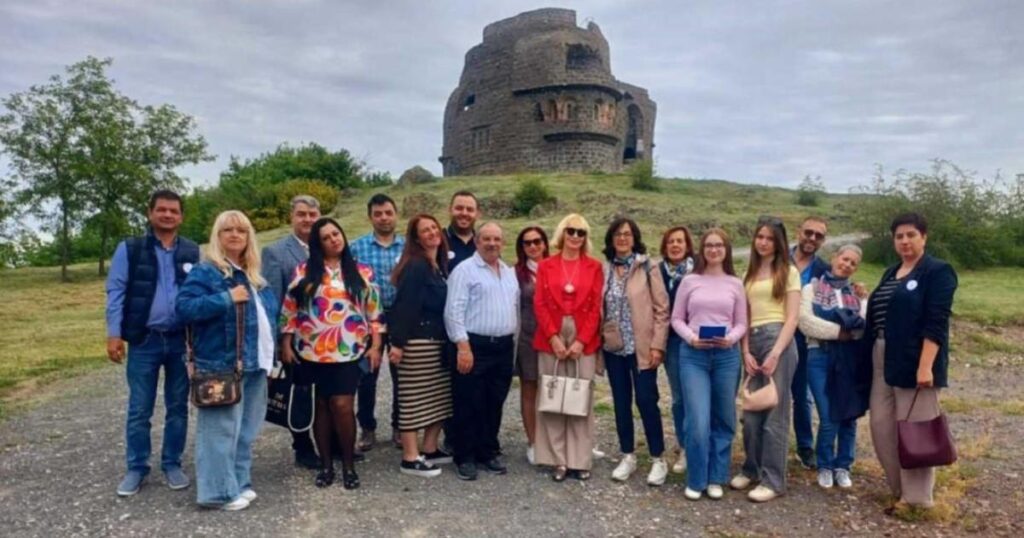
A group of educators from Malta, Italy and Romania recently took part in an Erasmus+ teachers’ mobility project entitled ‘Learning Using Hands-On and In Real Time Situations’ hosted by DSU-RCSOO ‘Kiro Burnaz’, a school in the town of Kumanovo in North Macedonia, in the heart of the Balkans.
Four educators from the Alternative Learning Programme (ALP) school in Paola, which forms part of St Thomas Moore College, took part in the mobility.
The week-long visit, held from May 5 to 9, brought together teachers from across Europe to exchange best practices, explore innovative teaching methods and engage deeply with Macedonian culture.
The mobility formed part of a broader Erasmus+ programme-supported project called ‘Strategic Actions For Early-school-leaving Reduction’ (SAFER), which is promoting lifelong learning and cross-border cooperation, focused on equipping educators with practical tools to create dynamic and engaging learning environments to avoid students leaving school early.
The mobility’s central theme – learning through hands-on and real-time situations – aimed to encourage the participants to shift from traditional, passive modes of instruction to more interactive, experience-driven approaches.
We often talk about 21st-century skills in theory, but this project put them into practice
Journey through practical education
Throughout the mobility, the teachers took part in a series of workshops and classroom visits at the local school and field-based learning experiences. These included a session where the students prepared traditional Macedonian food at the school’s bakery.
The teachers were also taken to an apiary in the school’s premises where a number of acacia trees are grown and whose flowers provide food for the bees. The students and their teacher also gave a detailed explanation of how the bees are taken care of.
These sessions emphasised learning by doing, a pedagogical model proven to boost student engagement, critical thinking and retention.
Another aspect that struck the teachers during the visit was the close connection between learning and life. They visited two business firms run by entrepreneurs who, only a few years earlier, were students at the school.
One student runs her own beauty parlour while another student set up a lab that produces herbal teas and other natural medicinal creams. Their success stories are powerful proof that education rooted in real-life experience can change futures.
The teachers also explored interdisciplinary approaches, learning how to integrate multiple subjects into hands-on projects to make lessons more relevant and exciting for students, and to encourage them to continue their studies.
One participant remarked: “We often talk about 21st-century skills in theory, but this project put them into practice. It was incredibly valuable to see how experiential learning can be implemented across different subjects and age groups. It showed that hands-on learning has a multiplier effect compared to chalk-and-talk. Students learn more with this method of teaching because they are not just seeing things done but they are doing it themselves.”
Cultural enrichment and deeper connections
In addition to pedagogical development, the mobility had a strong cultural component designed to deepen the participants’ understanding of North Macedonia’s heritage and way of life.
Each day concluded with immersive cultural tours to historically significant locations, including the capital city, Skopje, known for its blend of Ottoman, Byzantine and modern architecture.
The group of educators, accompanied by students from the local school, were taken to Zebrnjak memorial, commemorating the Battle of Kumanovo of 1912, which was part of the First Balkan War. There, the students shared with the teachers information about the historical site.
Cultural exposure is an essential part of professional growth. When teachers understand the context and culture of a country, they are better prepared to foster global awareness and tolerance in their classrooms.
The teachers also visited Matka canyon, one of the most picturesque natural attractions in North Macedonia located on the river Treska, not far from Skopje. They also boarded a boat on a lake and visited Vrelo cave, which boasts magnificent stalactites and stalagmites and is the deepest cave in the Balkans.
Throughout the tour, the local students acted as the teachers’ guides, highlighting interesting information about the sites.
The participants also paid a cordial courtesy visit to Kumanovo mayor Ivana Gjorgjievska and held an informative discussion with a representative of the education ministry.
Building a network of educators across Europe
One of the most useful outcomes of the mobility was the creation of strong professional bonds between the participating educators. It provided a forum for exchanging ideas, developing collaborative projects and building a support network for continued growth and innovation.
Plans are already under way for follow-up activities, including virtual exchanges between schools, collaborative lesson planning and future mobilities in partner countries.
These long-term goals aim to sustain the momentum of the SAFER project and embed experiential learning into teaching practices across Europe.
As one participant commented: “This was more than just a mobility; it was a transformative experience that reconnected us with the true purpose of education – to inspire curiosity, creativity and meaningful connections.”
Looking forward
Before the mobility ended, the participants met and evaluated its outcomes, and a survey confirmed that everyone was satisfied with what had been achieved. They also discussed the upcoming mobility, which will take place in October in Malta, with the theme ‘Using soft skills to facilitate learning’, and will conclude the project.
The teachers returned to their home countries carrying with them not just new strategies and lesson plans, but also a renewed sense of purpose and a deeper appreciation for cultural diversity.
The success of the mobility in North Macedonia sets a promising tone for future collaborations under the Erasmus+ programme, which continues to elevate education through the sharing of experience, the promotion of empathy and the strengthening of European unity.
The Erasmus+ mobility once again proved that learning transcends borders – and that when teachers grow, so do the students they serve.
Emanwel Zammit is an automobile engineering teacher at ALP and Erasmus+ projects coordinator.