

Kupchan: US will reengage in the region and Kosovo and Serbia through NSC and DASH, creating teams is taking time


Express newspaper
04/06/2025 16:06
It has been six months since a new US ambassador to Kosovo. In an interview with Gazeta Express, American analyst and professor Charles Kupchan says that the failure to appoint Jeff Hovenier’s successor from the White House has to do with the fact that the Trump II Administration is at the beginning of its mandate and has a large number of issues it is dealing with at the same time, such as Ukraine, Gaza, tariffs and even China, writes Gazeta Express.
“So, it’s not unusual that it takes time to vet people and appoint ambassadors,” Kupchan told Gazeta Express, adding that he does not see this issue as a dissenting political stance of the US regarding Kosovo.
“I think Trump is just taking time to review the long list of positions that need to be filled,” he told Express.
Kupchan remains of the same stance that there is no room for concern on the part of Kosovo, despite the fact that it has been known for several weeks who the new US ambassador to Belgrade will be.
The American professor says that there are probably many countries that still do not have ambassadors appointed and that it is too early to assume that the failure to appoint a new US ambassador to Pristina could be some kind of punishment for Kosovo.
“So, again, I think it’s too early to assume that this is some kind of punishment,” Kupchan added.
Regarding the Western Balkans region and Kosovo, Kupchan says Trump has made it clear that he wants Europe to do more to take care of its own affairs, especially those related to security aspects, while he himself wants to focus on the Indo-Pacific and the Western Hemisphere.
The American professor, however, recalls the fact that during his first term, Trump was engaged in the Western Balkans through Richard Grenell and says that he does not expect the Trump II Administration to ignore the Kosovo-Serbia dialogue and the problems facing Bosnia and Herzegovina.
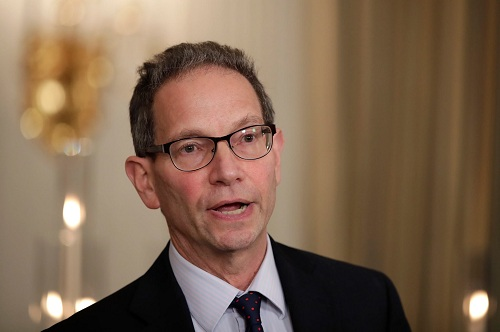 Charles Kupchan- Professor at Georgetown University
“But I think it will take time to reengage when senior diplomats are so focused on Ukraine, Russia, the Middle East, the Iran nuclear deal and tariff negotiations,” he said.
The Georgetown University professor does not expect the high level of politics to deal with the problems in the Western Balkans, but says that a political community in the National Security Council and the US State Department will be engaged, while things in Washington are calming down.
Kupchan confirms that there is dissatisfaction in Washington with the leader of the LVV and the acting Prime Minister, Albin Kurti, and that there is agreement in both political camps in the US that Kurti has taken provocative actions in the North that have hindered dialogue with Serbia.
“Is there dissatisfaction in Washington with Kurti? Yes. I think there is a view shared by Democrats and Republicans alike that he took provocative actions that hindered dialogue with Serbia,” Kupchan told Express.
The American professor says that there is also concern in the US about the fact that Kosovo is unable to form a new government and that this lack of institutions in Kosovo, combined with the political situation in Belgrade, makes things look turbulent.
According to Kupchan, the US just needs time to build the team with which it will re-engage in developments in the Western Balkans and in the dialogue between Kosovo and Serbia.
“And there is concern in Washington that Kosovo is not able to form a new government. And then when you combine what is happening in Pristina with the political turmoil and instability in Belgrade, things look turbulent. And so I think there is concern in Washington about the situation here, and it is just taking time to build the team that will reengage,” the American professor said.
What has happened in the past and Kurti’s actions in the North and in relation to alliances like the US and the EU, Kupchan says, will have an impact on how the relationship between Kosovo and the US will continue in the future.
The expert on developments in the Western Balkans region says that if Kurti wins a new mandate as prime minister, he encourages him to have a greater commitment to the dialogue process and move towards the creation of the Association.
“Yes. I think Kurti has done damage to Kosovo’s relationship with the EU and the US. And if there is a new government soon and Kurti gets a new mandate, I would encourage a greater engagement in the dialogue process. I would encourage the movement for the Association of Serbian Municipalities,” he says.
Kupchan adds that if he were in Kurti’s place, he would try to send signals to Brussels and Washington that Kosovo wants to move forward with the dialogue and move forward to implement the agreement reached under EU mediation. According to the American professor, if there are actions towards the establishment of the Association, Kosovo’s image in the eyes of Washington and Brussels will change.
At the end of the interview, discussing the current political crisis, Kupchan says that it is good news that Kosovo is a normal Western democracy, meaning where there is the same political polarization as in the US, France or Germany.
“What is happening in Kosovo is part of a broader story of political division and democratic dysfunction. It can be said that Kosovo is now in the same situation as many other democracies. I would say that the special sauce of democracy is consensus and compromise,” said Kupchan, when asked if he had a message for political leaders in Kosovo.
The American professor says that as far as he understands the political situation in Kosovo, the biggest obstacle is Albulena Haxhiu, whom Kurti has proposed for Speaker of the Parliament. He calls on the Self-Determination Movement and other parties to find a compromise on the formation of new institutions, since Kosovo has too many problems at home and abroad to afford such a waste of time.
“I would encourage the members of the Vetëvendosje party, as well as the opposition parties, to focus on consensus and compromise and reach a solution for the Speaker of Parliament, form a government and continue the work. Because Kosovo faces many challenges both at home and abroad and cannot afford to lose much time,” concluded Charles Kupchan./Express newspaper/
aaaaa