
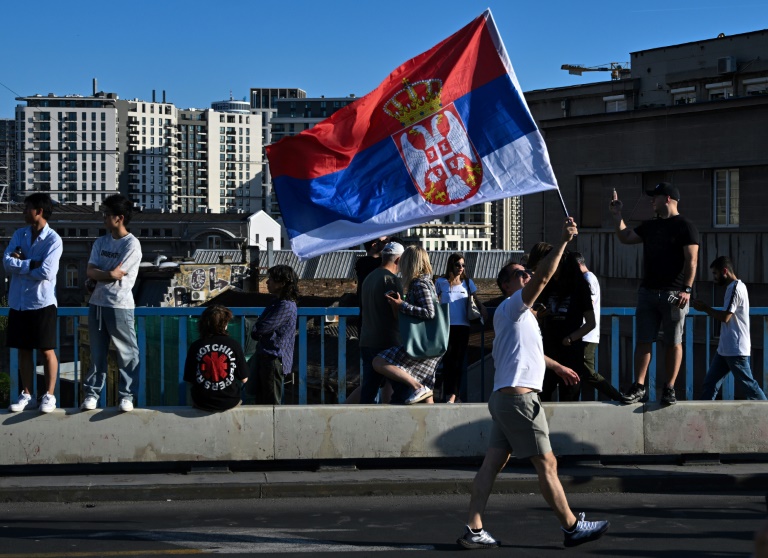
Kosjeric, a town of 10,000 in western Serbia, has become the epicentre of the Balkan nation’s political turmoil, hosting the first local election since months of mass protests — a key test for the student-led movement against ruling nationalists.
“We’re all voting for a better future for this town,” said area resident Drina Milutinovic, 74, as she spoke with students who had come to encourage her to vote freely.
For weeks, students have campaigned door-to-door, following an old Serbian tradition by carrying a buklija — a decorated wooden flask filled with rakija (brandy) bearing the message: “Go out and vote.”
The students are backing a new, independent electoral list of candidates aiming to challenge the ruling party through unity, rather than traditional opposition parties.
They hope to recreate the scenario from 1992, when a united opposition defeated strongman Slobodan Milosevic’s party, making Kosjeric one of the first municipalities in former Yugoslavia to come under opposition rule.
The Balkan nation has been rocked by anti-graft protests since 16 people were killed on November 1, when the roof of a freshly renovated railway station collapsed in Novi Sad — a disaster widely blamed on deep-rooted corruption.
Since then, students backed by the wider public blockaded universities and took to the streets, demanding accountability and a transparent investigation.
Feeling their demands were unmet, they called for early parliamentary elections.
Populist President Aleksandar Vucic, who labels the protests a “colour revolution” and even “an attempted coup”, has hinted that national elections “might be held soon” — though offered no date.
– Litmus test –
Meanwhile, Kosjeric is preparing for its regular local elections next Sunday — the first test between the ruling party and the protest movement — with an atmosphere usually reserved for national polls, marked by intense campaigning and alleged irregularities.
“They represent the first official opportunity to gauge the effects of months-long protests, at least on a micro level,” political analyst Bojan Klacar told AFP.
The ruling Serbian Progressive Party (SNS) is being challenged by the united independent candidates’ list featuring some new faces to politics as well as opposition members who have dropped party labels — a model planned for the eventual national elections.
“We responded to that student initiative to unite the whole opposition, so that we could stand as a powerful opponent to the ruling party,” said Tijana Maric from the United for Kosjeric list.
Maric said everyone is watching Kosjeric for its national impact.
“The outcome could give momentum to either side,” said Klacar, head of CeSID, an independent electoral monitoring group. “It could help the ruling party consolidate power or strengthen the students’ call for early elections.”
Students now aim to “raise awareness among the people about how important it is to vote”.
“We’re trying to visit every elderly woman here and let her know that we’re present, and to explain how crucial it is to go out and vote,” said university student Sara Andjelic, 21.
The SNS, by contrast, is relying on a mainstream campaign with rallies and TV ads.
Voting is also set for June 8 in Zajecar, where the SNS has ruled for a decade, though that race remains more conventional with a myriad of parties and independents on the ballot.
But Vucic is “confident” that the SNS will win, despite neither city being a party stronghold.
– Alleged irregularities –
Corruption watchdog Transparency Serbia reported this week a spike in ministerial visits to both cities.
“They come to us once a week… And we get to hear and meet those ministers,” Vesna Petrovic, a Kosjeric resident, told AFP.
Transparency Serbia also noted that authorities have been rushing local infrastructure projects and called for prosecutors to investigate alleged gift-giving — including cash — to voters.
The opposition made similar allegations of irregularities after the December 2023 parliamentary elections, which the SNS won and dismissed as unfounded.
Students will be actively involved in monitoring election day, with observers coming from across Serbia.
Their protests already forced the prime minister to resign, leading to the collapse of the government.
In mid-April, parliament elected a new cabinet led by Djuro Macut, a political newcomer and medical doctor.
mp-oz/giv