China doubles down on building telescopes in Thailand
https://www.bangkokpost.com/thailand/general/3038796/china-doubles-down-on-building-telescopes-in-thailand

China doubles down on building telescopes in Thailand
https://www.bangkokpost.com/thailand/general/3038796/china-doubles-down-on-building-telescopes-in-thailand
1 Comment
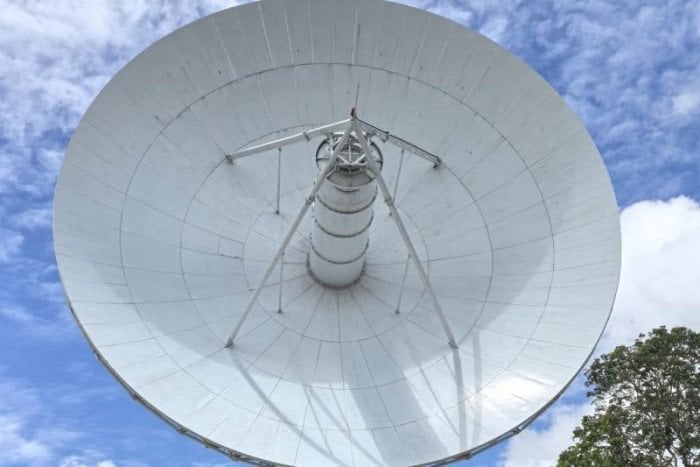
> China has completed its first overseas new-generation radio telescope in northern Thailand, bolstering a global scientific network that monitors deep space signals and tracks subtle shifts in the Earth’s rotation and tectonic plates.
> Together with a second telescope under construction in Songkhla, southern Thailand, the station will enhance deep-space tracking and high-precision **Earth monitoring, contributing to more accurate GPS, climate research and earthquake forecasting.** The telescope is equipped with a fast-slewing antenna, capable of rapidly switching between observation targets. It also features dual-frequency receivers to reduce atmospheric interference, along with high-speed data acquisition and recording systems.
> The two telescopes in Thailand are part of a technique called Very Long Baseline Interferometry (VLBI), which links multiple radio telescopes across vast distances **to function as one enormous, Earth-sized antenna.**
> These telescopes regularly take part in international campaigns coordinated by the International VLBI Service, which includes more than 30 active stations across Asia, Europe, **North America** and other regions.