
![[OC] Cost of Living: Systemic Crisis or Personal Choice?](https://www.byteseu.com/wp-content/uploads/2025/06/7t0122HoCmie2n4lJfAPmf7gDOP9qYOLcUBx1v9jXsw-844x1536.png "[OC] Cost of Living: Systemic Crisis or Personal Choice?")
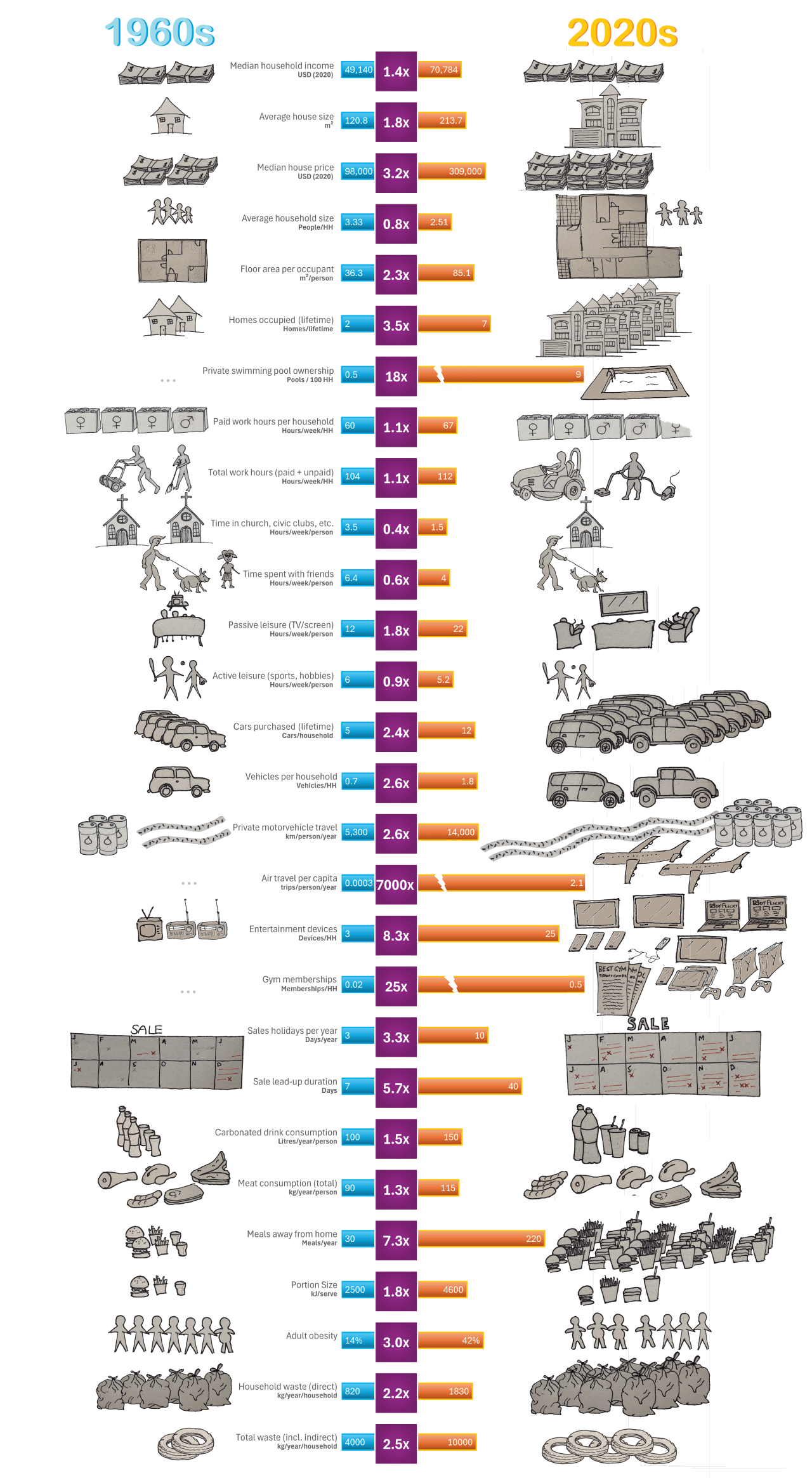
As part of a bigger project challenging norms on how we perceive happiness and what to prioritise in life, I have put together this comparison of the lifestyle of a typical U.S. middle-class household in the 1960s vs the 2020s. Using predominately government and academic sources, I charted key metrics like income, housing, transport, time use, consumption, and waste.
While real incomes have risen about 40%, the average house is now nearly twice the size, with 2.3× more space per person. Families own more than twice as many cars, eat out 7× as often, and average over 25 personal entertainment devices. At the same time, we spend less time with friends or in community, and screen use has doubled.
Some costs have risen faster than income (like housing and healthcare), but many pressures seem to be self-inflicted. They have been driven by rising expectations and lifestyle inflation. The data shows that we (in Australia too) now work fewer hours and have more leisure time, but feel more stressed and financially insecure.
Note I'm not attempting to blame or shame individuals, but to question our assumptions. We have more control than we think. Lowering our aspirations and living more with less might be the best way to reclaim time, reduce stress, and restore balance. I was pleased to see the recently shared post showing that 43% of Americans already feel that money won't buy them happiness, so I guess the next question is looking at why we're all still striving so hard for more money.
The data was collated in Excel and exported as multiple .png files. Images are hand-drawn, photographed and all composed in Paint.
Some of the data is best estimate from the nearest available time series. It is indicative at best, but if anyone has better figures for any of the key points I'm happy to update. Much more detail and references for all sources on my blog.
Posted by LivingMoreWithLess
36 Comments
So things like gym memberships are sort of a new phenomenon. I wonder what things people spent money on in the 60s that we don’t even think about today and so didn’t make it into the list.
Would be curious about recycling waste. I assume it wasn’t included as it might have been very close to 0 in the 1960s. Overall very interesting.
Wow! That’s eye-opening, and presented engagingly. Fascinating. It’s one of those charts that just draws you in.
I’d love for you to do the same for the UK…
There is so little causation between these data points that it makes it meaningless. Also many of these things are being portrayed as living a more indulgent or lavish lifestyle but are actually symptoms of the broken economy that are inflicting more costs on modern families. The car example for instance, modern cars break down much more frequently due to their complexity or cost saving measures on materials. It’s not possible to only own two cars in your lifetime any more. That’s a huge additional expense pushed on consumers because cars are not designed to last like they used to.
And then you go to Silicon Valley, where most of the houses are small things built around 1960 but cost more than a new McMansion anywhere else.
Yikes, this is not beautiful. It is cherry-picked heavily and provides no correlation.
Where are grocery prices? Car prices? Utilities? Child care? Is this adjusted for inflation?
I suggest adding a reference link to the image or a QR code that directs users to your blog. The Internet is fast, authorship and sources get lost easy.
I love that the graphics are made in paint and I’ve subscribed to your blog. You’re hitting the head of the nail on the connection between modern western culture’s consumption and mental health problems.
These entries are not remotely organized and there’s zero sense of proportion. Housing costs have way more impact than “private pool costs” or gym memberships but the chart barely reflects that.
Only some of these line items are universal, there’s no indication of demographics which might be paying for these either in the past or now.
A few entries are just ??? – Sales holidays? What *is* that? We’re buying… time off from… sales? What?
And food is still a massive need and yet here it’s presented extremely awkwardly. Meat prices only? Portion size but not restaurant spend in general.
Like, is this chart actually just bait?
Great job! Some people might be mad when they see this but don’t let that deter you. This is really insightful!
There have been 85 years of productivity and technology advancements. If we’re supposed to judge our current cost of living based on a 1960 lifestyle, whats the point of any of those advancements? This is the sort of stuff billionaires use to justify massive income inequality “the poors have cell phones and aren’t working 90 hours a week, they’d be rich by 1920s standards”.
Tvs used to be a major investment, now they’re basically free. Of course we have more of them. You can still only watch one at a time
A lot of what you’re pointing to as “choice” has a heck of a lot more to do with income inequality, globalized cheap junk, and work culture, all systemic factors, not “individual choice.” Trying to paint this as “everyone suddenly and for no reason got lazy and gluttonous” rather than “globalization burned through the whole world and there was no one left to exploit but ourselves” is a bit of a silly slant
It is systemic.
Your infographic lacks the fact that we shouldn’t have to work for basic needs.
On top of that, we want to enjoy life. We cope with existence.
You lost me at two plane trips a year for everybody? Is there a Spider George who never disembarks or have most people I know been living a secret life of air luxury?
this is when the poverty rate in the US was 2x it is now. Yes, people consumed less 60 years ago because they had less and living standards were lower. Yes, I suppose if more people were in poverty, consuming less then living costs would stop rising. But in what universe is a “solution”?
You cannot mix averages across these different categories and hope to get a representative survey. There’s a lot of correlation between them, and the distributions of some of these items are way more heavily skewed than others. That’s to say nothing of mixing median with mean across these categories.
Read “The End of Average” by Todd Rose to understand why taking the average across each individual characteristic does not give you a good picture of the “true” average, if there even is one.
If you don’t want to read the whole book, this article captures a lot of the key points:
https://www.thestar.com/news/insight/when-u-s-air-force-discovered-the-flaw-of-averages/article_e3231734-e5da-5bf5-9496-a34e52d60bd9.html
I don’t see this explicitly called or in the graphic, but you should point out those 1960’s numbers are all adjusted to present purchase power.
The median home value in 1960, for example, was really like $11,600.
I wish they built more starter homes, but it’s not as profitable, apparently. A house of the 1960s average size is still much less affordable than it was. I live in (rent) a townhouse around the old average size and they are now selling for over 530k (NJ). 12 years ago they sold for 260k. What are we doing?
Wow. So disappointed in this! Was really excited for it to show something actually interesting, which is that luxury items have become attainable, while necessities are now out of reach. That imperils us to a consumption culture. But this is a weirdly moralistic, cherry picked data set, with data points that hardly have any correlation, and have not been appropriately converted.
The cope in this thread when this is literally the most prosperous time in human history.
I wonder how services like Door Dash fit in?
I appreciate the effort, but I take massive issue with the assertion or at least what you’re juxtaposing this, if you don’t feel comfortable calling it an assertion, with.
First, how we measured these stresses is vastly different now than it was then. We likely severely under diagnosed anxieties and such due to things like stigma around it. Second, even if that weren’t an issue, we can’t determine if or how these things (changes in financial habits and changes in stress) are related from the information here. Third, even if they are related, they should be examined in context. It may be the case that the individuals most stressed are the ones saving the least, or that these spending behaviors are more adaptive than maladaptive.
It’s a question for psychologists and economists probably. I’m the former, I have no experience in the latter. There may be literature already covering it in either but it’s frankly out of my wheelhouse. I’m not saying there isn’t a connection, I’m just saying I don’t like that this isn’t actually really attempting to explore the connection before it’s attempting to make a statement. I just feel like saying “I’m just drawing parallels, I’m not saying *there is* causation here” feels like a cop out for what this presentation seems to be wanting to say.
Edit: I at least appreciate your responses acknowledging the bias and cherry picking here
This seems to ignore things like job location + concentration vs housing availability. Throw in salaries not keeping track with inflation… literally none of this matters. Time in church, meals out, private vehicle usage, etc. Even if it were the same as the 60’s it wouldn’t change the reality of today.
[Here’s an article from 1955 that pre-shames anticipated spending habits in the 1960s.](https://time.com/archive/6798898/the-u-s-in-1960-6180-a-year-for-tne-average-family/)
I was reading that if they US used metrics most modern nations did, our economy would be shit and our unemployment would be at 24% but the Oligarchy sure loves to push their propaganda here.
It’s all personal choice since we’ve collectively as a country been electing Republicans consistently since the 70’s. We haven’t had a liberal majority in the Supreme Court since the 70’s, Republicans have consistently held the Senate since the 10’s. We’ve elected Reagan, Bush, and Trump twice since the 80’s, that’s 24 years of ineffectual pro corporate stooge policy being shoved down our throat.
So yes, wages being stagnant and housing/medical/education costs skyrocketing is personal choice. Americans collectively vote for this year after year, decade after decade, generation after generation.
“the average house is now nearly twice the size, with 2.3× more space per person. ”
this is fairly goofy. the average home in the US is 45 years old, with a large inventory of homes built in those 60s you stated. yea I guess in the 60s you could bought a tiny 1920s home, but 60s homes are nowhere near only half the size of modern constructions. And, funny fact, those 1200sqft 100 year old homes, still sell for 2/3 the price of a 2400sqft home, there’s a general floor, and often value in the land, so there’s no way to “Lowering our aspirations and living more with less” on that front, and the size ‘inflation’ happened decades before we were born.
also, older homes had a way higher percentage of unfinished basements, which aren’t taken into consideration in ‘home size’
these were often finished later as premiums started to be rated more by finished sq ft. 1200sqft house with unfinished basement became 2000 sqft finished homes in the basement in the 80s/90s, just add drywall.
same house though. prob missing context you didn’t consider not being in America maybe?
The general gist of it is that, relative to general societal improvement, people of the modern age have a much greater access to day-to-day consumer luxuries (TVs, phones, consoles, computers, etc), but have lost as much access to life-long luxuries (basically just homeownership). But, given the general improvement, what we have comparably loss is a lot smaller than what we have comparable gained.
Some costs have risen faster than income (like a place to live and staying healthy/alive)
As someone who had to exhaustively study ethics in data gathering and presentation, this is covered in red flags and there is nothing substantive being shown here whatsoever aside from a very clear agenda. Groceries are excluded among other household necessities, but this graph chooses to focus on “wow, people have phones and computers now! So wasteful!” Absolute bollocks.
Everyone in this comment section is complaining it doesn’t include childcare or groceries.
But the explicit point of the comparison was to help us think about **choices**.
**Eating out** is a choice. **Groceries** are not a choice.
**Buying a bigger house** is a choice. **Childcare** is not a choice.
We already have plenty of great comparisons of price of groceries, childcare etc.
I think the OP’s choice to focus on what we **have more control over,** vs **what we have less control over**, and to gain new perspectives, is good.
Hours don’t add up — the total work hours = 112 (16*7) add that to leisure (22) and you get 134, which means the average person gets 4 hours of sleep a night.
> While real incomes have risen about 40%, the average house is now nearly twice the size, with 2.3× more space per person.
The problem with this comparison is that the land got more expensive not just the houses. e.g. in an expensive city a $1m property can have a land value of 650k and house value of 350k. If you reduce the size of the house by 50% the overall property price drops by only 10% but now you get a lot less value for it.
The result is that you simply can no longer get a property that is small and cheap. You either get a large expensive house or have to live in a shared flat with several people. Young people simply can no longer live like in the 60s. It isn’t their choice.
Bit misleading as if the regular person controls the skyrocketing of house prices
People eat out 220 times per year??!
The average person has gone from 5 cars in their lifetime to 12?
I guess in 1960 the average lifetime hadn’t really elapsed since the advent of the mass produced car. But I do find it funny because cars from the era had such a horrible reputation for reliability yet people owned fewer of them.