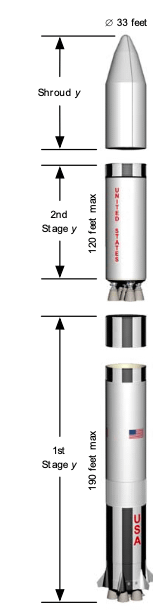
In this concept, the first stage of the SLS has 6-7 2Mlbf GG engines (gas generator cycle, ~2 million pounds of thrust each). The only 2Mlbf GG engines at that time were SpaceX’s [Merlin-2](https://en.wikipedia.org/wiki/SpaceX_Merlin#:~:text=edit-,Merlin%202%20concept,-edit) (canceled shortly after, would have been used in the cancelled [Falcon X and Falcon XX](https://nasawatch.com/commercialization/spacex-gives-a-preview-of-falcon-x-and-xx/), as well as a future version of the Falcon Heavy), and Rocketdyne’s F-1B (only proposed, would have been upgraded F-1s from the Saturn V first stage, and had been considered for other SLS concepts as well). In the second stage there are 5 Rocketdyne J-2Xs (based on the Saturn IB and Saturn V J-2s). It’s worth mentioning that Congress has *never* mandated NASA to reuse Space Shuttle hardware. They mandated them to reuse *existing* US hardware. From any rocket/company. NASA chose to work primarily on Space Shuttle hardware since they were more familiar with it, would require less new infrastructure, and would meet Congressional deadlines better.
DetlefKroeze on
Here’s a good presentation by Gary Lyles about the early development of SLS and some of the variants they looked at.
There’s an Eager Space video on this. Essentially it’s a modernised Saturn V, with F-1Bs and J-2Xs. Far more capable than the SLS, though development would’ve likely been more initially expensive (which is hard given how NASA funding works).
weird-oh on
Reminds me of something. Now where have I seen that before? Hmmm….
jtroopa on
Are the… Fins at the bottom really necessary? I was under the impression that the fins on the Saturn V were there simply because attitude control via thrust vectoring wasn’t all that mature at the time. Modern rockets don’t really make use of such today.
krum on
This is a “NASA concept”? A 9 year old could make this diagram.
Glittering_Cow945 on
Genius rocket idea! One cylinder on top of another!
NoBusiness674 on
Looks like it’s missing a third stage, maybe an S-IVB analog with a single J-2X or something like EUS with a cluster of RL-10s. Unless this was meant to lift heavy payloads into LEO instead of going to the moon, I can’t imagine a two stage architecture like this being optimal.
HungryKing9461 on
I’m surprised it’s all in feet — don’t NASA operate in SI units?
Certainly Von Braun insisted on it. And I thought that was still the case.
freakierice on
What’s with nasa and using wasteful rocket systems 🤦♂️

10 Comments
[Source](https://ntrs.nasa.gov/api/citations/20120013881/downloads/20120013881.pdf)
In this concept, the first stage of the SLS has 6-7 2Mlbf GG engines (gas generator cycle, ~2 million pounds of thrust each). The only 2Mlbf GG engines at that time were SpaceX’s [Merlin-2](https://en.wikipedia.org/wiki/SpaceX_Merlin#:~:text=edit-,Merlin%202%20concept,-edit) (canceled shortly after, would have been used in the cancelled [Falcon X and Falcon XX](https://nasawatch.com/commercialization/spacex-gives-a-preview-of-falcon-x-and-xx/), as well as a future version of the Falcon Heavy), and Rocketdyne’s F-1B (only proposed, would have been upgraded F-1s from the Saturn V first stage, and had been considered for other SLS concepts as well). In the second stage there are 5 Rocketdyne J-2Xs (based on the Saturn IB and Saturn V J-2s). It’s worth mentioning that Congress has *never* mandated NASA to reuse Space Shuttle hardware. They mandated them to reuse *existing* US hardware. From any rocket/company. NASA chose to work primarily on Space Shuttle hardware since they were more familiar with it, would require less new infrastructure, and would meet Congressional deadlines better.
Here’s a good presentation by Gary Lyles about the early development of SLS and some of the variants they looked at.
https://youtu.be/IweLWCBHpUE
There’s an Eager Space video on this. Essentially it’s a modernised Saturn V, with F-1Bs and J-2Xs. Far more capable than the SLS, though development would’ve likely been more initially expensive (which is hard given how NASA funding works).
Reminds me of something. Now where have I seen that before? Hmmm….
Are the… Fins at the bottom really necessary? I was under the impression that the fins on the Saturn V were there simply because attitude control via thrust vectoring wasn’t all that mature at the time. Modern rockets don’t really make use of such today.
This is a “NASA concept”? A 9 year old could make this diagram.
Genius rocket idea! One cylinder on top of another!
Looks like it’s missing a third stage, maybe an S-IVB analog with a single J-2X or something like EUS with a cluster of RL-10s. Unless this was meant to lift heavy payloads into LEO instead of going to the moon, I can’t imagine a two stage architecture like this being optimal.
I’m surprised it’s all in feet — don’t NASA operate in SI units?
Certainly Von Braun insisted on it. And I thought that was still the case.
What’s with nasa and using wasteful rocket systems 🤦♂️