
Dr. Eric Arzubi wants to change mental health in Montana.
His telepsychiatry practice, Frontier Psychiatry, is already helping. And now Arzubi, who launched the venture in 2020, is pushing boundaries in psychiatric care again, developing an online tool to reach Montana’s rural youth — for free.

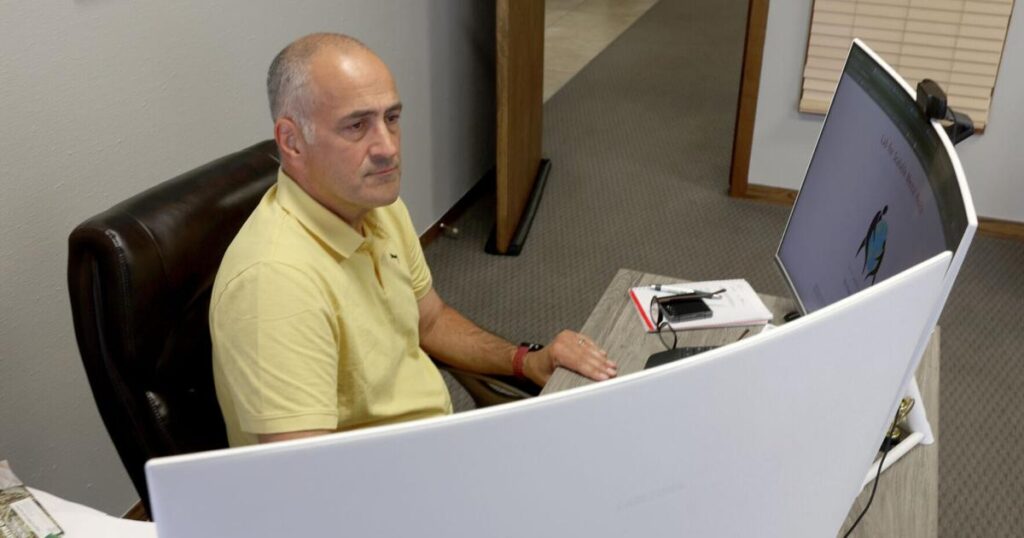
Dr. Eric Arzubi works at his Billings office.
LARRY MAYER, Billings Gazette
“It’s part of my oath as a physician to keep trying new things, to move the needle, to make things better,” said Arzubi. “Does it make me nervous sometimes to try new things, sure, but that should not be a reason to keep what’s potentially lifesaving interventions from our community. Otherwise, we’ll keep reading the same headlines over the next 20 years about how mental health in Montana is not very good.”
It’s a field in which he has plenty of experience. Arzubi is a child psychiatrist who was department chair of psychiatry at Billings Clinic. He left the hospital to practice on his own and is the co-founder and CEO of Frontier Psychiatry.
People are also reading…
Delivering and confirming
Arzubi is aiming to make a difference for mental health in Montana, and he wants to know if he’s on the right track. He and his team at Frontier Psychiatry monitor the metrics of the regional network of online-only care based in Billings.
“I can’t just deliver care and assume it’s good,” he said. “That’s not fair to the patient. I need to deliver care and confirm that it’s good care.”
And that’s just what he did.
Findings from their study comparing hospitalization rates of Frontier’s Medicaid patients in 2022 to those Montanans outside the practice were published in the Journal of the American Medical Association, a peer-reviewed scientific journal. Results were positive.
The study found that patients using telepsychiatry services had a 38% lower annualized hospitalization rate than non-Frontier Psychiatry patient controls. According to the study, telepsychiatry patients also had a 17% lower rate of emergency room admissions than non-Frontier Psychiatry patients.
“It’s great that Frontier is making care accessible,” said Arzubi. “By doing these kinds of studies, I want to prove to ourselves, our patients, and then ultimately to other health systems and payers, that what we’re doing is actually making a difference based on the data.”
To move the needle, one needs others in the field to bear witness to the results. To really make a difference on a grand scale though, Arzubi said intervention studies and their outcomes need to be scalable, actionable and translatable to other populations.
“Nobody’s cracked the code on how to solve the mental health crisis, and neither have we … If there’s a code to be cracked, I’d love to do it,” he said. “But I think the code is pretty straightforward as to what needs to happen.”
Still, that’s easier said than done.
It’s a big challenge,” Arzubi admitted, “because of how payers pay and don’t pay, all the regulations that are involved in health care — many of them for good reason — but it comes down to something very, very simple, and that is, ‘How do we scale access to high quality care and make it available at the right time, at the right place? That’s it. There’s no nuclear code or secret, that’s it. It’s that simple.’”
The swiftness of care Arzubi believes in is put into practice at his own practice. Care providers he works with also feel the impact.
“When human emotions are raging, to come in and manage those immediately was really important to us. To me, that was the greatest service and support for our children was knowing that we had immediate action and analysis. The staff could count on him and his team to give us immediate feedback or find out what was needed, and if it could wait,” said Dennis Sulser, former CEO of Youth Dynamics. “It is difficult in Montana to get an immediate response. I know Eric is astutely keyed into that. It has been a challenge particularly with kids — the wait time is often times more traumatic for them.”
Arzubi is setting out to eliminate that wait time, especially when it comes to youth in the state. His next endeavor is aimed at just that.
For rural youth
He continually has his eye on the horizon when it comes to mental health innovations. A study looking at the effectiveness of single session interventions caught his attention a few years ago. It was written by Dr. Jessica Schleider, a professor at Northwestern University in Chicago, and Arzubi has been following her work ever since. And now he’s adapting her findings for youth in Montana.
Arzubi
Schleider has been studying single session interventions for 10 years now and developed an online tool tailored for youth, which emulates a single therapy session. Arzubi said the most common number of therapy sessions attended by patients is one. This SSI tool is a single online session designed to provide immediate support and increase likelihood of future mental health engagement.
“The idea behind single session interventions is, ‘If I get just one session with you, just one session, what are the most powerful things I can do during that one session to actually move the needle, if you never come back again,’” Arzubi said.
Arzubi plans to launch a similar online SSI tool in Montana, called Project YES — tailored specifically to Montana youth’s mental health challenges — by early 2026. Dr. Schleider is aiding him in development of the Big Sky SSI Initiative.
“In behavioral health, if you do things right, you’re not going to have a one-size-fits-all solution. We know Montana has some pretty dire statistics when it comes to suicide rates, rates of suicide attempts, especially among youth. So, something different is happening in Montana when it comes to this,” he said. “We want to make sure that we’re capturing those nuances to make this even more effective.”
Arzubi said clinically, severe depression is the same regardless of who or where the individual is. But the types of things that lead to depression, in terms of family and societal pressures, are dependent on the environment. The factors that may impact Montana youth differ from the factors that may impact youth in other states or rural areas of the country.
And like Frontier’s 2022 Medicaid study, they will be studying this SSI tool just as closely, “to make sure it’s actually working.”
There’s no intervention implementation without research done simultaneously at Frontier Psychiatry.
The SSI service will be offered for free on mtpal.org, thanks to funding from Montana’s Department of Public Health and Human Services (DPHHS), and an anonymous donor secured by Montana Pediatrics’ Dr. Chelsea Bodner.
“I have to give the state of Montana a lot of credit for this,” he said.
Arzubi said the state approached him about an opportunity to fund “something innovative,” and asked if he had any ideas.
The doctor was on board at the word “innovative.”
“DPHHS has a longstanding relationship with Dr. Arzubi that goes back several years and includes multiple projects,” DPHHS spokesperson Jon Ebelt said. “Frontier Psychiatry runs the PRISM (Perinatal Psychiatric Access Line), and it was a natural fit to co-locate the Pediatric Access Line within the same organization.”
Montana Access to Pediatric Psychiatry Network (MAPP-Net), a program that aims to achieve health equity and outcomes related to racial, ethnic, and geographic disparities in access to care, began partnering with Frontier Psychiatry in 2023 to support the state’s Psychiatric Access Line.
“Through our work with Dr. Arzubi, we learned about this project and its potential to improve access to mental health supports for youth across the state, which aligns with the focus of the MAPP-Net program,” Ebelt said. “Rural Montana youth will benefit from Project YES by having access to culturally adaptive, single-session interventions that are relevant, accessible, and effective for rural adolescents.”
Arzubi immediately saw the potential.
“I said, ‘There’s this really cool tool that Dr. Schleider at Northwestern has been using and developing and studying, and if we could make that available for free, for kids statewide, I think would be a win,’” he said. “Making SSI available statewide, I think is very much aligned with our mission at Frontier Psychiatry, and that is making high quality, evidence-based interventions available to everyone and anyone who needs it, no matter where they live in a rural setting.”
“The design, dissemination, and implementation of this project are intended to ensure these interventions will reach youth when and where they need support most,” Ebelt said. “With 51 of 56 Montana counties designated as mental health professional shortage areas, Project YES aims to provide accessible support for youth who might otherwise go without mental health care.”
A better option
A recent trend in consumer-sought therapy is the use of free AI tools for therapeutic sessions and advice. Arzubi attributes the AI therapy trend to critical gaps in mental health care, gaps that could be filled by free and online care. It’s easily accessible, convenient, and cost effective, he said.
“It’s showing that the community is not going to wait for us to build tools for them, right? Because there’s such a shortage of high-quality care, patients are going to go find whatever they need,” Arzubi said. “If there’s a new tool, they’re going to go there. And I can’t blame them, because the mental health professionals aren’t making it easy enough to deliver the care that our patients deserve.”
Arzubi is excited to offer Montana another accessible online option — one that is scientifically validated, evidence based and proven to work. If someone is looking for help online, it’ll be available, vetted, “and tailored to this community,” he said.
“I hope that we can move the needle even just a little bit on the overall mental and emotional well-being of the youth of Montana,” Arzubi said.
He said the tool is not supposed to replace going to see a therapist or going to see a psychiatrist, but to replace using an AI tool as a person’s first therapy interaction.
It’s been found to have immediate positive effects on users, he said. Not that it cures anything, “but they do feel better, and they are more likely to later engage in the behavioral health system,” Arzubi said.
“I’m hoping we can do that even just a little, so that we can start to make the headlines around mental health and substance use disorders in Montana a little bit less horrible and make it just a little bit more hopeful,” Arzubi said. “Montana is famous for having high suicide rates. It would be cool if Montana were famous for being one of the states that starts coming up with creative solutions.”