
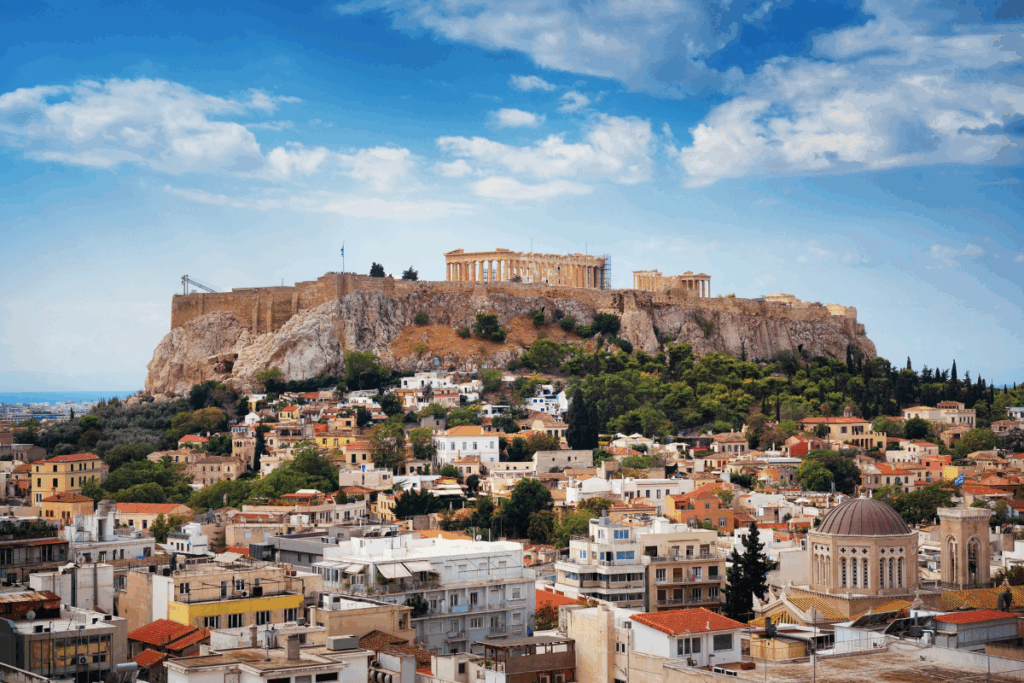
Athens faces rising water stress amid climate extremes. Credit: rabbit75_cav via Canva.com
Greece is headed towards a crisis, not due to war or inflation, but because the water may run out very soon. From shrinking reservoirs next to Athens to bone-dry farmlands in central Greece, the signs are evident everywhere. Lake Marathon is at its lowest level in years. Farmers are watching their fields dry before the summer peak, and on the islands, tourists arrive by ferry while water is delivered by truck.
This country isn’t just facing a drought; it’s facing floods that devastated communities that come across the city, and now months later, it’s experiencing rainfall deficits of up to 95%. The warning signs are affecting the Athens Metropolitan region, and it could hit severe shortages within 4 years. This is no longer just a rural or island problem. The capital may be next.
Most Read on Euro Weekly News
Athens four-year warning
It’s easy to assume that Greece’s water woes belong to rural plains or the sunburned islands. However, this danger is now reaching the capital, and hydrologists estimate that Attica, home to nearly half the country’s population, could face severe water scarcity within four years if current climate patterns do not shift.
- Lake Marathon, one of the reservoirs that feed Athens, is already low.
- The Mornos dam, once a cornerstone of the region, has now been below its water levels for months.
This isn’t just about a few dry days; experts are warning of chronic underinvestment in urban water resilience. The pipe leaks affect 50% of the drinking water lost. Dams are ageing, and the cities’ demands are increasing due to rising population density, tourism, and summer extremes. The infrastructure was never designed to withstand back-to-back drought years, and this is what Greece is currently facing.
Droughts after floods
It’s not just that Greece is drying out. It’s that the weather has stopped making sense. Not long ago, parts of Thessaly were underwater—whole neighbourhoods flooded, harvests washed away, and roads ripped open. But blink, and now nearly the entire country is running dry. In less than a year, it’s gone from water everywhere to water nowhere.
That’s the rhythm now: too much, then not enough. One season it’s storms and mudslides, the next it’s cracked soil and empty reservoirs. Locals are calling it unpredictable. Scientists call it climate whiplash—violent swings caused by the Mediterranean warming faster than expected.
The land doesn’t know how to cope:
- Floods harden the ground.
- Droughts follow and make it worse.
- Rain doesn’t seep in anymore—it runs off, floods streets, and vanishes before it helps.
- By the time summer hits, it’s not just the fields that are parched. It’s the systems meant to protect them.
And so the country marches forward: from response to recovery, from disaster to warning, caught in a loop that keeps tightening.
Who gets the water and who does not?
Farmers in Crete and Thessaly are watching their irrigation allocations getting slashed. Entire olive groves, along with vineyards, are being sacrificed so urban water supplies can hold out just a little bit longer.
- On islands such as Santorini or Mykonos, where millions of tourists arrive each summer in record numbers, the water is transported by boat.
- Locals are meanwhile being asked to limit showers and avoid watering in their own gardens.
The government insists that there’s enough food to go around, but the tension is currently mounting. The farmers are citing authorities that favour the short-term profits over long-term water scarcity.
This isn’t just a logistics issue; it’s a political one. When supply cannot meet the demand, the water becomes a power struggle, and Greece’s summer season may be what tips that balance.
Greece is running out of time.
This isn’t just a crisis about rainfall or pipe leaks; it’s more fundamental, the very idea that nature can still warn of future issues. Greece has experienced numerous extremes in the past, including droughts, heat waves, and wildfires. However, this is a different animal, where extremes increase year after year, with less room to recover in between.
And while officials are debating strategies such as efficiency upgrades and EU funds. Much of the burden still falls on the everyday people. So far, farmers are losing their crops, families are rationing water in summer, and towns are running out of tap water by noon. A dry summer used to be a warning, now it has become the new season.
Photo: Athens faces rising water stress amid climate extremes.
Credit: carmengabriela from Getty Images