

SALT LAKE CITY — On the morning of June 3, Brigham Young University history professor Jeffrey Hardy awoke to shocking news. The Russian government had blacklisted his employer.
“I was completely stunned. It seemed to come out of nowhere,” he said.
He learned from an article in the Moscow Times that BYU had been added to Russia’s “undesirable list” at the end of April — a label that makes involvement with the organization a criminal offense, as per a Russian law passed in 2015. The independent online news publication began as a print magazine in the country in 1992 and was also blacklisted in March 2024.
Hardy, a specialist in Soviet Union history, said he frequented the Moscow Times daily.
“I was just like, I thought it was a typo,” he said. “I couldn’t believe that somehow we had been targeted or singled out in that way.”
The official list states the date that BYU allegedly violated an order of the Ministry of Justice of the Russian Federation on Feb. 6 — the same day the university held an event called “Russia as a Global Threat.”
The event hosted the U.S. Deputy Assistant Secretary of State Sonata Coulter, who oversees policy toward Russia and Central Europe.
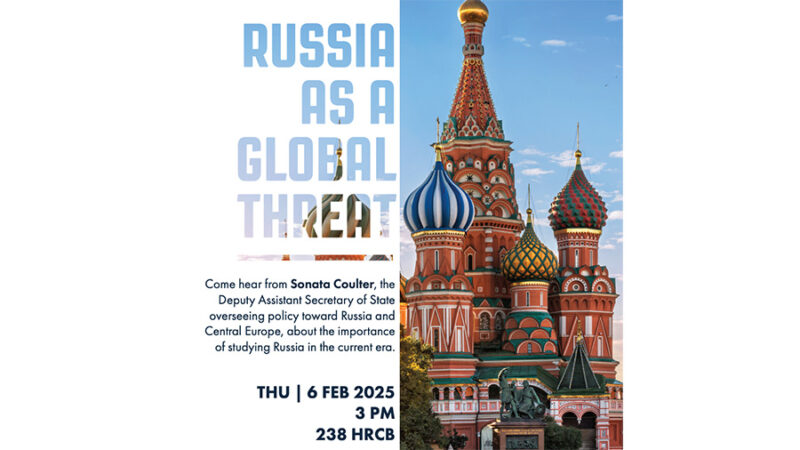
A flyer shows the event information for a seminar hosted by Brigham Young University, featuring Sonata Coulter, deputy assistant secretary of state. (Brigham Young University)
“I’m throwing a lot of conditional language in here because, you know, the undesirable organization law in Russia is written so vaguely and that we just don’t have a good sense of what this means,” Hardy said. “For a lot of individuals, I mean, it certainly means that the organizations on that list can’t operate in Russia.
Hardy said legal representation with the university would likely be looking at how to possibly be removed from the list, but the prospects of actually achieving that could be slim.
“To my knowledge, no organization has been delisted,” Hardy said, noting that if it is possible, he believes it could take “a number of years.”
KSL attempted to contact BYU’s legal team multiple times, but did not receive a response.
What it could mean for students
When asked about a study abroad or foreign exchange programs, Hardy said all such programs have been on hold since the COVID-19 pandemic.
“COVID shut everything down, and then, right when things were about to start back up again, the invasion of Ukraine happened in February 2022. So we don’t have a study abroad program; we don’t send students on internship there,” he said.
But the school does have enrolled students from Russia.
“That’s probably the number one concern, at this point,” he said. “I don’t have data on how many students we currently enroll from Russia, but I know that we do have some, and that’s going to certainly affect their enrollment or their possibility to return to Russia without fear of prosecution.”
Hardy estimated that it would be dangerous for any enrolled student to come to BYU and then return through border control back to Russia.
“I mean, they can’t come here, almost certainly. Or if they do come here, it would signify cutting up ties with Russia,” he said.
Egor Demin
For one basketball star student from Russia, Egor Demin, Hardy said he hopes the situation won’t mean much for him, given his recent decision to leave the Cougars for the NBA draft, which is now weeks away.
“You know, he’s leaving the university now as he enters the NBA draft, obviously (he’s) a top prospect — maybe one of the best basketball players Russia has ever produced,” he said. “We’ve got a number of athletes in the United States playing professionally from Russia — and hockey in particular; (Alexander) Ovechkin among others — and for the most part, they’ve been able to stay out of politics.”
For Demin, Hardy said now that he’s associated with an undesirable organization, unlike other Russian athletes, he may be in a “trickier situation.” Demin had previously said he wished to return to BYU to finish his degree.
“I don’t think that we’ll see him, for example, returning to BYU for any sort of, you know, recruiting events or anything like that,” Hardy said. “Just because there is this kind of threat looming over him if he does want to continue to travel home to Russia to see family, friends, you know, whatever he wants to do, I assume that he wants to maintain those ties.”